

Mujeres y consumo sostenible en mercados emergentes: implicancias para la gestión
Barra lateral del artículo
Contenido principal del artículo
Resumen
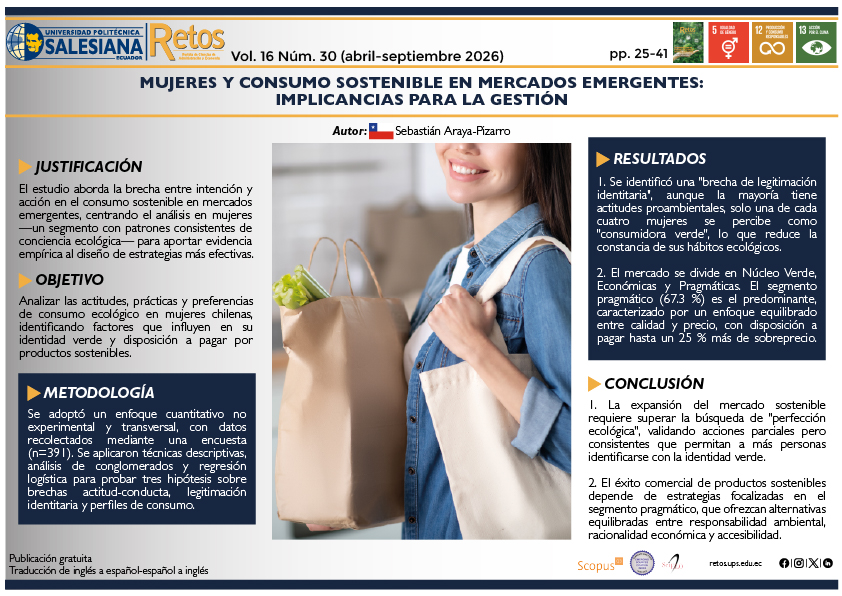
La literatura en sostenibilidad y marketing identifica a las mujeres como un segmento con patrones consistentes de sensibilidad ambiental, lo que permite examinar orientaciones ecológicas en contextos emergentes. Este estudio analiza las actitudes, prácticas y preferencias de consumo hacia productos ecológicos en mujeres chilenas, identificando factores sociodemográficos asociados a la autopercepción ecológica y a la disposición a pagar por alternativas sostenibles. Bajo un diseño cuantitativo no experimental y transeccional, se aplicó una encuesta a 391 mujeres residentes en un centro urbano estratégico de Chile (Coquimbo). El análisis combinó estadística descriptiva, regresión logística binaria y segmentación por conglomerados. Los resultados revelan una discrepancia en la legitimación identitaria, ya que solo una de cada cuatro mujeres se autodefine como “verde” pese a reportar actitudes favorables, sumado a una brecha actitud-conducta en acciones de alto esfuerzo. La regresión indica mayor autopercepción ecológica en mujeres jóvenes (OR=2.05, p=.017) y de hogares numerosos (OR=1.62, p=.047). La segmentación identifica tres perfiles: Núcleo Verde (9.7 %), Económicas (23.0 %) y un segmento Pragmático dominante (67.3 %), cuyo umbral de disposición a pagar se sitúa entre el 10 % y el 25 %. Se concluye que, en contextos emergentes, la expansión del consumo sostenible requiere estrategias que superen las fracturas identitaria y económica, conectando con el segmento pragmático mayoritario mediante ofertas que equilibren sostenibilidad, calidad y precio, y que consoliden la adopción de prácticas ecológicas más allá del núcleo de consumidoras ecológicamente comprometidas.
Detalles del artículo

Esta obra está bajo una licencia internacional Creative Commons Atribución-NoComercial-CompartirIgual 4.0.
Autoría: La lista de autores firmantes debe incluir únicamente a aquellas personas que hayan contribuido intelectualmente al desarrollo del trabajo. La colaboración en la recogida de datos no es, por sí misma, criterio suficiente de autoría. "Retos" declina toda responsabilidad por posibles conflictos derivados de la autoría de los trabajos que se publiquen.
Derechos de autor: La Universidad Politécnica Salesiana preserva los derechos de autor de los artículos publicados, y favorece y permite su reutilización bajo la licencia Creative Commons Attribution-NonCommercial-ShareAlike 3.0 Ecuador. Pueden ser copiados, utilizados, difundidos, transmitidos y expuestos públicamente, siempre y cuando: i) se cite la autoría y la fuente original de su publicación (revista, editorial y URL del trabajo); (Ii) no se utilicen con fines comerciales; Iii) se mencione la existencia y especificaciones de esta licencia.
Referencias
Adialita, T., Sigarlaki, F., Vasudevan, A., Rusuli, M., Chen, W., Cheng, Q., Krishnasamy, H. y Miskam, Z. (2025). Assessing consumer willingness to pay for sustainable products: An application of the extended theory of planned behavior. Journal of Infrastructure, Policy and Development, 9(2), 6582. https://doi.org/10.24294/jipd6582
Ajzen, I. (1991). The theory of planned behavior. Organizational Behavior and Human Decision Processes, 50(2), 179–211. https://doi.org/10.1016/0749-5978(91)90020-T
Alenazi, S. (2025). Sustainability Awareness, Price Sensitivity, and Willingness to Pay for Eco-Friendly Packaging: A Discrete Choice and Valuation Study in the Saudi Retail Sector. Sustainability, 17(16), 7287. https://doi.org/10.3390/su17167287
Araya-Pizarro, S. (2025). Determinantes psicosociales del consumo sostenible en la generación posmilenial: Un análisis basado en la teoría del comportamiento planificado. Universitas Psychologica, 24, 1–16. https://doi.org/10.11144/Javeriana.upsy24.dpcs
Araya-Pizarro, S. y Rojas-Escobar, L. (2020). Consumo responsable e intención de compra en sectores populares: Una aproximación multivariante. Ciencias Administrativas, 8(16), 13-24. https://doi.org/10.24215/23143738e062
Barbarossa, C. y De Pelsmacker, P. (2016). Positive and negative antecedents of purchasing eco-friendly products: A comparison between green and non-green consumers. Journal of Business Ethics, 134(2), 229–247. https://doi.org/10.1007/s10551-014-2425-z
Bechler, C. J., Tormala, Z. L. y Rucker, D. D. (2021). The attitude–behavior relationship revisited. Psychological Science, 32(8), 1285–1297. https://doi.org/10.1177/0956797621995206
Bem, D. J. (1972). Self-perception theory. Advances in Experimental Social Psychology, 6, 1–62. https://doi.org/10.1016/S0065-2601(08)60024-6
Bouman, T., Steg, L. y Zawadzki, S. J. (2020). The value of what others value: When perceived biospheric group values influence individuals’ pro-environmental engagement. Journal of Environmental Psychology, 71(April), 101470. https://doi.org/10.1016/j.jenvp.2020.101470
Carrington, M. J., Neville, B. A. y Whitwell, G. J. (2014). Lost in translation: Exploring the ethical consumer intention-behavior gap. Journal of Business Research, 67(1), 2759-2767. https://doi.org/10.1016/j.jbusres.2012.09.022
Diamantopoulos, A., Schlegelmilch, B. B., Sinkovics, R. R. y Bohlen, G. M. (2003). Can socio-demographics still play a role in profiling green consumers? A review of the evidence and an empirical investigation. Journal of Business Research, 56(6), 465-480. https://doi.org/10.1016/S0148-2963(01)00241-7
Dinh, C. T., Uehara, T. y Tsuge, T. (2021). Green attributes in young consumers’ purchase intentions: A cross-country, cross-product comparative study using a discrete choice experiment. Sustainability, 13(17), 9825. https://doi.org/10.3390/su13179825
Dolnicar, S., Grün, B. y Leisch, F. (2018). Market segmentation analysis: Understanding it, doing it, and making it useful. Springer. https://doi.org/10.1007/978-981-10-8818-6
Etikan, I., Musa, S. A. y Alkassim, R. S. (2016). Comparison of convenience sampling and purposive sampling. American Journal of Theoretical and Applied Statistics, 5(1), 1–4. https://doi.org/10.11648/j.ajtas.20160501.11
Gatersleben, B., Murtagh, N. y Abrahamse, W. (2014). Values, identity and pro-environmental behaviour. Contemporary Social Science, 9(4), 374-392. https://doi.org/10.1080/21582041.2012.682086
Higgins, E. T. (1987). Self-discrepancy: A theory relating self and affect. Psychological Review, 94(3), 319-340. https://doi.org/10.1037/0033-295X.94.3.319
Isac, N., Javed, A., Radulescu, M., Cismasu, I. D. L., Yousaf, Z. y Serbu, R. S. (2025). Is greenwashing impacting on green brand trust and purchase intentions? Mediating role of environmental knowledge. Environment, Development and Sustainability, 27(9), 21329–21346. https://doi.org/10.1007/s10668-023-04352-0
Jaiswal, D., Kaushal, V., Singh, P. K. y Biswas, A. (2021). Green market segmentation and consumer profiling: A cluster approach to an emerging consumer market. Benchmarking, 28(3), 792-812. https://doi.org/10.1108/BIJ-05-2020-0247
Kollmuss, A. y Agyeman, J. (2002). Mind the gap: Why do people act environmentally and what are the barriers to pro-environmental behavior? Environmental Education Research, 8(3), 239–260. https://doi.org/10.1080/13504620220145401
Lou, X. y Li, L. M. W. (2021). The relationship between identity and environmental concern: A meta-analysis. Journal of Environmental Psychology, 76(June), 101653. https://doi.org/10.1016/j.jenvp.2021.101653
McCright, A. M. y Xiao, C. (2014). Gender and environmental concern: Insights from recent work and for future research. Society & Natural Resources, 27(10), 1109-1113. https://doi.org/10.1080/08941920.2014.918235
Neves, C., Oliveira, T. y Santini, F. (2025). Understanding the determinants of sustainable consumption behavior: Insights from a meta and weight analysis. Journal of Environmental Management, 393(August), 126932. https://doi.org/10.1016/j.jenvman.2025.126932
Palavecinos, M., Amérigo, M., Ulloa, J. B. y Muñoz, J. (2016). Preocupación y conducta ecológica responsable en estudiantes universitarios: Estudio comparativo entre estudiantes chilenos y españoles. Psychosocial Intervention, 25(3), 143-148. https://doi.org/10.1016/j.psi.2016.01.001
Paul, J., Modi, A. y Patel, J. (2016). Predicting green product consumption using theory of planned behavior and reasoned action. Journal of Retailing and Consumer Services, 29, 123-134. https://doi.org/10.1016/j.jretconser.2015.11.006
Sánchez, M., López-Mosquera, N. y Lera-López, F. (2016). Improving pro-environmental behaviours in Spain: The role of attitudes and socio-demographic and political factors. Journal of Environmental Policy and Planning, 18(1), 47-66. https://doi.org/10.1080/1523908X.2015.1046983
Sandoval-Díaz, J. y Neumann, P. (2023). Green products purchase intention in Chilean consumers: Comparing three models using structural equations. Revista Colombiana de Psicología, 32(1), 83-101. https://doi.org/10.15446/rcp.v32n1.92739
Syed, S., Acquaye, A., Khalfan, M. M., Obuobisa-Darko, T. y Yamoah, F. A. (2024). Decoding sustainable consumption behavior: A systematic review of theories and models and provision of a guidance framework. Resources, Conservation and Recycling Advances, 23(October), 200232. https://doi.org/10.1016/j.rcradv.2024.200232
Tajfel, H. y Turner, J. C. (1979). An integrative theory of intergroup conflict. The social psychology of intergroup relations, 33-47. https://doi.org/10.13140/RG.2.2.30820.60809
Testa, F., Pretner, G., Iovino, R., Bianchi, G., Tessitore, S. y Iraldo, F. (2021). Drivers to green consumption: A systematic review. Environment, Development and Sustainability, 23(4), 4826-4880. https://doi.org/10.1007/s10668-020-00844-5
Tsaabitah, A. J., Ismoyowati, D. y Yuliando, H. (2025). Green consumer preferences toward green marketing: A conjoint approach. BIO Web of Conferences, 167, 1-7. https://doi.org/10.1051/bioconf/202516707003
Vesely, S., Masson, T., Chokrai, P., Becker, A. M., Fritsche, I., Klöckner, C. A., Tiberio, L., Carrus, G. y Panno, A. (2021). Climate change action as a project of identity: Eight meta-analyses. Global Environmental Change, 70, 102322. https://doi.org/10.1016/j.gloenvcha.2021.102322
Wang, B. y Udall, A. M. (2023). Sustainable consumer behaviors: The effects of identity, environment value and marketing promotion. Sustainability, 15(2), 1-14. https://doi.org/10.3390/su15021129
White, K., Habib, R. y Hardisty, D. J. (2019). How to SHIFT consumer behaviors to be more sustainable: A literature review and guiding framework. Journal of Marketing, 83(3), 22-49. https://doi.org/10.1177/0022242919825649
Whitmarsh, L. y O’Neill, S. (2010). Green identity, green living? The role of pro-environmental self-identity in determining consistency across diverse pro-environmental behaviours. Journal of Environmental Psychology, 30(3), 305-314. https://doi.org/10.1016/j.jenvp.2010.01.003
Wild, S. y Schulze Heuling, L. (2024). Exploring the role of identity in pro-environmental behavior: Cultural and educational influences on younger generations. Frontiers in Psychology, 15(October), 1-11. https://doi.org/10.3389/fpsyg.2024.1459165
Yusoff, N., Alias, M. y Ismail, N. (2023). Drivers of green purchasing behaviour: A systematic review and a research agenda. F1000Research, 12, 1286. https://doi.org/10.12688/f1000research.140765.1
Zhao, Z., Gong, Y., Li, Y., Zhang, L. y Sun, Y. (2021). Gender-related beliefs, norms, and the link with green consumption. Frontiers in Psychology, 12(December), 1-13. https://doi.org/10.3389/fpsyg.2021.710239