

Reacción de boicot al greenwashing según el perfil del consumidor: una encuesta en Brasil
Barra lateral del artículo
Contenido principal del artículo
Resumen
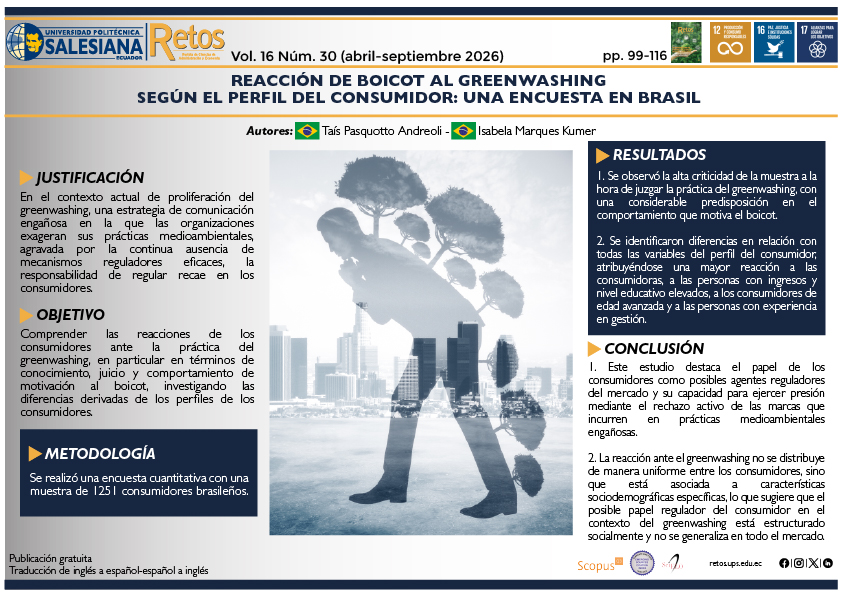
No todas las afirmaciones responsables o sostenibles de las organizaciones reflejan prácticas genuinas, sino que se caracterizan por ser greenwashing, una estrategia de comunicación engañosa en la que las organizaciones exageran sus prácticas medioambientales para mejorar su imagen en el mercado. Con el panorama actual de proliferación del greenwashing, agravado por la continua ausencia de mecanismos reguladores eficaces, la responsabilidad de regular acaba recayendo en los consumidores. Este estudio tiene como objetivo comprender las reacciones de los consumidores ante el greenwashing, particularmente en términos de conocimiento, juicio y comportamiento de motivación al boicot, investigando las diferencias derivadas de los perfiles de los consumidores. Se realizó una encuesta con 1251 consumidores brasileños, realizando un análisis descriptivo general, seguido de la técnica de análisis paramétrico de varianza (ANOVA). Se observó la alta criticidad de la muestra en juzgar la práctica del greenwashing, con una predisposición autodeclarada en el comportamiento que motiva el boicot. Además, se identificaron diferencias en todas las variables del perfil de los consumidores en prácticamente todas las métricas investigadas, como el género, la educación, la edad, los ingresos y la experiencia profesional en gestión, con una mayor reacción atribuida a las consumidoras, a las personas con altos ingresos y educación, con más edad y con experiencia en gestión. Contribuye a una comprensión las reacciones de los consumidores ante el greenwashing en función de sus perfiles.
Detalles del artículo

Esta obra está bajo una licencia internacional Creative Commons Atribución-NoComercial-CompartirIgual 4.0.
Autoría: La lista de autores firmantes debe incluir únicamente a aquellas personas que hayan contribuido intelectualmente al desarrollo del trabajo. La colaboración en la recogida de datos no es, por sí misma, criterio suficiente de autoría. "Retos" declina toda responsabilidad por posibles conflictos derivados de la autoría de los trabajos que se publiquen.
Derechos de autor: La Universidad Politécnica Salesiana preserva los derechos de autor de los artículos publicados, y favorece y permite su reutilización bajo la licencia Creative Commons Attribution-NonCommercial-ShareAlike 3.0 Ecuador. Pueden ser copiados, utilizados, difundidos, transmitidos y expuestos públicamente, siempre y cuando: i) se cite la autoría y la fuente original de su publicación (revista, editorial y URL del trabajo); (Ii) no se utilicen con fines comerciales; Iii) se mencione la existencia y especificaciones de esta licencia.
Referencias
Andreoli, T. P. y Negrais, J. (2023). Greenwashing e demarketing: análise e comparação da reação dos consumidores por meio de um grupo focal [Greenwashing and demarketing: analysis and comparison of consumer reactions through a focus group]. Navus: Revista de Gestão e Tecnologia, (13), 1-18. https://doi.org/10.34019/2448-0423.2023.v13.41639
Andreoli, T. P. y Silva, P. C. (2024). Greenwashing and boycott: Critical appreciation of academic production. Mix Sustentável, 10(3), 121-134. https://doi.org/10.29183/2447-3073.MIX2024.v10.n3.121-134
Andreoli, T. P., Silva, P. C. y Lopes, E. L. (2025). Consumer boycott of greenwashing practices. Revista de Gestão. https://doi.org/10.1108/REGE-08-2024-0134
Barda, C. y Sardianou, E. (2010). Analysing consumers’ ‘activism’ in response to rising prices. International Journal of Consumer Studies, 34(2), https://doi.org/10.1111/J.1470-6431.2009.00832.X
Bernini, F., Giuliani, M. y La Rosa, F. (2024). Measuring greenwashing: A systematic methodological literature review. Business Ethics, the Environment & Responsibility, 33(4). https://doi.org/10.1111/beer.12631
Boermans, D. D., Jagoda, A., Lemiski, D., Wegener, J. y Krzywonos, M. (2024). Environmental awareness and sustainable behavior of respondents in Germany, the Netherlands and Poland: A qualitative focus group study. Journal of Environmental Management, 370. https://doi.org/10.1016/j.jenvman.2024.122515
Braga, S. S. J., Martínez, M. P., Correa, C. M., Moura-Leite, R. C. y Da Silva, D. (2019). Greenwashing effect, attitudes, and beliefs in green consumption. RAUSP Management Journal, 54(2). https://doi.org/10.1108/RAUSP-08-2018-0070
Bulut, C., Nazli, M., Aydin, E. y Haque, A. U. (2021). The effect of environmental concern on conscious green consumption of post-millennials: the moderating role of greenwashing perceptions. Young Consumers, 22(2). https://doi.org/https://doi.org/10.1108/YC-10-2020-1241
Cummings, K. H., Zafari, B. y Beitelspacher, L. (2025). #Canceled! Exploring the phenomenon of canceling. Journal of Business Research, 186. https://doi.org/10.1016/J.JBUSRES.2024.115025
Cruz, B. de P. A., Pires, R. J. M. y Ross, S. D. (2013). Gender differences in the perception of guilt in consumer boycotts. Brazilian Journal of Business Management, 15(49). https://doi.org/10.7819/RBGN.V15I49.1357
Farooq, Y. y Wicaksono, H. (2021). Advancing on the analysis of causes and consequences of green skepticism. Journal of Cleaner Production, 320. https://doi.org/10.1016/J.JCLEPRO.2021.128927
Forliano, C., Battisti, E., De Bernardi, P. y Kliestik, T. (2025). Mapping the greenwashing research landscape: a theoretical and field analysis. Review of Managerial Science, 1-50. https://doi.org/10.1007/s11846-025-00856-3
Freitas Netto, S. V., Sobral, M. F. F., Ribeiro, A. R. B. y Soares, G. R. da L. (2020). Concepts and forms of greenwashing: a systematic review. Environmental Sciences Europe, 32(1). https://doi.org/10.1186/s12302-020-0300-3
Gardberg, N. A. y Newburry, W. (2013). Who boycotts whom? Marginalization, company knowledge, and strategic issues. Business & Society, 52(2). https://doi.org/10.1177/0007650309352507
Gopal, M. M. y Pisharady, B. S. (2024). Exploring greenwashing awareness, green trust, and green skepticism in cosmetic purchase decisions. En Paradigm Shift (Chapter 35, p. 288). Redshine Archive. https://doi.org/10.25215/9392917244.35
Ibrahim Nnindini, S. y Dankwah, J. B. (2024). Describing brown as green: an examination of the relationship between greenwashing and consumer negative emotive outcomes. Cogent Business & Management, 11(1). https://doi.org/10.1080/23311975.2024.2367781
Ioannou, I., Kassinis, G. y Papagiannakis, G. (2023). The impact of perceived greenwashing on customer satisfaction and the contingent role of capability reputation. Journal of Business Ethics, 185(2), 333-347. https://doi.org/https://doi.org/10.1007/s10551-022-05151-9
Janz, F., Jordanow, S., Heidenreich, S. y Schäfer, J. (2024). Shades of green deception — An empirical examination into the consequences of greenwashing of innovations. Creativity and Innovation Management, 34(2), 312-332. https://doi.org/10.1111/caim.12639
Jog, D. y Singhal, D. (2024). Greenwashing understanding among indian consumers and its impact on their green consumption. Global Business Review, 25(2). https://doi.org/10.1177/0972150920962933
Kim, C., Yan, X., Kim, J., Terasaki, S. y Furukawa, H. (2022). Effect of consumer animosity on boycott campaigns in a cross-cultural context: Does consumer affinity matter? Journal of Retailing and Consumer Services, 69. https://doi.org/10.1016/J.JRETCONSER.2022.103123
Kim, C., Yan, X. y Park, S. (2023). Do consumer boycotts really matter with global companies? The moderating effect of gender differences. International Journal of Emerging Markets, 18(12), 5707-5726. https://doi.org/10.1108/IJOEM-03-2021-0312
Klein, J. G., Smith, N. C. y John, A. (2004). Why we boycott: Consumer motivations for boycott participation. Journal of Marketing, 68(3). https://doi.org/https://doi.org/10.1002/cb.313
Kolcava, D. (2023). Greenwashing and public demand for government regulation. Journal of Public Policy, 43(1). https://doi.org/10.1017/S0143814X22000277
Kreczmańska-Gigol, K. y Gigol, T. (2022). The impact of consumers’ green skepticism on the purchase of energy-efficient and environmentally friendly products. Energies 15(6). https://doi.org/10.3390/EN15062077
Le, N., Do, D. Q., Nguyen, X. T. y Nguyen, T. L. H. (2024). Greenwashing and the purchase behavior toward electric motorbikes: The role of eco-literacy. Journal of Marketing Communications, 1-31. https://doi.org/10.1080/13527266.2024.2413401
Li, Y., Qi, T., Li, Q., Tan, W. y; Huang, Y. (2025). The motivation of corporate greenwashing: evidence from energy consumption intensity. Sustainable Development. https://doi.org/https://doi.org/10.1002/bse.3177
Liu, Y., Li, W., Wang, L. y Meng, Q. (2023). Why greenwashing occurs and what happens afterwards? A systematic literature review and future research agenda. Environmental Science and Pollution Research, 30(56), 118102-118116. https://doi.org/10.1007/s11356-023-30571-z
Martínez, M. P., Cremasco, C. P., Gabriel Filho, L. R. A., Braga Junior, S. S., Bednaski, A. V., Quevedo-Silva, F. y Moura-Leite Padgett, R. C. (2020). Fuzzy inference system to study the behavior of the green consumer facing the perception of greenwashing. Journal of Cleaner Production. https://doi.org/10.1016/j.jclepro.2019.03.060
Mata, F., Baptista, N., Dos-Santos, M. y; Jesus-Silva, N. (2023). Profiling european consumers that engage in boycotting. european conference on knowledge management. Proceedings of the 24th European Conference on Knowledge Management 24(1). https://doi.org/10.34190/ECKM.24.1.1390
Miao, G., Chen, G., Wang, F. y; Das, A. K. (2023). The effect of corporate greenwashing on employees’ environmental performance: person-organization values fit perspective. Sustainability, 15(4). https://doi.org/10.3390/su15043498
Montgomery, A. W., Lyon, T. P. y Barg, J. (2023). No end in sight? A greenwash review and research agenda. Organization and Environment, 37(2). https://doi.org/https://doi.org/10.1177/10860266231168905
Neilson, L. A. (2010). Boycott or buycott? Understanding political consumerism. Journal of Consumer Behaviour, 9(3), 214-227. https://doi.org/10.1002/cb.313
Neureiter, A., Stubenvoll, M. y Matthes, J. (2024). Is it greenwashing? Environmental compensation claims in advertising, perceived greenwashing, political consumerism, and brand outcomes. Journal of Advertising, 53(4). https://doi.org/10.1080/00913367.2023.2268718
Nguyen, N. B. y Duong, T. D. (2025). Examining the impact of greenwashing on customer boycott intentions: the mediating role of green confusion. Discover Sustainability, 6(1), 460. https://doi.org/10.1007/s43621-025-01337-z
Nguyen, T. T. H., Yang, Z., Nguyen, N., Johnson, L. W. y Cao, T. K. (2019). Greenwash and green purchase intention: the mediating role of green skepticism. Sustainability, 11(9). https://doi.org/10.3390/su11092653
Nygaard, A. y Silkoset, R. (2023). Sustainable development and greenwashing: How blockchain technology information can empower green consumers. Business Strategy and the Environment, 32(6). https://doi.org/10.1002/bse.3338
Park, M. y Jang, H. (2024). Beyond efficacy: how self-esteem and guilt drive participation in tourism boycotts. Tourism and Hospitality, 5(4). https://doi.org/10.3390/TOURHOSP5040072
Robertson, J. L., Montgomery, A. W. y; Ozbilir, T. (2023). Employees' response to corporate greenwashing. Business Strategy and the Environment, 32(7). https://doi.org/10.1002/bse.3351
Sajid, M., Zakkariya, K. A., Suki, N. M. y Islam, J. U. (2024). When going green goes wrong: The effects of greenwashing on brand avoidance and negative word-of-mouth. Journal of Retailing and Consumer Services, 78. https://doi.org/10.1016/j.jretconser.2024.103773
Santos, C., Coelho, A. y Marques, A. (2024). The greenwashing effects on corporate reputation and brand hate, through environmental performance and green perceived risk. Asia-Pacific Journal of Business Administration, 16(3). https://doi.org/10.1108/APJBA-05-2022-0216
Schmuck, D., Matthes, J. y Naderer, B. (2018). Misleading consumers with green advertising? an affect-reason-involvement account of greenwashing effects in environmental advertising. Journal of Advertising, 47(2). https://doi.org/10.1080/00913367.2018.1452652
Senan, N. A. M., Al-Kahtani, S. M., Alanazi, I. D., AbdAlatti, A., Alshadadi, M. A., Alhebri, A. y Mohammad, R. A. (2025). Unveiling the linkages between greenwashing, brand hate, and negative consumer behavior: the moderating effect of environmental concern. Discover Sustainability, 6(1), 446. https://doi.org/10.1007/s43621-025-01179-9
Szabo, S. y Webster, J. (2020). Perceived greenwashing: the effects of green marketing on environmental and product perceptions. Journal of Business Ethics, 171(4). https://doi.org/10.1007/s10551-020-04461-0
Tao, Z. (2025). From green demand to deceptive practices: A cross-cultural study the impact of consumer green preferences on corporate greenwashing behavior in China, Republic of Korea, and Malaysia. Sustainable Futures, 9. https://doi.org/10.1016/J.SFTR.2025.100440
Van Kenhove, N. y Biro, L. (2016). Advertising skepticism: The influence of demographic factors, consumerism and green washing in the organic food industry (Master’s thesis). Linnaeus University, School of Business and Economics, Department of Marketing. https://bit.ly/3OxAc07
Wang, W., Ma, D., Wu, F., Sun, M., Xu, S., Hua, Q. y Sun, Z. (2023). Exploring the knowledge structure and hotspot evolution of greenwashing: A visual analysis based on bibliometrics. Sustainability, 15(3). https://doi.org/10.3390/su15032290
Witek, L. y Kuźniar, W. (2020). Green purchase behavior: the effectiveness of sociodemographic variables for explaining green purchases in emerging market. Sustainability, 13(1), 209. https://doi.org/10.3390/SU13010209
Zhang, H. y Dou, W. (2024). Impact of air pollution prevention and control on urban green economy efficiency: evidence from China. Scientific Reports, 14(1), 27905. https://doi.org/10.1038/s41598-024-79467-z
Zejjari, I. y Benhayoun, I. (2025). Predicting the determinants of consumer’s intention to boycott surrogate Israeli products–evidence on nonlinear relationships from Morocco. Journal of Islamic Marketing. https://doi.org/10.1108/JIMA-02-2024-0096