

Determinants of the Quality of Accounting Information at Brazilian Federal Universities
Article Sidebar
Main Article Content
Abstract
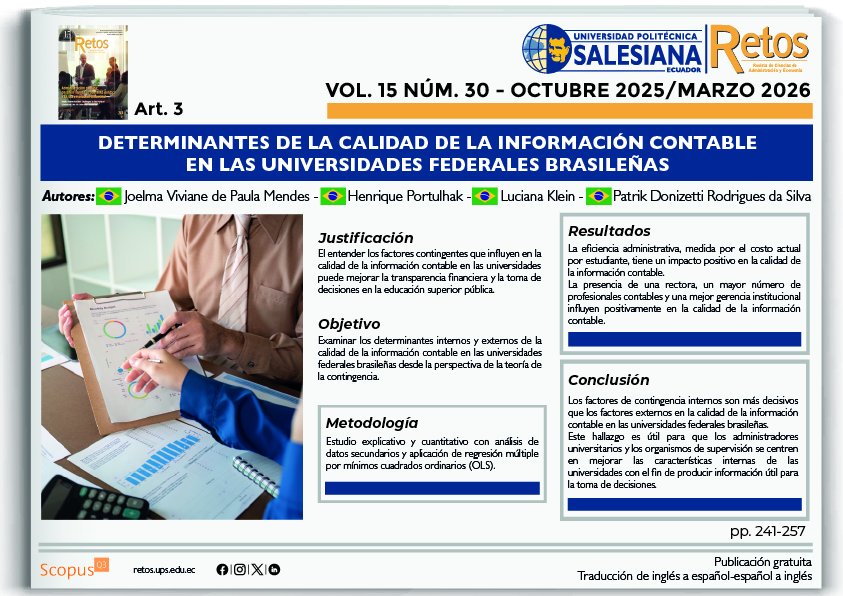
This research examined the determinants of the quality of accounting information at Brazilian federal universities, from a contingency
perspective, focusing on both internal and external factors that influence the information disclosed by these institutions. Understanding these
determinants is relevant for improving financial transparency and decision-making in public higher education. An explanatory and quantitative
approach was adopted to analyze secondary data and documentary sources. A sample of 62 federal universities was studied, and their quality of
accounting information was assessed using the index developed by Beest et al. (2009). Seven variables, based on contingency theory, were tested
using an Ordinary Least Squares (OLS) multiple regression model. The findings revealed that internal factors —such as administrative efficiency,
the number of accounting professionals, the presence of a female dean, and governance quality —have a significant impact on the quality of
accounting information. On the other hand, external factors like socio-economic development in education and university location (capital vs.
interior) did not significantly affect the quality of information. The study concluded that internal factors play a more critical role than external
ones in determining quality of accounting information in Brazilian federal universities. These insights are valuable for university management and
control bodies to focus on enhancing internal characteristics, such as administrative efficiency, technical structure, governance and leadership, in
the production of information useful for decision-making.
Article Details

This work is licensed under a Creative Commons Attribution-NonCommercial-ShareAlike 4.0 International License.
Authorship: The list of authors signing must include only those people who have contributed intellectually to the development of the work. Collaboration in the collection of data is not, by itself, a sufficient criterion of authorship. "Retos" declines any responsibility for possible conflicts arising from the authorship of the works that are published.
Copyright: The Salesian Polytechnic University preserves the copyrights of the published articles, and favors and allows their reuse under the Creative Commons Attribution-NonCommercial-ShareAlike 3.0 Ecuador license. They may be copied, used, disseminated, transmitted and publicly displayed, provided that: i) the authorship and the original source of their publication (journal, editorial and work URL) are cited; (Ii) are not used for commercial purposes; Iii) mention the existence and specifications of this license.
References
Ambarchian, V., & Ambarchian, M. (2020). Assessing the quality of IPSAS-Based financial Reports of the supranational organizations. Financial and Credit Activity: Problems of Theory and Practice, 4(35), 158-168. https://doi.org/10.18371/fcaptp.v4i35.221858
Anderson, R. C., Mansi, S. A., & Reeb, D. M. (2004). Board characteristics, accounting report integrity, and the cost of debt. Journal of Accounting and Economics, 37(3), 315-342. https://doi.org/10.1016/j.jacceco.2004.01.004
Aquino, A. C. B., Caperchione, E., Cardoso, R. L., & Steccolini, I. (2020). Influências estrangeiras no desenvolvimento e inovações recentes em contabilidade e finanças do setor público na América Latina. Revista de Administração Pública, 53(6), 1–10. https://doi.org/10.1590/0034-761220200057
Arun, T. G., Almahrog, Y. E., & Aribi, Z. A. (2015). Female directors and earnings management: Evidence from UK companies. International Review of Financial Analysis, 39, 137-146. https://doi.org/10.1016/j.irfa.2015.03.002
Avellaneda, C. N., & Gomes, R. C. (2015). Is small beautiful? Testing the direct and nonlinear effects of size on municipal performance. Public Administration Review, 75(1), 137-149. https://doi.org/10.1111/puar.12307
Baldissera, J. F., Fiirst, C., Defaveri, I. R., & Folador, E. L. (2017). Transparência na gestão pública: aplicação da LAI no município de Cascavel sob a abordagem da Teoria Contingencial. Revista Competitividade e Sustentabilidade, 4(1), 47-62. https://doi.org/10.48075/comsus.v4i1.16227
Baldissera, J. F., Dall’Asta, D., Casagrande, L. F., & Oliveira, A. M. B. D. (2020). Influência dos aspectos socioeconômicos, financeiro-orçamentários e político-eleitorais na transparência dos governos locais. Revista de Administração Pública, 54(2), 340-359. https://doi.org/10.1590/0034-761220190048
Bardin, L. (2011). Análise de conteúdo. Edições 70.
Beest, F. V., Braam, G. J. M., & Boelens, S. (2009). Quality of Financial Reporting: measuring qualitative characteristics, Nijmegen Center for Economics, NICE Working Paper 09, 108. https://repository.ubn.ru.nl/bitstream/handle/2066/74896/74896.pdf
Bilhim, J. A. F., Azevedo, R. R., & Santos, P. G. (2022). Reformas do Setor Público e Mudanças na Contabilidade Pública. Contabilidade, Gestão e Governança, 25(esp), 388-397. http://dx.doi.org/10.51341/cgg.v25iesp.3012
Brignall, S., & Modell, S. (2000). An institutional perspective on performance measurement and management in the ‘new public sector’. Management Accounting Research, 11(3), 281-306. https://doi.org/10.1006/mare.2000.0136
Brocco, C., Grando, T., Martins, V. Q., Brunozi, A. C., & Corrêa, S. (2018). Transparência da gestão pública municipal: fatores explicativos do nível de transparência dos municípios de médio e grande porte do Rio Grande do Sul. Revista Ambiente Contábil, 10(1), 139-159. https://doi.org/10.21680/2176-9036.2018v10n1ID12040
Burns, D. J. (2012). Exploring the effects of using consumer culture as a unifying pedagogical framework on the ethical perceptions of MBA students. Business Ethics: A European Review, 21(1), 1-14. https://doi.org/10.1111/j.1467-8608.2011.01636.x
Casqueiro, M. L., Irffi, G., & Silva, C. D. C. D. (2020). A expansão das Universidades Federais e os seus efeitos de curto prazo sobre os Indicadores Municipais. Avaliação: Revista da Avaliação da Educação Superior, 25(1), 155-177. https://doi.org/10.1590/S1414-40772020000100009
Chenhall, R. H. (2003). Management control systems design within its organizational context: findings from contingency-based research and directions for the future. Accounting, Organizations and Society, 28(2-3), 127-168. https://doi.org/10.1016/S0361-3682(01)00027-7
Clatworthy, M. A., & Peel, M. J. (2021). Reporting accountant appointments and accounting restatements: Evidence from UK private companies. The British Accounting Review, 53(3), 100974. https://doi.org/10.1016/j.bar.2020.100974
Dallagnol, E. C., & Portulhak, H. (2025). Public value disclosure by Brazilian federal universities. The British Accounting Review, 101587. https://doi.org/10.1016/j.bar.2025.101587
Donaldson, L. (1999). Teoria da contingência estrutural. In Clegg, S. R.; Hardy, C.; Nord, W. R. Handbook de estudos organizacionais: modelos e análise e novas questões em estudos organizacionais. Atlas, 105-133.
Fávero, L. P., & Belfiore, P. (2023). Manual de análise de dados: estatística e modelagem multivariada com Excel®, SPSS®, Stata®, R® e Python®. Elsevier.
Flórez-Parra, J. M., López-Pérez, M. V., & López-Hernández, A. M. (2017). Transparency and its determinants at Colombian universities. Higher Education Research & Development, 36(4), 674-687. https://doi.org/10.1080/07294360.2016.1239613
Flórez-Parra, J. M., Lopez-Perez, M. V., López Hernández, A. M., & Garde Sánchez, R. (2021). Analysing and evaluating environmental information disclosure in universities: the role of corporate governance, stakeholders and culture. International Journal of Sustainability in Higher Education, 22(4), 931-957. https://doi.org/10.1108/IJSHE-08-2020-0323
Freitag, V. C., Almeida, K. K. N., & Lucena, W. G. L. (2021). Teoria da Contingência. In K. K. N. Almeida, R. D. França (Org.), Teorias Aplicadas à Pesquisa em Contabilidade (Cap. 4, pp. 85-110). Editora UFPB. http://www.editora.ufpb.br/sistema/press5/index.php/UFPB/catalog/book/758
Grin, E. J., Nascimento, A. B., Abrucio, F. L., & Fernandes, A. S. (2018). Sobre desconexões e hiatos: uma análise de capacidades estatais e finanças públicas em municípios brasileiros. Cadernos Gestão Pública e Cidadania, 23(76). https://doi.org/10.12660/cgpc.v23n76.75417
Gomes, N. C., & Silva, M. C. (2022). Análise dos Fatores Explicativos do Ranking da Qualidade da Informação Contábil e Fiscal. Journal of Globalization, Competitiveness and Governability, 16(3), 101-116. https://doi.org/10.3232/GCG.2022.V16.N3.05
Gul, F. A., Fung, S. Y. K., & Jaggi, B. (2009). Earnings quality: Some evidence on the role of auditor tenure and auditors’ industry expertise. Journal of Accounting and Economics, 47(3), 265-287. https://doi.org/10.1016/j.jacceco.2009.03.001
Hendriksen, E. S.; Van Breda, M. F. (1999). Teoria da Contabilidade. Atlas.
Herath, S. K., & Albarqi, N. (2017). Financial reporting quality: A literature review. International Journal of Business Management and Commerce, 2(2), 1-14. https://www.ijbmcnet.com/images/Vol2No2/1.pdf
Hyndman, N., & Liguori, M. (2016). Public sector reforms: changing contours on an NPM landscape. Financial Accountability & Management, 32(1), 5-32. https://doi.org/10.1111/faam.12078
Jorge, S., & Mattei, G. (2016). Contingency model of reforms in public sector accounting. In A. Farazmand (Ed.), Global Encyclopedia of Public Administration, Public Policy, and Governance (pp. 1103-1117). Springer. https://doi.org/10.1007/978-3-319-31816-5_2295-2
Kast, F. E.; Rosenzweig, J. E. (1972). General systems theory: Applications for organization and management. Academy of Management Journal, 15(4), 447-465. https://doi.org/10.2307/255141
Kim, J., & Chung, I. H. (2023). Accrual-Based Accounting and Fiscal Performance: Empirical Evidence from Higher Education Institutions. Public Performance & Management Review, 46(4), 920-941. https://doi.org/10.1080/15309576.2023.2178468
Lara, J. M. G., Osma, B. G., Mora, A., & Scapin, M. (2017). The monitoring role of female directors over accounting quality. Journal of Corporate Finance, 45, 651-668. https://doi.org/10.1016/j.jcorpfin.2017.05.016
Lima, R., & Lima, D. (2019). Experiência do Brasil na implementação das IPSAS. Revista Contemporânea de Contabilidade, 16(38). https://doi.org/10.5007/2175-8069.2019v16n38p166
Marenco, A., Strohschoen, M. T. B., & Joner, W. (2017). Capacidade estatal, burocracia e tributação nos municípios brasileiros. Revista de Sociologia e Política, 25(64), 3-21. https://doi.org/10.1590/1678-987317256401
Marôco, J. (2014). Análise Estatística com o SPSS Statistics. Edições Silabo.
Mnif, Y., & Gafsi, Y. (2020). A contingency theory perspective on the analysis of central government accounting disclosure under International Public Sector Accounting Standards (IPSAS). Meditari Accountancy Research, 28(6), 1089-1117. https://doi.org/10.1108/MEDAR-04-2019-0480
Molero, E. (2011). Are workplaces with many female in management run differently? Journal of Business Research, 64(4), 385–393. https://doi.org/10.1016/j.jbusres.2010.01.009
Nicolò, G., Aversano, N., Sannino, G., Polcini, P. T. (2022). Online sustainability disclosure practices in the university context. The role of the board of directors. Corporate Governance: The International Journal of Business in Society, 23(4), 800-826. https://doi.org/10.1108/CG-05-2022-0224
Opanyi, R. O. (2016). The effect of adoption of international public sector accounting standards on quality of financial reports in public sector in Kenya. European Scientific Journal, 12(28), 161-187. https://doi.org/10.19044/esj.2016.v12n28p161
Otley, D. (2016). The contingency theory of management accounting and control: 1980–2014. Management Accounting Research, 31, 45-62. https://doi.org/10.1016/j.mar.2016.02.001
Pessôa, I. S., Canuto, E. S. L., Costa, J. C., Almeida, J. E. F. (2018). Determinantes da Transparência das Universidades Federais Brasileiras. Revista de Gestão e Contabilidade da UFPI, 5(2), 97-114. https://doi.org/10.26694/2358.1735.2018.v5ed27199
Pina, V., Torres, L., & Yetano, A. (2009). Accrual accounting in EU local governments: One method, several approaches. European Accounting Review, 18(4), 765-807. https://doi.org/10.1080/09638180903118694
Ranking de Universidades Folha (2023). Folha de São Paulo. https://ruf.folha.uol.com.br/2023/ranking-de-universidades/principal/
Schmidthuber, L., Hilgers, D., & Hofmann, S. (2022). International Public Sector Accounting Standards (IPSASs): A systematic literature review and future research agenda. Financial Accountability & Management, 38, 119-142. https://doi.org/10.1111/faam.12265
Sell, F. F., Beuren, I. M., & Lavarda, C. E. F. (2020). Influência de fatores contingenciais no desempenho municipal: evidências inferenciais. Revista de Contabilidade e Organizações, 14, e164058. https://doi.org/10.11606/issn.1982-6486.rco.2020.164058
Sellami, Y. M., & Gafsi, Y. (2020). Public management systems, accounting education, and compliance with international public sector accounting standards in sub-Saharan Africa. International Journal of Public Sector Management, 33(2/3), 141-164. https://doi.org/10.1108/IJPSM-12-2018-0274
Setiyawati, H., & Doktoralina, C. (2019). The importance of quality accounting information management in regional governments in Indonesia. Management Science Letters, 9(12), 2083-2092. http://dx.doi.org/10.5267/j.msl.2019.6.025
Soares, Y. M. A., Cavalcante, P. R. N., & Santos, Y. D. (2019). Informações contingenciais: um estudo sobre a percepção de gestores do setor de óleo e gás no Brasil. Revista Capital Científico, 17(3), 26-40. https://doi.org/10.5935/2177-4153.20190017
Sousa, K. M. (2022). Efeito Spillover: uma análise espacial da qualidade da informação contábil nos municípios brasileiros. Revista de Educação e Pesquisa em Contabilidade, 16(4), 367-384. https://doi.org/10.17524/repec.v16i4.3037
Sousa, K. M., & Callado, A. A. C. (2019). Indicadores financeiros e não financeiros e a qualidade da educação superior das universidades federais brasileiras. Revista Ciências Administrativas, 25(2), 1-15. https://doi.org/10.5020/2318-0722.2019.8385
Souza, G. F. R. C. T. (2022). Transparência fiscal e disclosure contábil nos governos estaduais brasileiros [Dissertação de Mestrado, Universidade de São Paulo]. Biblioteca Digital USP. https://doi.org/10.11606/D.12.2022.tde-24082022-130407
Visentini, M. S., Scheid, L. L., Fenne, V. U., & Correa, D. D. V. (2021). Fatores associados à transparência pública nos 497 municípios gaúchos. Planejamento e Políticas Públicas, (59), 257-284. https://doi.org/10.38116/ppp59art9
Woods, M. (2009). A contingency theory perspective on the risk management control system within Birmingham city council. Management Accounting Research, 20(1), 69-81. https://doi.org/10.1016/j.mar.2008.10.003
Zhai, J., & Wang, Y. (2016). Accounting information quality, governance efficiency and capital investment choice. China Journal of Accounting Research, 9(4), 251-266. https://doi.org/10.1016/j.cjar.2016.08.001