

Financial socialization and well-being: the mediating role of psychological factors in Mexican adultsm
Article Sidebar
Main Article Content
Abstract
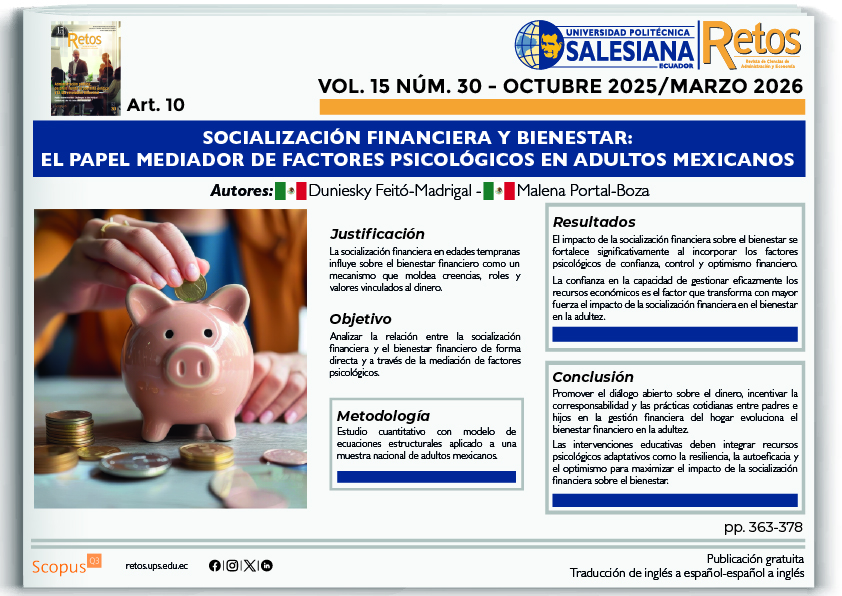
this study explores the direct impact of financial socialization on financial well-being and also evaluates the mediating effect of financial
trust, degree of control, and optimism as psychological factors, drawing on theories of family financial socialization, social learning, and behavioral
finance. Using structural equation modeling for an adult sample, the results indicate that financial socialization has a positive, but weak,
direct effect on financial well-being. However, this effect is intensified when psychological factors, particularly financial trust, intervene. The
analysis revealed complementary partial mediation, suggesting that, overall, indirect effects outweigh the direct effect. These findings emphasize
the importance of individual beliefs, perceptions, and attitudes in strengthening the relationship between formative experiences in childhood
and financial well-being in adulthood. In the Mexican context, characterized by high levels of informality and limited access to formal financial
services, the results highlight the importance of consolidating homes as spaces for economic education. It is recommended that financial education
strategies simultaneously integrate socio-emotional skills and practical financial management tools to optimize the use of public resources and
amplify the social impact of regional financial inclusion and well-being policies.
Article Details

This work is licensed under a Creative Commons Attribution-NonCommercial-ShareAlike 4.0 International License.
Authorship: The list of authors signing must include only those people who have contributed intellectually to the development of the work. Collaboration in the collection of data is not, by itself, a sufficient criterion of authorship. "Retos" declines any responsibility for possible conflicts arising from the authorship of the works that are published.
Copyright: The Salesian Polytechnic University preserves the copyrights of the published articles, and favors and allows their reuse under the Creative Commons Attribution-NonCommercial-ShareAlike 3.0 Ecuador license. They may be copied, used, disseminated, transmitted and publicly displayed, provided that: i) the authorship and the original source of their publication (journal, editorial and work URL) are cited; (Ii) are not used for commercial purposes; Iii) mention the existence and specifications of this license.
References
Antoni, X. (2023). The role of family structure on financial socialiSation techniques and behaviour of students in the Eastern Cape, South Africa. Cogent Economics & Finance, 11. https://doi.org/10.1080/23322039.2023.2196844
Arya, V., Banerjee, R., Lowies, B., Viljoen, C., & Lushington, K. (2023). The effect of psychological factors on financial behaviour among older Australians: Evidence from the early stages of COVID-19 pandemic. PLoS ONE 18(6). https://doi.org/10.1371/journal.pone.0286733
Bandura, A. (1986). Social foundations of thought and action: A social cognitive theory. Prentice-Hall.
Barnet, C. & Wolff, F. (2002). Motives for pocket money allowance and family incentives. Journal of Economic Psychology, 23, 339–366. https://doi.org/10.1016/S0167-4870(02)00080-6
Béres, D., Mészáros, A., Hanák, Z. & Németh, E. (2024). The role of pocket money in the financial socialization of young people. International Journal of Business and Society, 25(3), 1253-1272. DOI: 10.33736/ijbs.8578.2024
Boto, D., Bucciol, A. & Manfrè, M. (2022). The role of financial socialization and self-control on saving habits. Journal of Behavioral and Experimental Economics, 100, 101-903. https://doi.org/10.1016/j.socec.2022.101903
Brüggen, E. C., Hogreve, J., Holmlund, M., Kabadayi, S., & Löfgren, M. (2017). Financial well-being: A conceptualization and research agenda. Journal of Business Research, 79, 228-237. https://doi.org/10.1016/j.jbusres.2017.03.013
Carton, F.L., Xiong, H. & McCarthy, J.B. (2022). Drivers of financial well-being in socio-economic deprived populations. Journal of Behavioral and Experimental Finance 34, https://doi.org/10.1016/j.jbef.2022.100628
Cepeda, G., Nitzl, C., & Roldán, J. L. (2017). Mediation Analyses in Partial Least Squares Structural Equation Modeling: Guidelines and Empirical Examples. In H. Latan & R. Noonan (Eds.), Partial Least Squares Path Modeling: Basic concepts, methodological issues and applications (pp. 173–195). Springer. https://doi.org/10.1007/978-3-319-64069-3
Consejo Nacional de Evaluación de la Política de Desarrollo Social (CONEVAL) (2023). Informe de pobreza y evaluación 2022-2023. CONEVAL. https://www.coneval.org.mx/Medicion/MP/Paginas/Pobreza_2022.aspx
Consumer Financial Protection Bureau (CFPB). (2017). Financial well-being: The goal of financial education. https://www.consumerfinance.gov/data-research/research-reports/financial-well-being/
Danes, S.M. (1994). Parental perceptions of children's financial socialization. Journal of Financial Counseling and Planning, 5, 127-149. https://experts.umn.edu/en/publications/parental-perceptions-of-childrens-financial-socialization
Deenanath, V., Danes, S. M. & Jang, J. (2019). Purposive and unintentional family financial socialization, subjective financial knowledge, and financial behavior of high school students. Journal of Financial Counseling and Planning, 30(1), 83-96.
Encuesta Nacional de Inclusión Financiera (ENIF). (2024). Reporte de Resultados. https://www.cnbv.gob.mx/Inclusi%C3%B3n/Anexos%20Inclusin%20Financiera/Reporte_ENIF2024.pdf
Encuesta Nacional de Salud Financiera (ENSAFI) (2023). Instituto Nacional de Estadística y Geografía INEGI. https://www.inegi.org.mx/programas/ensafi/2023/
Fan, L. & Henager, R. (2021). A Structural Determinants Framework for Financial Well Being. Journal of Family and Economic Issues, Springer. https://doi.org/10.1007/s10834-021-09798-w
Farooq, S. H., Shah, S. Z. A., & Rasheed, S. (2021). Impact of financial attitude, financial literacy and parental financial socialization on prudent financial management practices: A moderating effect of financial well-being among the youth of Pakistan. Abasyn Journal of Social Sciences, 14(1), 15–27. https://doi.org/10.34091/AJSS.14.1.02
Fornell, C., & Larcker, D. (1981). Evaluating structural equation models with unobserved variables and Measurement Error. Journal of Marketing Research, 18(1), 39–50. https://doi.org/10.2307/3151312
Garcés, M., Santoya, Y., Vázquez, P. & Geney, E. (2021). Influencia de la comunicación familiar en el estrés percibido durante la pandemia de COVID-19. Salud Uninorte, 37(3), 569-582. https://dx.doi.org/10.14482/sun.37.3.616.981
Gudmunson, C. G., & Danes, S. M. (2011). Family financial socialization: Theory and critical review. Journal of Family and Economic Issues, 32(4), 644-667. https://doi.org/10.1007/s10834-011-9275-y
Gutter, M., & Copur, Z. (2011). Financial behaviors and financial well-being of college students: Evidence from a national survey. Journal of Family and Economic Issues, 32(4), 699-714. https://doi.org/10.1007/s10834-011-9255-2
Hair, J. F., Ringle, C. M. & Sarstedt, M. (2011). PLS-SEM: Indeed a silver bullet. Journal of Marketing Theory and Practice, 19(2), 139–152. https://doi.org/10.2753/MTP1069-6679190202
Henseler, J. (2016). Guest editorial. Industrial Management & Data Systems, 116 (9), 1842-1848. https://www.emerald.com/insight/publication/issn/0263-5577/vol/116/iss/9
Instituto Nacional de Estadística y Geografía (INEGI). (2023). Antecedentes de la Encuesta Nacional de Salud Financiera. https://www.inegi.org.mx/programas/ensafi/2023/
Instituto Nacional de las Personas Adultas Mayores, (agosto, 2022). Transformaciones en las estructuras familiares y su impacto en los cuidados. https://acortar.link/YDlTtK
Jin, M. & Chen, Z. (2020). Comparing Financial Socialization and Formal Financial Education: Building Financial Capability. Social Indicators Research 149, 641–656. https://doi.org/10.1007/s11205-019-02248-z
Jorgensen, B.L. & Savla, J. (2010). Financial Literacy of Young Adults: The Importance of Parental Socialization. Family Relations, 59, 465–478. https://doi.org/10.1111/j.1741-3729.2010.00616.x
Kaur, R. & Singh, M. (2024). The Dynamics of Family Financial Socialization: Impact on Financial Self-efficacy and Financial Behavior. NMIMS Management Review 32(2) 106–117, DOI: 10.1177/09711023241282195
Kim, A. R. & Yang, H. K. (2019). The impact of overconfidence on f inancial behaviors. Financial Planning Review, 12(2), 79–112. https://doi.org/10.36029/FPR.2019.05.12.2.79
Lusardi, A. (2015). Financial literacy: Do people know the ABCs of finance? Public Understanding of Science, 24(3) 260–271. DOI: 10.1177/0963662514564516
Lusardi, A. & Mitchell, O.S. (2014). The Economic Importance of Financial Literacy: Theory and Evidence. Journal of Economic Literature, 52(1), 5-44. https://www.aeaweb.org/articles?id=10.1257/jel.52.1.5
McNeal, J.U. (2007). On Becoming a Consumer: The Developement of Consumer Behavior Patterns in Childhood. Elsevier. Burlington. MA. https://doi.org/10.1016/B978-0-7506-8335-7.50004-0
Mendes, K., Matheis, T.K., García, G.A. & Klein, L.L. (2023). Antecedentes del bienestar financiero: ¿cómo son relevantes las percepciones del sistema financiero y el conocimiento financiero? Revista Evidenciação Contábil & Finanças João Pessoa, 11(3), 137-158, DOI 10.22478/ufpb.23181001.2023v11n3.60717
Nam, S. J. (2023). Effects of financial empowerment and self confidence in financial empowerment on financial well being. Current Psychology 42,28309–28319 https://doi.org/10.1007/s12144-022-03916-z
Netemeyer, R. G., Warmath, D., Fernandes, D., & Lynch, J. G. (2018). How am I doing? Perceived financial well-being, its potential antecedents, and its relation to overall well-being. Journal of Consumer Research, 45(1), 68-89. https://doi.org/10.1093/jcr/ucx109
Organización para la Cooperación y el Desarrollo Económicos (OCDE). (2022). G20/OECD High-Level Principles on Financial Consumer Protection, 11 December. https://www.fsb.org/2022/12/cos_111104a/
Rea, J. K., Danes, S. M., Serido, J., Borden, L. M. & Shim, S. (2019). Being able to support yourself: Young adults’ meaning of financial well-being through family financial socialization. Journal of Family and Economic Issues, 40(2), 250-268. https://doi.org/10.1007/s10834-018-9602-7
Rettig, K.D., Leichtentritt, R.D., & Danes, S.M. (1999). The effects of resources, decision making, and decision implementing on perceived family well-being in adjusting to an economic stressor. Journal of Family and Economic Issues, 20, 5–34. https://doi.org/10.1023/A:1022163729635
Sabri, M.F., Wahab, R., Mahdzan, N.S., Magli, A.S., Rahim, H.A., Suhaimi, S.S.A. & Nazuri, N.S. (2023) An enigma of Malaysia’s low-income young adults: Mediation of financial behaviour on financial well being and locus of control cohesion. PLoS ONE 18(7). https://doi.org/10.1371/journal. pone.0288204
Seligman, M. E. P. (1998). Learned optimism: How to change your mind and your life. Pocket Books.
Shim, S., Serido, J., Card, N., & Tang, C. (2015). Socialization processes and pathways to healthy financial development for emerging young professionals. Journal of Applied Developmental Psychology, 38, 29–38. https://doi.org/10.1016/j.appdev.2015.01.002
Tang, N., Baker, A. & Peter, P. C. (2015). Investigating the disconnect between financial knowledge and behavior: The role of parental influence and psychological characteristics in responsible financial behaviors among young adults. Journal of Consumer Affairs, 49(2), 376-406.
Xiao, J. J., & Porto, N. (2017). Consumer financial capability and financial satisfaction. Social Indicators Research, 131(1), 15-35. https://doi.org/10.1007/s11205-016-1219-9
Yue, A. & Zhu, F. (2020). Impact of school financial education on parental saving socialization in Hong Kong adolescents. Journal of Behavioral and Experimental Economics, 87, 101-557. https://doi.org/10.1016/j.socec.2020.101557
Zhao, H. & Zhang, L. (2020). Talking money at home: the value of family financial socialization. International Journal of Bank Marketing, 38(7), 1617-1634. https://doi.org/10.1108/IJBM-04-2020-0174