

El emprendimiento universitario en Colombia desde el apoyo familiar, persistencia emprendedora y desempeño
Barra lateral del artículo
Contenido principal del artículo
Resumen
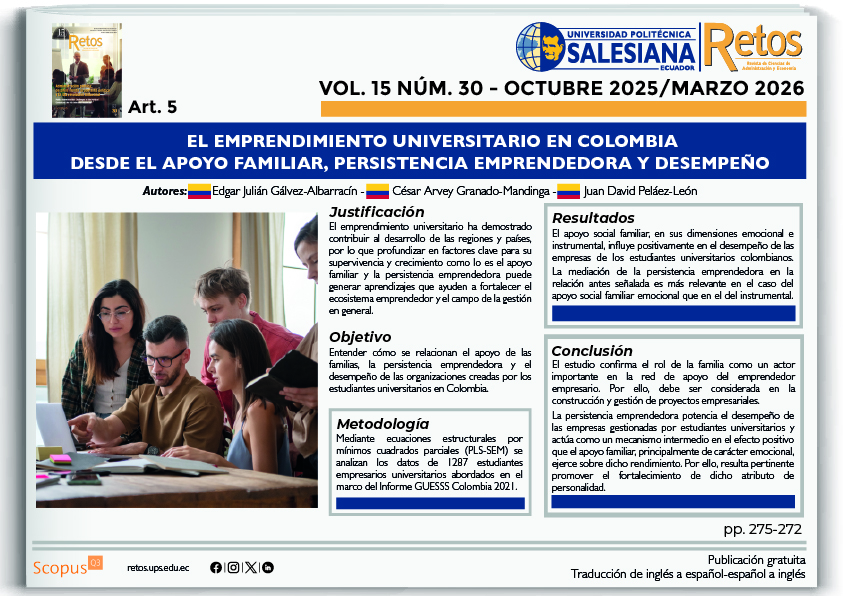
El emprendimiento universitario (EU) viene ganando cada vez mayor atención académica y organizacional, sin embargo, son escasas las investigaciones respecto al papel que tiene el Apoyo Social Familiar (ASF) en el Desempeño Empresarial (DE) de los negocios establecidos por estudiantes. Dicho vacío de información resulta relevante dado que el ASF en sus dimensiones emocional (ASFE) e instrumental (ASFI), puede ser estratégico para el desarrollo y sostenibilidad de estos emprendimientos. Consecuentemente este estudio tiene por objeto analizar el efecto del ASF sobre el DE de los emprendimientos liderados por estudiantes universitarios en Colombia, considerando adicionalmente el rol mediador de la Persistencia Emprendedora (PE), cualidad central para mantener el compromiso emprendedor y asumir obstáculos. El trabajo adopta entonces un enfoque cuantitativo, utilizando información de 1287 estudiantes empresarios abordados en el Informe GUESSS Colombia 2021. El procesamiento estadístico de los datos se realizó a través de ecuaciones estructurales por mínimos cuadrados parciales (PLS-SEM). Los resultados señalan que el ASFE y el ASFI inciden positivamente en el DE. Asimismo, se encuentra que la mediación de la PE es más relevante cuando se considera el componente emocional del apoyo familiar. Se concluye que el apoyo familiar tiene un papel relevante en el éxito de los emprendimientos universitarios, lo que, con base en redes de apoyo cercanas, conlleva importantes implicaciones para el diseño de políticas educativas y programas institucionales orientados a fortalecer el emprendimiento de estudiantes universitarios.
Detalles del artículo

Esta obra está bajo una licencia internacional Creative Commons Atribución-NoComercial-CompartirIgual 4.0.
Autoría: La lista de autores firmantes debe incluir únicamente a aquellas personas que hayan contribuido intelectualmente al desarrollo del trabajo. La colaboración en la recogida de datos no es, por sí misma, criterio suficiente de autoría. "Retos" declina toda responsabilidad por posibles conflictos derivados de la autoría de los trabajos que se publiquen.
Derechos de autor: La Universidad Politécnica Salesiana preserva los derechos de autor de los artículos publicados, y favorece y permite su reutilización bajo la licencia Creative Commons Attribution-NonCommercial-ShareAlike 3.0 Ecuador. Pueden ser copiados, utilizados, difundidos, transmitidos y expuestos públicamente, siempre y cuando: i) se cite la autoría y la fuente original de su publicación (revista, editorial y URL del trabajo); (Ii) no se utilicen con fines comerciales; Iii) se mencione la existencia y especificaciones de esta licencia.
Referencias
Adams, G. A., King, L. A., & King, D. W. (1996). Relationships of job and family involvement, family social support, and work-family conflict with job and life satisfaction. Journal of Applied Psychology, 81(4), 411–420. https://doi.org/10.1037/0021-9010.81.4.411
Adomako, S. (2020). Regulatory focus, persistence and new venture performance. Journal of Small Business and Enterprise Development, 27(7), 1107–1124. https://doi.org/10.1108/JSBED-03-2020-0065
Al Issa, H.E. (2022). Psychological capital for success: the mediating role of entrepreneurial persistence and risk-taking. Journal of Entrepreneurship in Emerging Economies, 14(4), 525–548. https://doi.org/10.1108/JEEE-09-2020-0337
Aldrich, H. E., & Cliff, J. E. (2003). The pervasive effects of family on entrepreneurship: Toward a family embeddedness perspective. Journal of Business Venturing, 18(5), 573–596. https://doi.org/10.1016/S0883-9026(03)00011-9
Asghar, N., Khattak, A., Danish, M. H., Bokhari, I. H., & Waris, M. (2023). Managerial skills, technology adaptation and firm performance: Mediating role of process innovation and product innovation. Cogent Business and Management, 10(3). https://doi.org/10.1080/23311975.2023.2281485
Badulescu, D., Akhtar, M. N., Ahmad, M., & Soharwardi, M. A. (2021). Accounting Policies, Institutional Factors, and Firm Performance: Qualitative Insights in a Developing Country. Journal of Risk and Financial Management, 14(10). https://doi.org/10.3390/jrfm14100473
Caliendo, M., Goethner, M., & Weißenberger, M. (2020). Entrepreneurial persistence beyond survival: Measurement and determinants. Journal of Small Business Management, 58(3), 617–647. https://doi.org/10.1080/00472778.2019.1666532
Chen, Y., Chen, L., Zou, S., & Hou, H. (2021). Easy to Start, Hard to Persist: Antecedents and Outcomes of Entrepreneurial Persistence in Online Marketplaces. International Journal of Electronic Commerce, 25(4), 469–496. https://doi.org/10.1080/10864415.2021.1967003
Clarysse, B., Mustar, P., & Dedeyne, L. (2022). Student Entrepreneurship: Reflections and Future Avenues for Research. Foundations and Trends® in Entrepreneurship, 18, 268–329. https://doi.org/10.1561/0300000109
Cogan, A., Pret, T., & Cardon, M. S. (2022). Everyday social support processes: Household members’ instrumental and emotional support of entrepreneurs. International Small Business Journal: Researching Entrepreneurship, 40(5), 537–563. https://doi.org/10.1177/02662426211054098
Coppens, K., & Knockaert, M. (2022). Committed to the venture or the family? A study of entrepreneurial persistence in distressed ventures. Small Business Economics, 58(1), 263–280. https://doi.org/10.1007/s11187-021-00486-5
De Clercq, D., Kaciak, E., & Thongpapanl, N. (2022). When does market hostility curtail competitive performance through diminished entrepreneurial efforts? Buffering effects of women entrepreneurs’ family business support. Small Business Economics, 59(3), 827–844. https://doi.org/10.1007/s11187-021-00549-7
Dewitt, S., Jafari-Sadeghi, V., Sukumar, A., Aruvanahalli Nagaraju, R., Sadraei, R., & Li, F. (2023). Family dynamics and relationships in female entrepreneurship: an exploratory study. Journal of Family Business Management, 13(3), 626–644. https://doi.org/10.1108/JFBM-01-2022-0013
Edelman, L. F., Manolova, T., Shirokova, G., & Tsukanova, T. (2016). The impact of family support on young entrepreneurs’ start-up activities. Journal of Business Venturing, 31(4), 428–448. https://doi.org/10.1016/j.jbusvent.2016.04.003
Fang, H., Chrisman, J. J., & Holt, D. T. (2021). Strategic Persistence in Family Business. Entrepreneurship Theory and Practice, 45(4), 931–950. https://doi.org/10.1177/10422587211001806
Gao, J. L., Li, D. S., & Conway, M. L. (2021). Family support and entrepreneurial passion: The mediating role of entrepreneurs’ psychological capital. Social Behavior and Personality, 49(3). https://doi.org/10.2224/SBP.9791
Hair, J. F., Risher, J. J., Sarstedt, M., & Ringle, C. M. (2019). When to use and how to report the results of PLS-SEM. European Business Review, 31(1), 2–24. https://doi.org/10.1108/EBR-11-2018-0203
Heckl, D., & Moormann, J. (2010). Process Performance Management. In Handbook on Business Process Management (Vol. 1, pp. 115–135). https://doi.org/10.1007/978-3-642-01982-1_6
Henseler, J., Ringle, C. M., & Sarstedt, M. (2015). A new criterion for assessing discriminant validity in variance-based structural equation modeling. Journal of the Academy of Marketing Science, 43, 115–135. https://doi.org/10.1007/s11747-014-0403-8
Inoubli, C. E., & Gharbi, L. (2024). Investigating how social context moderates the relationship between intentions and behaviors in student entrepreneurship: Case of Tunisian students. International Journal of Management Education, 22(1). https://doi.org/10.1016/j.ijme.2023.100918
Kaplan, R. S., & Norton. (2001). The strategy-focused organization: how balanced scorecard companies thrive in the new business environment. In D. P. (David P.) Norton y D. P. Norton (Eds.), Strategy focused organization. Harvard Business School Press.
Kar, B., & Ahmed, Y. A. (2022). Exploring kin and family support to young firms in Ethiopia. African Journal of Economic and Management Studies, 13(3), 385–401. https://doi.org/10.1108/AJEMS-05-2021-0199
Klyver, K., Schenkel, M. T., & Nielsen, M. S. (2020). Can’t always get what I want: Cultural expectations of emotional support in entrepreneurship. International Small Business Journal: Researching Entrepreneurship, 38(7), 677–690. https://doi.org/10.1177/0266242620915675
Lee, K. J., Kim, S. G., & Lee, S. Y. (2022). Family Support, Managerial Self-Efficacy, and Performance of Micro-Firms in Tourism Destinations During the COVID-19 Pandemic. Journal of Quality Assurance in Hospitality and Tourism, 25(5), 1488-1511. https://doi.org/10.1080/1528008X.2022.2161694
Lingappa, A. K., Shah, A., & Mathew, A. O. (2020). Academic, Family, and Peer Influence on Entrepreneurial Intention of Engineering Students. SAGE Open, 10(3). https://doi.org/10.1177/2158244020933877
Longva, K. K. (2021). Student venture creation: developing social networks within entrepreneurial ecosystems in the transition from student to entrepreneur. International Journal of Entrepreneurial Behaviour y Research, 27(5), 1264–1284. https://doi.org/10.1108/IJEBR-09-2020-0661
Lu, X., Xiong, Y., Lv, X., & Shan, B. (2022). Emotion in the Area of Entrepreneurship: An Analysis of Research Hotspots. Frontiers in Psychology, 13. https://doi.org/10.3389/fpsyg.2022.922148
Manzi-Puertas, M. A., Agirre-Aramburu, I., & López-Pérez, S. (2024). Navigating the student entrepreneurial journey: Dynamics and interplay of resourceful and innovative behavior. Journal of Business Research, 174. https://doi.org/10.1016/j.jbusres.2024.114524
Martins, I., Lopez, T., Alvarez, C., Pérez, J.P., Gálvez-Albarracín, E., González-Campo, C.H., & Murillo-Vargas, G. (2022). El espíritu emprendedor de los estudiantes en Colombia: Resultados del Proyecto GUESSS Colombia 2021. Universidad EAFIT. https://www.guesssurvey.org/resources/nat_2021/GUESSS_Report_2021_Colombia.pdf
Marzana, D., Pérez-acosta, A. M., Marta, E., & Isabel González, M. (2010). La transición a la edad adulta en Colombia: una lectura relacional. Avances En Psicología Latinoamericana, 28(1), 99–112.
Mei, H., Ma, Z., Zhan, Z., Ning, W., Zuo, H., Wang, J., & Huang, Y. (2022). University Students’ Successive Development from Entrepreneurial Intention to Behavior: The Mediating Role of Commitment and Moderating Role of Family Support. Frontiers in Psychology, 13. https://doi.org/10.3389/fpsyg.2022.859210
Powell, G. N., & Eddleston, K. A. (2017). Family Involvement in the Firm, Family-to-Business Support, and Entrepreneurial Outcomes: An Exploration. Journal of Small Business Management, 55(4), 614–631. https://doi.org/https://doi.org/10.1111/jsbm.12252
Ramanust, S. (2020). Being an Entrepreneur in the Pharmaceutical Sector of Thailand and Ensuring Career Success: Role of Entrepreneurial Grit and Orientation. Systematic Reviews in Pharmacy, 11(12), 2291–2297. http://dx.doi.org/10.31838/srp.2020.12.349
Romero-Parra, R. M., Romero-Chacín, J., & Barboza-Arenas, L. A. (2022). Relationship between profile and entrepreneurial vision of university students. Retos Revista de Ciencias de la Administración y Economía, 12(23), pp. 67-82. https://doi.org/10.17163/ret.n23.2022.04
Saleem, I., Saleem, A., Hassan, A., Farukh, M. U., & Kamran, H. (2023). Psychological aspects affecting the venture performance of Indian women entrepreneurs. Cogent Business and Management, 10(3). https://doi.org/10.1080/23311975.2023.2259144
Simmons, S. A., Carr, J. C., Hsu, D., & Craig, S. B. (2023). Intention to reengage in entrepreneurship: Performance feedback, sensation seeking and workaholism. Journal of Business Research, 165. https://doi.org/10.1016/j.jbusres.2023.114042
Symeonidou, N., DeTienne, D. R., & Chirico, F. (2022). The persistence of family firms: How does performance threshold affect family firm exit? Small Business Economics, 59(2), 477–489. https://doi.org/10.1007/s11187-021-00482-9
Valencia-Arias, A., Rodríguez-Correa P. A., Cárdenas-Ruiz J. A., & Gómez-Molina, S. (2022). Factors that influence the entrepreneurial intention of psychology students of the virtual modality. Retos Revista de Ciencias de la Administración y Economía, 12(23), pp. 5-24. https://doi.org/10.17163/ret.n23.2022.01
Xu, F., Kellermanns, F. W., Jin, L., & Xi, J. (2020). Family support as social exchange in entrepreneurship: Its moderating impact on entrepreneurial stressors-well-being relationships. Journal of Business Research, 120, 59–73. https://doi.org/10.1016/j.jbusres.2020.07.033
Zhu, F., Thornhill, S., & Hsu, D. (2021). When owner, family, and community roles intertwine: Examining entrepreneurs’ persistence decisions and the gender effect. Journal of Small Business Management, 59, 1–32. https://doi.org/10.1080/00472778.2021.1883037