

Spain and artificial intelligence: installed capacities, challenges, and opportunities
Article Sidebar
Main Article Content
Abstract
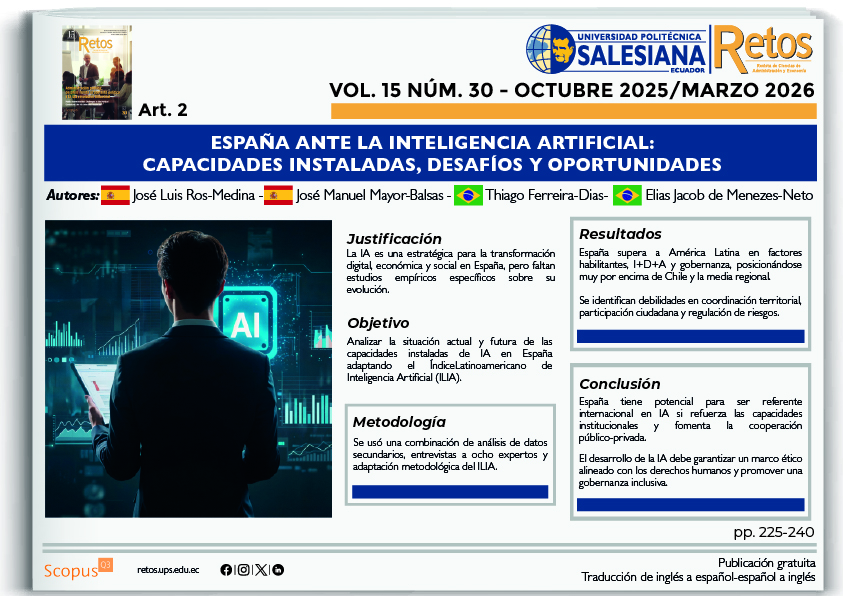
This research analyzes the current state and future prospects of the installed capacities for the development of artificial intelligence (AI) in Spain. The study is justified by the growing strategic importance of AI as a driver of digital, economic, and social transformation, as well as by the scarcity of empirical analyses that address its specific evolution in the Spanish context. The main objective is to assess Spain’s situation by adapting the Latin American Artificial Intelligence Index (ILIA), comparing its results with those of Chile and the Latin American average, which allows for the identification of strengths, weaknesses, and areas for improvement. The methodology combines the analysis of secondary data with qualitative primary data obtained through in-depth interviews with eight experts from the academic, public, business, and civil society sectors. The main findings of the index show that Spain significantly outperforms Latin American countries in enabling factors, R&D&I, and governance. However, weaknesses were identified in territorial coordination, citizen participation, and risk regulation. The interviews confirm an optimistic view of the future of AI in Spain, highlighting key sectors such as healthcare, education, industry, and human talent development. It is concluded that Spain has the potential to position itself as a regional and international benchmark, provided that it strengthens its institutional capacities, promotes public-private cooperation, and ensures ethical development aligned with human rights.
Article Details

This work is licensed under a Creative Commons Attribution-NonCommercial-ShareAlike 4.0 International License.
Authorship: The list of authors signing must include only those people who have contributed intellectually to the development of the work. Collaboration in the collection of data is not, by itself, a sufficient criterion of authorship. "Retos" declines any responsibility for possible conflicts arising from the authorship of the works that are published.
Copyright: The Salesian Polytechnic University preserves the copyrights of the published articles, and favors and allows their reuse under the Creative Commons Attribution-NonCommercial-ShareAlike 3.0 Ecuador license. They may be copied, used, disseminated, transmitted and publicly displayed, provided that: i) the authorship and the original source of their publication (journal, editorial and work URL) are cited; (Ii) are not used for commercial purposes; Iii) mention the existence and specifications of this license.
References
Ananny, M., y Crawford, K. (2017). Seeing without knowing: Limitations of the transparency ideal and its application to algorithmic accountability. New Media & Society, 20(3), 973-989.
Azuaje, M. (2021). Estrategia nacional de inteligencia artificial y propiedad intelectual: Algunos temas cruciales. Universidad Autónoma de Chile.
Binns, R. (2017). Algorithmic accountability and public reason. Philosophy & Technology, 31(4), 543-556. https://doi.org/10.1007/s13347-017-0263-5
Bredin, H., Xu, C., y Coria, J. (2020). Pyannote.audio: Neural building blocks for speaker diarization. En ICASSP 2020 – 2020 IEEE International Conference on Acoustics, Speech and Signal Processing (ICASSP) (pp. 7124–7128). IEEE. https://doi.org/10.1109/ICASSP40776.2020.9052974
Bredin, H., y Laurent, A. (2021). End-to-end speaker segmentation for overlap-aware resegmentation. En Proceedings of Interspeech 2021 (pp. 3111-3115). ISCA. https://doi.org/10.21437/Interspeech.2021-560
Briggs, J., y Kodnani, D. (2023). The potentially large effects of artificial intelligence on economic growth. Economics Research, Goldman Sachs, 1.
CENIA (2023). Apéndice metodológico. En Índice Latinoamericano de Inteligencia Artificial (pp. 247-320).
Cerrillo, A. (2019). Com obrir les caixes negres de les administracions públiques? Transparència i rendició de comptes en l’ús dels algoritmes. Revista Catalana de Dret Públic, 58, 13-28.
CIS (2025). Estudio 3495 Inteligencia Artificial. Centro de Investigaciones Sociológicas. Madrid.
Comisión Europea (2020). Libro blanco sobre la inteligencia artificial: Un enfoque europeo orientado a la excelencia y la confianza. Bruselas.
Cotino, L. (2019). Ética en el diseño para el desarrollo de una inteligencia artificial, robótica y big data confiables y su utilidad desde el derecho. Revista Catalana de Dret Públic, 58, 29-48.
Criado, J.I. (2021). Inteligencia artificial (y administración pública). Eunomía. Revista en Cultura de la Legalidad, 20, 348-372. https://doi.org/10.20318/eunomia.2021.6097
De Pisón, J. M. (2022). Inteligencia artificial y los derechos de los humanos: Viejos y nuevos retos de la filosofía del Derecho. Revista Internacional de Pensamiento Político, 17, 377-387. https://doi.org/10.46661/revintpensampolit.7430
Deloitte (2024). Deloitte Global’s 2025 Predictions Report: Generative AI. https://www.deloitte.com/global/en/about/press-room/deloitte-globals-2025-predictions-report.html
Estupiñán, J., Leyva, M. Y., Peñafiel, A. J., y El Assafiri, Y. (2021). Inteligencia artificial y propiedad intelectual. Revista Universidad y Sociedad, 13(S3), 362-368.
Fuentes, P., Hankins, E., Stirling, R., Cirri, G., Grau, G., Rahim, S., Crampton, E. (2024). Government AI Readiness Index 2024. Oxford Insights.
Grootendorst, M. (2022). BERTopic: Neural topic modeling with a class-based TF-IDF procedure. ArXiv preprint arXiv, 2203.05794. https://doi.org/10.48550/arXiv.2203.05794
ILIA (2025). Índice Latinoamericano de Inteligencia Artificial. https://indicelatam.cl/
Jacob de Menezes-Neto, E., y Clementino, M. B. M. (2022). Using deep learning to predict outcomes of legal appeals better than human experts: A study with data from Brazilian federal courts. PloS one, 17(7), e0272287. https://doi.org/10.1371/journal.pone.0272287
Martínez, R. (2019). Inteligencia artificial desde el diseño: Retos y estrategias para el cumplimiento normativo. Revista Catalana de Dret Públic, 58, 64-81.
Maslej, N., Fattorini, L., Perrault, R., Gil, Y., Parli, V., Kariuki, N., Capstick, E., Reuel, A., Brynjolfsson, E., Etchemendy, J., Ligett, K., Lyons, T., Manyika, J., Niebles, J. C., Shoham, Y., Wald, R., Walsh, T., Hamrah, A., Santarlasci, L., … Oak, S. (2025). Artificial Intelligence Index Report 2025 (No. arXiv:2504.07139). arXiv. https://doi.org/10.48550/arXiv.2504.07139
McKinsey & Company (2025). The State of AI: How Organizations Are Rewiring to Capture Value. https://www.mckinsey.com/capabilities/quantumblack/our-insights/the-state-of-ai
Ministerio de Ciencia, Innovación y Universidades. (2019). Estrategia Española de I+D+I en Inteligencia Artificial. Gobierno de España. Madrid.
Moreno, C., Megías, A., y del Rio, A. F. (2023). Retos para la democracia en el nuevo contexto de IA e IoT: Hacia una nueva ciudadanía. Revista internacional de pensamiento político, 18, 139-155. https://doi.org/10.46661/revintpensampolit.8211
Navarro, S. N. (2018). Obras generadas por algoritmos: En torno a su posible protección jurídica. Revista de Derecho Civil, 5(2), 273-291.
NTT DATA (2024). Global GenAI Report: How Organizations Are Mastering Their GenAI Destiny in 2025. https://mar.nttdata.com/insights/press-releases/ntt-data-gen-ai-report-2024
Ponce-Cedeño, A. D., Robles-Zambrano, G. K., y Díaz-Basurto, I. J. (2023). La inteligencia artificial y el derecho a la intimidad-privacidad. Iustitia Socialis, 8(1), 84-93. https://doi.org/10.35381/racji.v8i1.2493
Robles-Fernández, Á. L., Santiago-Alarcón, D., y Lira-Noriega, A. (2022). Wildlife susceptibility to infectious diseases at global scales. Proceedings of the National Academy of Sciences (PNAS), 119(35), 1-12. https://doi.org/10.1073/pnas.2122851119
Thomson Reuters (2025). 2025 Generative AI in Professional Services Report. https://www.thomsonreuters.com/en/reports/2025-generative-ai-in-professional-services-report
Tortoise (2024). The Global Artificial Intelligence Index. Methodology Report. https://www.tortoisemedia.com/_app/immutable/assets/AI-Methodology-2409.BGTLUPC-.pdf
Valero, J. (2019). Las garantías jurídicas de la inteligencia artificial en la actividad administrativa desde la perspectiva de la buena administración. Revista Catalana de Dret Públic, 58, 82-96.
Vinuesa, R., Azizpour, H., Leite, I., Balaam, M., Dignum, V., Domisch, S., Felländer, A., Langhans, S. D., Tegmark, M., y Fuso Nerini, F. (2020). The role of artificial intelligence in achieving the Sustainable Development Goals. Nature Communications, 11(1), 233. https://doi.org/10.1038/s41467-019-14108-y
Viveros, J. S. (2022). La inteligencia artificial y la responsabilidad internacional de los estados. Estudios en Derecho a la Información, 83-105. https://doi.org/10.22201/iij.25940082e.2022.14.16894