

Effects of technostress on continuance commitment and organizational performance in Chilean higher education institutions
Article Sidebar
Main Article Content
Abstract
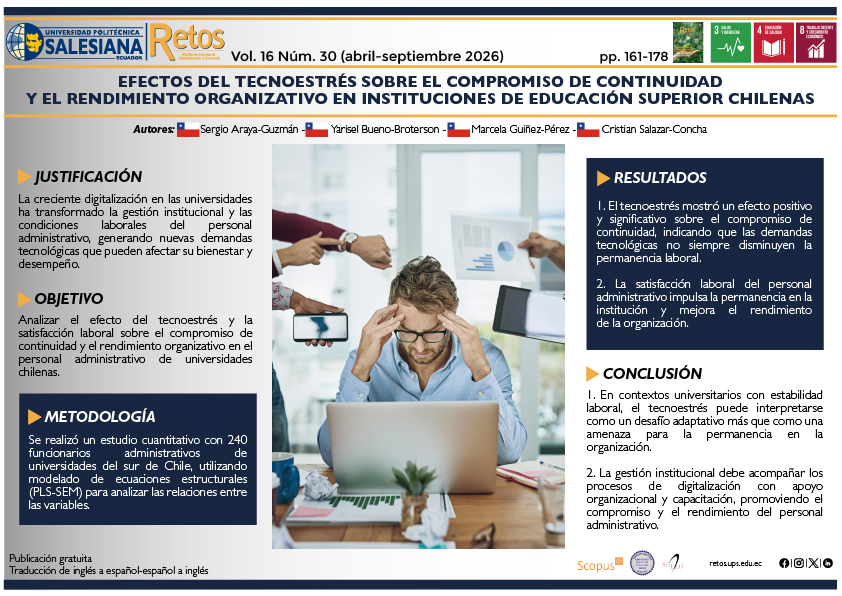
In the digital age, the use of multiple technologies and the need to continuously adapt to different tools and platforms generate new pressures and demands for workers. In this context, the present study examines the effect of technostress and job satisfaction influence in continuance commitment and organizational performance in Chilean universities. To this end, a questionnaire previously adapted and validated from previous studies was administered to civil servants and administrative staff at universities in southern Chile who use digital technologies in their work. A total of 240 valid responses were obtained and analyzed using structural equations (PLS-SEM). The results show that technostress has a positive and significant effect on commitment to continuity, an atypical finding that contradicts the prevailing literature, which traditionally associates technostress with negative consequences on work attitudes. In addition, it was confirmed that job satisfaction is a determining factor in linking commitment and organizational performance. These findings contribute to the literature on technostress in university settings by demonstrating that, under certain institutional conditions, technostress can coexist with attitudes of adaptation and job retention. In addition, the results offer relevant information for promoting digitization strategies aimed at strengthening job satisfaction and people management in digitized environments.
Article Details

This work is licensed under a Creative Commons Attribution-NonCommercial-ShareAlike 4.0 International License.
Authorship: The list of authors signing must include only those people who have contributed intellectually to the development of the work. Collaboration in the collection of data is not, by itself, a sufficient criterion of authorship. "Retos" declines any responsibility for possible conflicts arising from the authorship of the works that are published.
Copyright: The Salesian Polytechnic University preserves the copyrights of the published articles, and favors and allows their reuse under the Creative Commons Attribution-NonCommercial-ShareAlike 3.0 Ecuador license. They may be copied, used, disseminated, transmitted and publicly displayed, provided that: i) the authorship and the original source of their publication (journal, editorial and work URL) are cited; (Ii) are not used for commercial purposes; Iii) mention the existence and specifications of this license.
References
Al-Ansari, M. A. y Alshare, K. (2019). The impact of technostress components on the employee’s satisfaction and perceived performance: The case of Qatar. Journal of Global Information Management, 27(3), 65-86. https://doi.org/10.4018/JGIM.2019070104
Alcas, N., Alarcón, H. H., Venturo, C. O., Alarcón, M. A., Fuentes, J. A. y López, T. I. (2019). Tecnoestrés docente y percepción de la calidad de servicio en una Universidad privada de Lima. Propósitos y Representaciones, 231-247. https://doi.org/10.20511/pyr2019.v7n3.388
Arce, L. y Rojas, K. (2020). Satisfacción laboral y estrés en teletrabajadores y trabajadores presenciales de una universidad estatal de Costa Rica. Cuadernos de Investigación, 12(2). https://doi.org/10.22458/urj.v12i2.3141
Becker, H. S. (1960). Notes on the concept of commitment. American Journal of Sociology, 66(1), 32-40. https://doi.org/10.1086/222820
Bueno-Broterson, Y., Araya-Guzmán, S. y Salazar-Concha, C. (2025). Gestión del conocimiento y rendimiento organizativo: Un análisis en el contexto educativo chileno. Prometeica - Revista de Filosofía y Ciencias, 32(19799), 1-22. https://doi.org/10.34024/prometeica.2025.32.19799
Califf, C. B., Sarker, S. y Sarker, S. (2015). The bright and dark sides of technostress: A mixed-methods study involving healthcare IT. MIS Quarterly, 39(3), 641-670.
Cardona, J. & Calderón, G. (2006). El impacto del aprendizaje en el rendimiento de las organizaciones. Cuadernos de Administración Bogotá, 19(32), 11-43. https://bit.ly/46U4Irm
Chiang-Vega, M., Hidalgo-Ortiz, J. P. & Gómez-Fuentealba, N. (2021). Efecto de la satisfacción laboral y la confianza sobre el clima organizacional, mediante ecuaciones estructurales. Retos: Revista de Ciencias de la Administración y Economía, 11(22), 347-362. https://doi.org/10.17163/ret.n22.2021.10
Cohen, J. (1988). Statistical power analysis for the behavioral sciences (2nd ed.). Lawrence Erlbaum Associates. https://doi.org/10.4324/9780203771587
Cuervo-Carabel, T., Meneghel, I., Orviz-Martínez, N. y Arce-García, S. (2020). Nuevos retos asociados a la tecnificación laboral: el tecnoestrés y su gestión a través de la Psicología Organizacional Positiva. Aloma: Revista de Psicología, Ciències de l'educación i de l’Esport, 38(1), 21-30. https://bit.ly/4aAUfDt
Comisión Económica para América Latina y el Caribe. (2021). La educación en tiempos de la pandemia de COVID-19. Naciones Unidas.
De Oliveira, R., Malaquias, F. F. y Teles, G. (2025). Technostress and remote work: Understanding underlying factors of role ambiguity. Journal of Technology Management & Innovation, 20(1), 45-58. https://bit.ly/4cM0W71
El Kiassi, R. y Jahidi, A. (2023). Technostress: A concept analysis. International Journal of Accounting, Finance, Auditing, Management and Economics, 4(5), 119-131. https://bit.ly/3P2SUNe
García-Tamariz, P. E., Mansilla-Mahmud, M. A. & Mateo-Dueñas, R. (2024). Compromiso con la tarea y satisfacción laboral: evidencia en el sector comercial peruano. Retos Revista de Ciencias de la Administración y Economía, 14(28), 203-220. https://doi.org/10.17163/ret.n28.2024.02
Gutterman, A. S. (2023). Organizational Performance and Effectiveness. SSRN.
https://doi.org/10.2139/ssrn.4532570
Hair, J. F., Sarstedt, M., Ringle, C. M. y Gudergan, S. P. (2017). Advanced issues in partial least squares structural equation modeling. Sage publications. https://bit.ly/3N2O7Le
Harunavamwe M. y Ward, C. (2022). The influence of technostress, work–family conflict, and perceived organizational support on workplace flourishing amidst COVID-19. Frontiers, 1-17. https://doi.org/10.3389/fpsyg.2022.921211
Henseler, J., Ringle, C. M. y Sarstedt, M. (2015). A new criterion for assessing discriminant validity in variance-based structural equation modeling. Journal of the Academy of Marketing Science, 43(1), 115-135. https://doi.org/10.1007/s11747-014-0403-8
Heo, E. J. y Jung, M.S. (2020). Effects of Nurses' Technostress on Organizational Performance. The Korean Journal of Health Service Management, 14(3), 15-30. https://doi.org/10.12811/kshsm.2020.14.3.015
Hernández, B. G., Guerrero, P., Gómez, H., y Ramírez, K. (2024). Satisfacción laboral y rendimiento laboral en el rendimiento de colaboradores en organizaciones bancarias de México. Revista Venezolana De Gerencia, 29(107), 1144-1158. https://doi.org/10.52080/rvgluz.29.107.10
Herrera-Sánchez, M. J., Casanova Villalba, C. I., Moreno-Novillo, Á. C., y Mina Bone, S. G. (2024). Tecnoestrés en docentes universitarios con funciones académicas y administrativas en Ecuador. Revista Venezolana De Gerencia, 29(Especial 11), 606-621. https://doi.org/10.52080/rvgluz.29.e11.36
Herrera-Sánchez, M. J., Casanova-Villalba, C. I., Bravo Bravo, I. F. y Barba Mosquera, A. E. (2023). Estudio comparativo de las desigualdades en el tecnoestrés entre instituciones de educación superior en América Latina y Europa. Código Científico Revista de Investigación, 4(2), 1288-1303. https://doi.org/10.55813/gaea/ccri/v4/n2/287
Hessari, F., Daneshmandi, F. y Nategh, T. (2024). Examining the Impact of Technostress on Perceived Organizational Commitment: The Mediating Role of Individual Innovation. International Journal of Business and Applied Economics, 3(4), p803-824. https://doi.org/10.55927/ijbae.v3i4.9617
Iqbal, T., Ahmad, M. y Alnuaimi, M. (2025). Enhancing higher education institutions’ performance: The role of quality management initiatives. SAGE Open. https://doi.org/10.1177/21582440251358980
Kot, P. (2022). Role of technostress in job satisfaction and work engagement in people working with information and communication technologies. Pakistan Journal of Psychological Research, 37(3), 331-349. https://doi.org/10.33824/PJPR.2022.37.3.20
Kumar, P. S. (2024). Technostress: A comprehensive literature review on dimensions, impacts, and management strategies. Computers in Human Behavior Reports, 16(100475). https://doi.org/10.1016/j.chbr.2024.100475
Magno, D., Siqueria, A. C., Wagner, E., Popadiuk, S. y Gouveia, R. (2020). A relationship between technostress, satisfaction at work, organizational commitment and demography: evidence from the Brazilian public sector. Revista Gestão & Tecnologia, 20(4), 176-201. https://doi.org/10.20397/2177-6652/2020.v20i4.1919
Molino, M., Ingusci, E., Signore, F., Manuti, A., Giancaspro, M. L., Russo, V., Zito, M. y Cortese, C. G. (2020). Well-being costs of technology use during COVID-19 remote working: An investigation using the Italian translation of the technostress creator’s scale. Sustainability, 12(15). https://doi.org/10.3390/su12155911
Morais, C., Santos, J. y Costa, P. (2024). Explaining organizational commitment and job satisfaction: The moderating role of leadership congruency. Humanities and Social Sciences Communications, 11(1). https://doi.org/10.1057/s41599-024-03855-z
Mujtaba, T. y Reiss, M. (2013). Factors that lead to positive or negative stress in secondary school teachers of mathematics and science. Oxford Review of Education, 39(5), 627-648. https://doi.org/10.1080/03054985.2013.840279
Olvera, J., Triviño, E. y Bastidas, C. (2022). Technostress and job satisfaction in employees of a food company during the COVID-19 pandemic. Revista PSIDIAL: Psicología y Diálogo de Saberes, 1(1), 39-59. https://doi.org/10.33936/psidial.v1i1.4299
Pedraza Melo, N. A., y González Cisneros, A. L. (2021). Capital humano, aprendizaje, satisfacción y compromiso en el desempeño de instituciones educativas. Revista Venezolana de Gerencia, 26(96), 1019-1040. https://doi.org/10.52080/rvgluz.26.96.3
Pedraza, N. A. (2020). Satisfacción laboral y compromiso organizacional del capital humano en el desempeño en instituciones de educación superior. RIDE Revista Iberoamericana para la Investigación y el Desarrollo Educativo, 10(20). https://doi.org/10.23913/ride.v10i20.595
Ragu-Nathan, T. S., Tarafdar, M., Nathan, R. y Tu, Q. (2008). The Consequences of Technostress for End Users in Organizations: Conceptual Development and Empirical Validation. Information Systems Research, 19(4), 417-433. https://doi.org/10.1287/isre.1070.0165
Saavedra, C. (2023). Eustrés y Distrés: Revisión Sistemática de la Literatura. Cuadernos Hispanoamericanos de Psicología, 22(2), 1-17. https://bit.ly/3OyUdU5
Saidy, C., Al-Ghaith, W. y Alshehri, A. (2022). Technostress creators and job performance among ICT users. Frontiers in Psychology, 13. https://doi.org/10.3389/fpsyg.2022.827027
Salanova, M. (2003). Trabajando con tecnologías y afrontando el tecnoestrés: el rol de las creencias de eficacia. Revista de Psicología del Trabajo y de las Organizaciones, 19(3), 225-246. https://bit.ly/3OCSehy
Salazar-Concha, C., Ficapal-Cusí, P., Boada-Grau. J. y Camacho, L.J. (2022). Validation of the Spanish version of the Technostress Creators Scale in Chilean workers. Anales de Psicología / Annals of Psychology, 38(3), 518-529. https://doi.org/10.6018/analesps.509551
Santiago-Torner, C. (2023). Liderazgo ético y compromiso organizacional. El rol inesperado de la motivación intrínseca. Revista Universidad & Empresa, 25(45), 1-31. https://doi.org/10.12804/revistas.urosario.edu.co/empresa/a.13169
Subsecretaría de Telecomunicaciones. (2023). El 94,3% de los hogares en Chile declara tener acceso propio y pagado a internet. Gobierno de Chile.
Suresh, A. y Mohanty, S. (2023). Acceptance of e-learning in higher education: The role of task-technology fit with the information systems success model. Heliyon, 9(3). https://doi.org/10.1016/j.heliyon.2023.e13751
Taneja, A. y Singh, E. (2018). Impact of technostress on organizational commitment in information technology sector. Anusandhan The Research Repository of GIBS, 1(1), 75-79. https://bit.ly/4ayFtgA
Tarafdar, M., Cooper, C. L. y Stich, J. F. (2019). Techno eustress, techno distress and design: Theoretical directions and an agenda for research. Information Systems Journal, 29(1), 6-42. https://doi.org/10.1111/isj.12169
Tarafdar, M., Pullins, E. y Ragu-Nathan, T. (2015). Technostress: negative effect on performance and possible mitigations. Information Systems Journal, 25, 103-132. https://doi.org/10.1111/isj.12042
Valenzuela, L. y Martínez, C. (2015). Orientación al cliente, tecnologías de información y desempeño organizacional: Caso empresa de consumo masivo en Chile. Revista Venezolana de Gerencia, 20(70), 334-352. https://www.redalyc.org/pdf/290/29040281009.pdf
Wang, G.-X. y Rashid, A. M. (2022). Job satisfaction as the mediator between a learning organization and organizational commitment among lecturers. European Journal of Educational Research, 11(2), 847-858. https://doi.org/10.12973/eu-jer.11.2.847
Zumayyah, A., Zugiyo, Y. y Nuzulia, S. (2023). Early childhood teacher job satisfaction in terms of technostress and work-family conflict in Indonesia. Journal Pendidikan Usia Dini, 17(1), 120-133. https://doi.org/10.21009/JPUD.171.09