

Micromobility App Adoption in Chile: Extended TAM and Collaborative Consumption
Article Sidebar
Main Article Content
Abstract
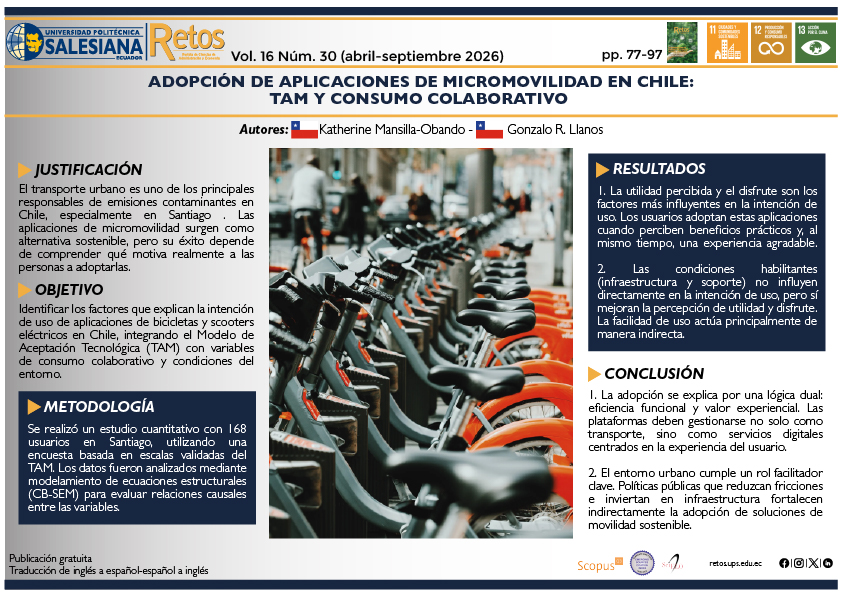
Sustainable consumption has become an essential aspect of business, raising awareness of environmental care so that future generations can enjoy it. This study examines the factors that influence users’ intention to use sustainable micromobility applications (bikes and e-scooters) in Chile, integrating the Technology Acceptance Model (TAM) with collaborative consumption perspectives. The proposed model deepens the understanding of consumer behavior in the adoption of mobile applications by integrating insights from collaborative consumption and the Technology Acceptance Model (TAM), thereby offering meaningful contributions to the existing literature on sustainable mobility and digital platforms. Based on data from 168 users in Chile and using a covariance-based structural equation model (CB-SEM), this study finds that perceived usefulness and enjoyment play the most important roles in influencing the intention to adopt sustainable transportation. This provides valuable insights into consumer preferences and behavior in Chile, which may be beneficial to mobile application companies already established or seeking to expand in the country. Moreover, the study offers implications for policymakers concerned with transportation planning, environmental sustainability, and the development of smart cities in emerging economies. In addition, this study presents several limitations and outlines avenues for future research aimed at deepening the analysis of sustainable transportation adoption in different socio-economic and technological contexts.
Article Details

This work is licensed under a Creative Commons Attribution-NonCommercial-ShareAlike 4.0 International License.
Authorship: The list of authors signing must include only those people who have contributed intellectually to the development of the work. Collaboration in the collection of data is not, by itself, a sufficient criterion of authorship. "Retos" declines any responsibility for possible conflicts arising from the authorship of the works that are published.
Copyright: The Salesian Polytechnic University preserves the copyrights of the published articles, and favors and allows their reuse under the Creative Commons Attribution-NonCommercial-ShareAlike 3.0 Ecuador license. They may be copied, used, disseminated, transmitted and publicly displayed, provided that: i) the authorship and the original source of their publication (journal, editorial and work URL) are cited; (Ii) are not used for commercial purposes; Iii) mention the existence and specifications of this license.
References
Akel, G. y Bayır, T. (2025). The role of perceived consumer value dimensions in predicting behavioral intention toward car-sharing: An empirical study based on the extended technology acceptance model. Entertainment Computing, 54, 100967. https://doi.org/10.1016/j.entcom.2025.100967
Anthony Jr., B. (2023). Data enabling digital ecosystem for sustainable shared electric mobility-as-a-service in smart cities—An innovative business model perspective. Research in Transportation Business & Management, 51, 101043. https://doi.org/10.1016/j.rtbm.2023.101043
Ashraf, A. R., Thongpapanl, N. y Auh, S. (2014). The application of the technology acceptance model under different cultural contexts: The case of online shopping adoption. Journal of International Marketing, 22(3), 68-93. https://doi.org/10.1509/jim.14.0065
Bibri, S. E. (2020). Data-driven smart eco-cities of the future: An applied analytical framework. Sustainable Cities and Society, 52, 101873. https://doi.org/10.1016/j.scs.2019.101873
Brilhante, O. y Klaas, J. (2018). Green city concept and a method to measure green city performance over time applied to fifty cities globally. Sustainability, 10(6), 2073. https://doi.org/10.3390/su10062073
Çallı, L. y Çallı, B. A. (2024). Value‐centric analysis of user adoption for sustainable urban micro‐mobility transportation through shared e‐scooter services. Sustainable Development, 32(6), 6408-6433.
Camero, A., and Alba, E. (2019). Smart City and information technology: A review. Cities, 93, 84–94. https://doi.org/10.1016/j.cities.2019.04.014
Coppola, P. y Lobo, A. (2022). Inclusive and collaborative advanced transport: are we really heading to sustainable mobility? European Transport Research Review, 14(46). https://doi.org/10.1186/s12544-022-00570-1
Cristancho-Triana, G. J., Cancino-Gómez, Y. A. y Ninco-Hernández, F. A. (2024). Factores que influyen en el comportamiento de consumo sostenible en la generación Z. Retos Revista de Ciencias de la Administración y Economía, 14(27), 51-67. https://doi.org/10.17163/ret.n27.2024.04
Da Silveira, A. B., Levrini, G. R. D. y Ertz, M. (2021). How Digital Platforms Materialize Sustainable Collaborative Consumption: A Brazilian and Canadian Bike-Sharing Case Study. Journal of International Consumer Marketing, 34(1), 51–71. https://doi.org/10.1080/08961530.2021.1907828
Davis, F. D., Bagozzi, R. P. y Warshaw, P. R. (1989). User acceptance of computer technology: A comparison of two theoretical models. Management Science, 35(8), 982-1003. https://doi.org/10.1287/mnsc.35.8.982
Davis, F. D. (1985). A technology acceptance model for empirically testing new end-user information systems: Theory and results (Tesis doctoral). MIT Sloan School of Management.
Davis, F. D., Bagozzi, R. P. y Warshaw, P. R. (1992). Extrinsic and Intrinsic Motivation to Use Computers in the Workplace. Journal of Applied Social Psychology 22(14), 1111-1132. https://doi.org/10.1111/j.1559-1816.1992.tb00945
De Souza Bido, D. y Da Silva, D. (2019). SmartPLS 3: especificação, estimação, avaliação e relato. Administração: Ensino e Pesquisa, 20(2), 488-536. https://doi.org/10.13058/raep.2019.v20n2.1545
Diario Sustentable (2019). Grin llega a Chile con su servicio de scooters eléctricos. https://goo.su/znfzTm
Elassy, M., Al-Hattab, M., Takruri, M. y Badawi, S. (2024). Intelligent transportation systems for sustainable smart cities. Transportation
Engineering, 16, 100252. https://doi.org/10.1016/j.treng.2024.100252
Hair Jr., J. F., Black, W. C., Babin, B. J. y Anderson, R. E. (2010). Multivariate Data Analysis (7th ed.), Pearson Education, New York.
IESE Business School. (2022). IESE cities in motion index 2022. https://bit.ly/4rs4ChX
Jabareen, Y. (2006). Sustainable urban forms: Their typologies, models, and concepts. Journal of Planning Education and Research, 26(1), 38-52. https://doi.org/10.1177/0739456X05285119
Karami, A., Allahviranloo, M. y Samadzad, M. (2025). The impacts of personality traits on the acceptance of shared e-scooters: Evidence from Tehran. Cities, 158, 105633. https://doi.org/10.1016/j.cities.2024.105633
Khan, Z. (2006). Cities and sustainability: Urban ecology perspectives. Urban Studies, 43(3), 457-475. https://doi.org/10.1080/00420980500456201
King, W. R. y He, J. (2006). A meta-analysis of the technology acceptance model. Information & Management, 43(6), 740-755. https://doi.org/10.1016/j.im.2006.05.003
Kwong, K. K. K. (2013). Partial least squares structural equation modeling (PLS-SEM) techniques using SmartPLS. Marketing bulletin, 24(1), 1-32. https://bit.ly/4cF0NT6
Legris, P., Ingham, J. y Collerette, P. (2003). Why do people use information technology? A critical review of the technology acceptance model. Information & Management, 40(3), 191-204. https://doi.org/10.1016/S0378-7206(01)00143-4
Llanos, G.; Guiñez-Cabrera, N., Mansilla-Obando, K., Gómez-Sotta, E., Buchuk, P., Altamirano, M. y Alviz, M. (2023). Collaborative Consumption in an Emerging Market: What Motivates Consumers to Adopt It under Economic and Political Uncertainty? Sustainability, 15(21), 15482. https://doi.org/10.3390/su152115482
Ministerio del Medio Ambiente. (2023). Inventario nacional de gases de efecto invernadero de Chile 1990–2020: Informe del inventario nacional 2022. Gobierno de Chile. https://bit.ly/4uqH1RK
Ozmen, M. (2023). Examining micromobility adoption with structural equation modeling: An extended TAM approach. Journal of Transport and Land Use, 16(1), 324-345. https://doi.org/10.5198/jtlu.2023.2121
Palos, A., Martínez, J. y Rivera, J. (2019). Technology Acceptance Model (TAM) in Latin America: A systematic review. Journal of Theoretical and Applied Electronic Commerce Research, 14(3), 58-75. https://doi.org/10.4067/S0718-18762019000300105
Pamidimukkala, A., Kermanshachi, S., Rosenberger, J. M. y Hladik, G. (2025). Utilizing extended theory of planned behavior to evaluate consumers’ adoption intention of electric vehicles. Green Energy and Intelligent Transportation, 100258. https://doi.org/10.1016/j.geits.2025.100258
Razali, N. N., Anuar, M. M. y Ngah, A. H. (2021). Green value and sustainable transportation engagement: The mediating role of attitude. Management Science Letters, 11(3), 547-554. https://bit.ly/4s68Jlc
Rejali, S., Aghabayk, K., Mohammadi, A. y Shiwakoti, N. (2021). Assessing a priori acceptance of shared dockless e-scooters in Iran. Transportation Research Part D: Transport and Environment, 100, 103042. https://doi.org/10.1016/j.trd.2021.103042
Roseland, M. (1997). Dimensions of the eco-city. Cities, 14(4), 197202. https://doi.org/10.1016/S0264-2751(97)00003-6
Saad, M. M., Ibrahim, M. A. y El Sayad, Z. M. (2017). Eco-city as approach for sustainable development. American Academic Scientific Research Journal for Engineering, Technology, and Sciences, 28(1), 54-74. https://bit.ly/40kjy71
Sachs, J. D., Lafortune, G. y Fuller, G. (2024). Sustainable Development Report 2024: The SDGs and the UN Summit of the Future. Sustainable Development Solutions Network. https://bit.ly/4bcBsgQ
Suryawan, I. W. K., Suhardono, S., Lee, C. H., Rahman, A. y Ulhasanah, N. (2026). Adoption dynamics of e-scooters from a consumer perspective towards sustainable urban mobility. Travel Behaviour and Society, 43, 101178. https://doi.org/10.1016/j.tbs.2025.101178
Siriwardana, M. y Nong, D. (2021). Nationally Determined Contributions (NDCs) to decarbonise the world: A transitional impact evaluation. Energy Economics, 97, 105184. https://doi.org/10.1016/j.eneco.2021.105184
Thompson, R. L., Higgins, C. A. y Howell, J. M. (1991). Personal computing: Toward a conceptual model of utilization. MIS quarterly, 125-143. https://doi.org/10.2307/249443
Uber Newsroom (2021). Lime scooters de Lime se suman a la plataforma de Uber en Chile. https://bit.ly/4bifkBN
United Nations (2018). World Urbanization Prospects: the 2018 Revision. United Nations Department of Economic and Social Affairs. https://bit.ly/4bmn5qr
Venkatesh, V., Morris, M. G., Davis, G. B. y Davis, F. D. (2003). User acceptance of information technology: Toward a unified view. MIS quarterly, 425-478. https://doi.org/10.2307/30036540
Wang, H. (2018). Urban ecology and sustainable city development. Sustainability, 10(5), 1–14. https://doi.org/10.3390/su10051352
Winkler, L., Pearce, D., Nelson, J. y Babacan, O. (2023). The effect of sustainable mobility transition policies on cumulative urban transport emissions and energy demand. Nature Communications, 14(1), 2357. https://doi.org/10.1038/s41467-023-37728-x
Wu, R., Wu, Z., Wen, J., Cai, Y. y Li, Y. (2019). Extrinsic and intrinsic motivations as predictors of bicycle sharing usage intention: An empirical study for Tianjin, China. Journal of Cleaner Production, 225, 451–458. https://doi.org/10.1016/j.jclepro.2019.04.016
Zhang, Y., Li, Z. y Yang, L. (2015). Tourist motivations for cycling in urban environments. Journal of Sustainable Tourism, 23(4), 557–576. https://doi.org/10.1080/09669582.2014.987903
Zhu, J., Xie, N., Cai, Z., Tang, W. y Chen, X. (2023). A comprehensive review of shared mobility for sustainable transportation systems. International Journal of Sustainable Transportation. Journal of Sustainable Transportation, 17(5), 527-551. https://doi.org/10.1080/15568318.2022.2054390