

Modelos de comunicación para la sostenibilidad: un estudio comparativo en Chile, Colombia y Ecuador
Barra lateral del artículo
Contenido principal del artículo
Resumen
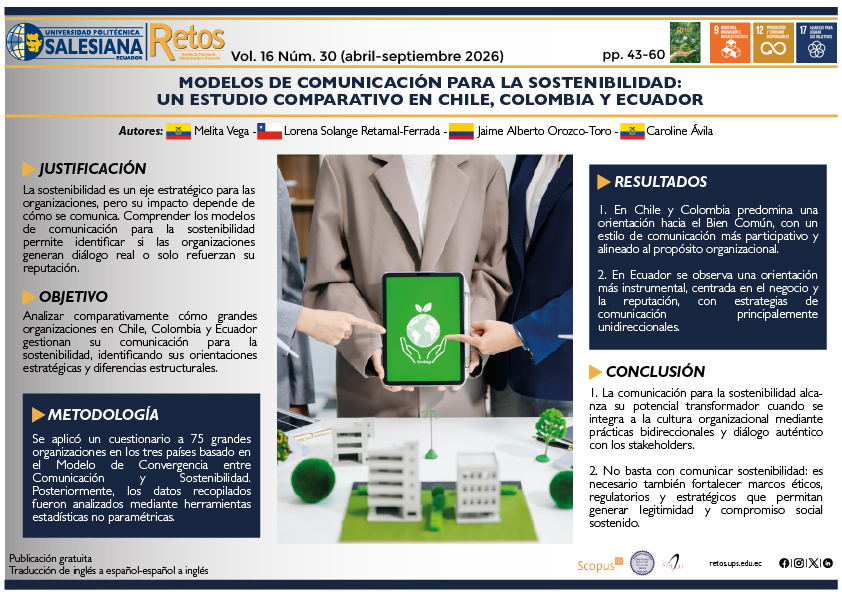
Este estudio analiza los contextos comunicacionales en los que grandes organizaciones de Chile, Colombia y Ecuador gestionan su comunicación para la sostenibilidad, así como sus principales características, orientaciones estratégicas y diferencias estructurales en el ámbito organizacional latinoamericano. Se adoptó una metodología cuantitativa de tipo no experimental mediante la aplicación de un cuestionario a 75 organizaciones de los tres países. El instrumento se basó en el Modelo de Convergencia de Comunicación y Sostenibilidad, el cual evalúa el nivel de integración de las prácticas sostenibles de las organizaciones, sus formatos comunicacionales y relaciones con los públicos. Los resultados muestran un reconocimiento general sobre el valor estratégico de la sostenibilidad, pero con variaciones en su implementación e impacto en cada país. Las organizaciones chilenas y colombianas ejecutan principalmente modelos comunicativos simétricos y participativos en los que la sostenibilidad se alinea con el propósito institucional mediante diálogos con los públicos. En contraste, las organizaciones ecuatorianas muestran una orientación más instrumental en sus prácticas con diálogos unidireccionales centradas en el fortalecimiento de la reputación corporativa y cumplimiento de objetivos comerciales. Estas diferencias se deben a factores como la madurez de los marcos regulatorios, la presión social y la trayectoria institucional en materia de sostenibilidad. El estudio concluye que la comunicación para la sostenibilidad alcanza su potencial transformador cuando es integrada a la cultura organizacional junto con prácticas de comunicación bidireccionales.
Detalles del artículo

Esta obra está bajo una licencia internacional Creative Commons Atribución-NoComercial-CompartirIgual 4.0.
Autoría: La lista de autores firmantes debe incluir únicamente a aquellas personas que hayan contribuido intelectualmente al desarrollo del trabajo. La colaboración en la recogida de datos no es, por sí misma, criterio suficiente de autoría. "Retos" declina toda responsabilidad por posibles conflictos derivados de la autoría de los trabajos que se publiquen.
Derechos de autor: La Universidad Politécnica Salesiana preserva los derechos de autor de los artículos publicados, y favorece y permite su reutilización bajo la licencia Creative Commons Attribution-NonCommercial-ShareAlike 3.0 Ecuador. Pueden ser copiados, utilizados, difundidos, transmitidos y expuestos públicamente, siempre y cuando: i) se cite la autoría y la fuente original de su publicación (revista, editorial y URL del trabajo); (Ii) no se utilicen con fines comerciales; Iii) se mencione la existencia y especificaciones de esta licencia.
Referencias
Acevedo-Duque, Á., Álvarez-Herranz, A. P. y Artigas, W. (2023). Contribución a la marca país a través de la sostenibilidad de los procesos productivos en Chile: Empresas B Corp. Retos Revista de Ciencias de la Administración y Economía, 13(26), 253-271. https://doi.org/10.17163/ret.n26.2023.05
Aguado Moralejo, I., Echebarria Miguel, C. y Barrutia Legarreta, J. (2009). El desarrollo sostenible a lo largo de la historia del pensamiento económico. Revista de Economía Mundial, 21, 87-110. https://www.redalyc.org/pdf/866/86611886004.pdf
Austin, J. E., Reficco, E. y equipo de investigación SEKN. (2005). Aspectos clave de la colaboración. En J. E. Austin et al., Alianzas sociales en América Latina: Enseñanzas extraídas de colaboraciones entre el sector privado y organizaciones de la sociedad civil (pp. 29–67). Banco Interamericano de Desarrollo. http://dx.doi.org/10.18235/0012473
Barrio-Fraile, E., Enrique, A. M., Freire-Sánchez, A. y Vidal-Mestre, M. (2024). Análisis conceptual del propósito corporativo: sostenibilidad, RSC, ODS y comunicación. Cuadernos.info, 59, 251-272. https://doi.org/10.7764/cdi.59.75543
Bartlett, J., Tywoniak, S. y Hatcher, C. (2007). Public relations professional practice and the institutionalisation of CSR. Journal of Communication Management, 11(4), 281-299. https://doi.org/10.1108/13632540710843904
Bauman, Z. (2010). Mundo consumo: Ética del individuo en la aldea global. Paidós
Bettiol, M., Buoso, G. y Di María, E. (2024). Sustainability strategies in clusters and the role of communication. Investigaciones Regionales – Journal of Regional Research, 60(3), 39-54. https://doi.org/10.38191/iirr-jorr.24.022
Bondi, M. y Turnbull, J. (2025). Negotiating the good and bad in CSR reports: Sustainability in the railway sector. Language & Dialogue, 15(2), 282-304. https://doi.org/10.1075/ld.00196.bon
Carvajal-Ordoñez, V. F., Mosquera Abadía, H. A. y Espinosa, M. T. (2025). Clima laboral como estrategia de desarrollo sostenible en la industria 5.0. European Public & Social Innovation Review, 10, 1–15. https://doi.org/10.31637/epsir-2025-1955
Clow, K. E. y James, K. E. (2014). Marketing scales. En Marketing scales (pp. 284-321). SAGE Publications. https://doi.org/10.4135/9781483384726.n10
Cortina, A. (2005). Ética de la empresa: Claves para una nueva cultura empresarial. Trotta
Costa-Sánchez, C. y Peñafiel-Saiz, C. (2024). Comunicación del compromiso social y para la sostenibilidad. Análisis multifocal y tendencias. El Profesional de la Información, 33(3), 1-9. https://doi.org/10.3145/epi.2024.0301
Durán González, A. M. y Mosquera López, P. (2016). Correspondencia de los modelos de relaciones públicas a distintos contextos evolutivos de responsabilidad social empresarial. Revista Internacional de Relaciones Públicas, 6(11), 5-26. https://doi.org/10.5783/revrrpp.v6i11.397
Durán, A. M., Mosquera, P. y Vega, M. (2017). Analysis of public relations management as a sustainable pillar in Ecuadorian organizations in different contexts. En Corporate social responsibility and corporate governance (pp. 199-222). Emerald Publishing Limited. https://doi.org/10.1108/S2043-052320170000011010
Eljadue Pérez, I., Mejía Reátiga, C., Zapata Domínguez, Á. y Betancourt Rodríguez, L. (2024). Análisis de la relación sostenibilidad-turismo cultural como motor de desarrollo. Revista Lasallista de Investigación, 21(1), 189-208. https://doi.org/10.22507/rli.v21n1a11
Estanyol, E., Lalueza, F. y Compte-Pujol, M. (2025). Comunicar la responsabilidad social corporativa en la era de la desinformación: Una aproximación a las agencias de relaciones públicas en España. Palabra Clave, 28(S1), e28s114. https://doi.org/10.5294/pacla.2025.28.s1.14
Fernández Vallejo, A. M. (2023). Visual strategies of sustainability communication on corporate webpages: A critical multimodal discourse analysis in the hospitality sector. Ibérica, 45, 109-137. https://doi.org/10.17398/2340-2784.45.109
Foladori, G. y Tommasino, H. (2000). El concepto de desarrollo sustentable treinta años después. Desenvolvimento e Meio Ambiente, 1, 41-56. https://doi.org/10.5380/dma.v1i0.3056
Garriga, E. y Melé, D. (2004). Corporate social responsibility theories: Mapping the territory. Journal of Business Ethics, 53(1-2), 51-71. https://doi.org/10.1023/B:BUSI.0000039399.90587.34
Grunig, J. E. y Hunt, T. (2000). Dirección de relaciones públicas. Editorial Gestión 2000.
Heredia, L. y Sullca-Tapia, J. P. (2022). Comunicación, trabajo en equipo y compromiso organizacional en universidades públicas. Revista Venezolana de Gerencia, 27(8), 926-938. https://doi.org/10.52080/rvgluz.27.8.13
Ibáñez-Hernández, A., Carretón-Ballester, C. y Papí-Gálvez, N. (2025). Responsibility of the pharmaceutical industry: Sustainability and communication with publics. Catalan Journal of Communication & Cultural Studies, 17(1), 61-87. https://doi.org/10.1386/cjcs_00104_1
Kim, H., Xu, H. y Rim, H. (2024). ‘We care about how you dialogue with your employees’: The effects of bottom-up CSR through the lens of dialogic communication. Journal of Public Relations Research, 36(3). https://doi.org/10.1080/1062726X.2023.2215886
Leff, E. (2004). Racionalidad ambiental: La reapropiación social de la naturaleza. Siglo XXI
Mendoza-Solis, M., García-Alcaraz, J. L. y Sánchez-Ramírez, C. (2025). Influencia del liderazgo transaccional y transformacional en el desempeño social, ambiental y operativo. Retos Revista de Ciencias de la Administración y Economía, 15(30), 311-326. https://doi.org/10.17163/ret.n30.2025.07
Miller, B., Austin, L. y Schulz, M. (2018). Delineating CSR and Social Change: Querying Corporations as Actors for Social Good. Public Relations Inquiry, 7(1), 45-61. https://doi.org/10.1177/2046147X17743544
Morillo Sánchez, J. H. (2024). Entropía de la información como barrera comunicacional en la praxis gerencial. Revista de Investigación Educativa (REDINE), 16(2), 79-89. https://doi.org/10.5281/zenodo.12559333
Oliver-González, A. B. y Martín-Herrero, J. M. (2025). Asuntos públicos como herramienta de comunicación e imagen corporativa. European Public & Social Innovation Review, 10, 1-17. https://doi.org/10.31637/epsir-2025-484
Orozco Toro, J. A., Vega, M., Retamal-Ferrada, L., Ávila, C. y Durán, A. M. (2023). Comunicar para el bien común. El enfoque estratégico de la comunicación para la sostenibilidad en Ecuador, Colombia y Chile. Palabra Clave, 26(4), e2641. https://doi.org/10.5294/pacla.2023.26.4.1
Overton, H., Harrison, V. y Eng, N. (2022). CSR communication and legitimacy creation. En The Routledge handbook of corporate social responsibility communication (pp. 283-295). Routledge. https://doi.org/10.4324/9781003184911-28
Pinzón-Castro, S. Y. y Maldonado-Guzmán, G. (2023). Efectos de la cultura sustentable en la RSE y el desempeño financiero en la industria manufacturera. Retos Revista de Ciencias de la Administración y Economía, 13(26), 191-203. https://doi.org/10.17163/ret.n26.2023.01
Porter, M. E. y Kramer, M. (2006). Strategy and society: The link between competitive advantage and corporate social responsibility. Harvard Business Review, 84(12), 78-92
Quiles-Soler, C., Carretón-Ballester, C., Lorenzo-Sola, F. y González-Díaz, C. (2025). The 2030 agenda in Spanish universities: Sustainability and its communication. Revista de Comunicación, 24(1), 431-454. https://doi.org/10.26441/RC24.1-2025-3784
Roper, J. (2012). Environmental risk, sustainability discourses, and public relations. Public Relations Inquiry, 1(1), 69-87. https://doi.org/10.1177/2046147X11422147
S
achs, J. (2016). La era del desarrollo sostenible. Planeta
Schmeltz, L. (2017). Getting CSR communication fit: A study of strategically fitting cause, consumers and company in corporate CSR communication. Public Relations Inquiry, 6(1), 47–72. https://doi.org/10.1177/2046147X16666731
Sedovs, E., Volkova, T. y Ludviga, I. (2025). Sustainable development and strategic management: What is on the horizon in our non-ergodic world? Sustainable Futures, 9, e100414. https://doi.org/10.1016/j.sftr.2024.100414
Tchupo, D. E. y Macht, G. A. (2023). Entropy for team communication pattern recognition. Applied Ergonomics, 111. https://doi.org/10.1016/j.apergo.2023.104038
Wagner, D. A., Nair, T., Thapa, A. y Kumar, A. (2025). The Gini learning index: A new framework to measure learning inequality across contexts. International Journal of Educational Development, 119, 103433. https://doi.org/10.1016/j.ijedudev.2025.103433
Wedayanti, M. D., Anirwan, Ismail, Rustam, A., Laha, S. H., Idrus, I. A., Baharuddin, T., Rivai, N. I., Haris, A. y Ali, M. (2024). Policy design for sustainable development: A bibliometric study of ecological communications. International Journal of Sustainable Development and
Planning, 19(6), 2373-2379. https://doi.org/10.18280/ijsdp.190635
Weder, F. (2024). Sustainability as guiding principle of communicative action: The transformative and transformational potential of corporate sustainability communication as niche construction, a case from the energy sector. Corporate Communications: An International Journal. 30(2), 241-259. https://doi.org/10.1108/CCIJ-12-2023-0184
Weder, F., Krainer, L. y Karmasin, M. (eds.). (2021). The sustainability communication reader: A reflective compendium. Springer VS. https://doi.org/10.1007/978-3-658-31883-3