

University students’ perception of the entrepreneurial ecosystem and social entrepreneurial intention
Article Sidebar
Main Article Content
Abstract
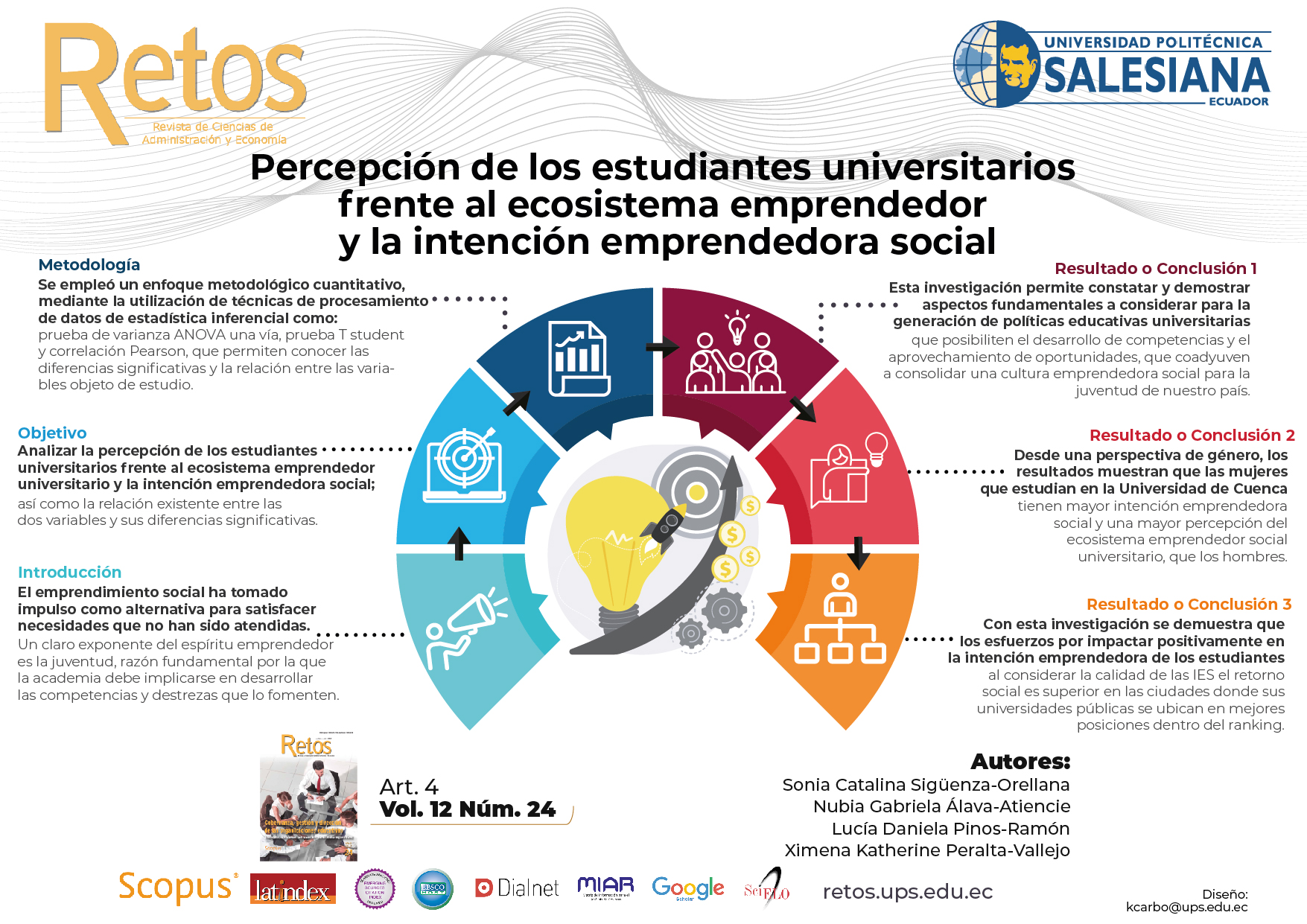
Entrepreneurship today has become a priority to promote the sustainability of countries. According to the Global Entrepreneurship Monitor, Ecuador
is the country with the highest level of entrepreneurship in Latin America. Specifically, social entrepreneurship has gained momentum as an alternative to satisfy needs that have not been addressed at the governmental level. In this context, the article analyzes the relationship and the significant differences between the
entrepreneurial ecosystem and the social entrepreneurial intention of the students of the University of Cuenca; using the variables gender and faculties as transversal
treatment. To meet this objective we worked with a representative sample of 856 students, which was filtered, generating a robust sample of 543 students.
The analysis of results used inferential statiscal techniques such as: ANOVA one way, Student´s t test and Pearson correlation, which show that there are no significant differences by sex in the students´ perception of the entrepreneurial ecosystem and the social enterpreneurial intention. In addition, students consider
that the entrepreneurial ecosystem differs among the twelve faculties, identifying the faculty of Dentistry and faculty of Arts with a suitable ecosystem compared
to the perception that more intervention is required in the ecosystem of the faculty of Philosophy and faculty of Jurisprudence. Finally, the positive relationship
between the two variables is an indicator that should be worked on in strategies to promote the social entrepreneurial culture at the university.
Article Details

This work is licensed under a Creative Commons Attribution-NonCommercial-ShareAlike 4.0 International License.
Authorship: The list of authors signing must include only those people who have contributed intellectually to the development of the work. Collaboration in the collection of data is not, by itself, a sufficient criterion of authorship. "Retos" declines any responsibility for possible conflicts arising from the authorship of the works that are published.
Copyright: The Salesian Polytechnic University preserves the copyrights of the published articles, and favors and allows their reuse under the Creative Commons Attribution-NonCommercial-ShareAlike 3.0 Ecuador license. They may be copied, used, disseminated, transmitted and publicly displayed, provided that: i) the authorship and the original source of their publication (journal, editorial and work URL) are cited; (Ii) are not used for commercial purposes; Iii) mention the existence and specifications of this license.
References
Ács, Z. J., Autio, E. y Szerb, L. (2014). National Systems of Entrepreneurship: Measurement issues and policy implications. Research Policy, 43(3), 476-494. https://doi.org/10.1016/j.respol.2013.08.016
Adekiya, A. A. y Ibrahim, F. (2016). Entrepreneurship intention among students. The antecedent role of culture and entrepreneurship training and development. The International Journal of Management Education, 14(2),116-132. https://doi.org/10.1016/j.ijme.2016.03.001
AEI (2014). Ecuador, un país Emprendedor e Innovador en el 2020. Estrategia para desarrollar un Ecosistema de Emprendimiento e Innovación. Alianza para el Emprendimiento e Innovación (AEI). https://bit.ly/2kYSwlz
Ajzen, I. (1991). The theory of planned behavior. Organizational Behavior and Human Decision Processes, 50, 179-211. https://doi.org/https://doi.org/10.1016/0749-5978(91)90020-T
Ali, M. A., Kabil, M., Alayan, R., Magda, R. y David, L. D. (2021). Entrepreneurship ecosystem performance in egypt: An empirical study based on the global entrepreneurship index (gei). Sustainability 13(13) (Switzerland). https://doi.org/10.3390/su13137171
Austin, J., Stevenson, H. y Wei-Skillern, J. (2012). Social and commercial entrepreneurship: same, different, ¿or both? Revista de Administração, 47(3), 370-384. https://doi.org/10.5700/rausp1055
Badler, C. E., Alsina, S. M., Puigsubirá, C. R. y Vitelleschi, M. S. (2005). Información faltante en experimentos biológicos. Una solución mediante imputación múltiple a través del programa SAS. FABICIB, 8(1), 79-87. https://doi.org/https://doi.org/10.14409/fabicib.v8i1.736
Baraldi, A. N. y Enders, C. K. (2010). An introduction to modern missing data analyses. Journal of School Psychology, 48(1), 5-37. https://doi.org/10.1016/J.JSP.2009.10.001
Braches, B. y Elliott, C. (2017). Articulating the entrepreneurship career: A study of German women entrepreneurs. International Small Business Journal: Researching Entrepreneurship, 35(5), 535-557. https://doi.org/10.1177/0266242616651921
Cadena, L. F. (2020). El aporte del emprendimiento social a la educación media técnica. Crescendo, 10(4), 653. https://doi.org/10.21895/incres.2019.v10n4.07
Campo-Ternera, L., Amar-Sepúlveda, P., Olivero Vega, E. y Huguett Herazo, S. (2019). Emprendimiento e innovación como motor del desarrollo sostenible: Estudio bibliométrico (2006-2016). Revista de Ciencias Sociales, 24(4), 26-37. https://doi.org/10.31876/rcs.v24i4.24907
Cantillo Campo, N., Pedraza Reyes, C. y Suárez Barros, H. (2021). Formación del emprendimiento social: Compromiso de la Universidad de la Guajira en Colombia. Revista de Ciencias Sociales (Ve), XXVII(1), 216-229. https://bit.ly/3wCaGuO
Chell, E. (2007). Social enterprise and entrepreneurship: Towards a convergent theory of the entrepreneurial process. International Small Business Journal, 25(1), 5-26. https://doi.org/10.1177/0266242607071779
Chin, W. (1998). The partial least squares approach for structural equation modeling. En G. A. Marcoulides (ed.), Modern methods for business research (pp. 295-336). Lawrence Erlbaum Associates Publishers. https://bit.ly/3QcCv45
CLADEA (2018). Desafíos y oportunidades para el emprendimiento femenino. https://bit.ly/3R0pQSW
Cortina, J. M. (1993). What is coefficient alpha? An examination of theory and applications. Journal of Applied Psychology, 78(1), 98-104. https://doi.org/10.1037/0021-9010.78.1.98
Cuesta, M., Fonseca-Pedrero, E., Vallejo, G. y Muñoz, J. (2013). Datos perdidos y propiedades psicométricas en los tests de personalidad. Anales de Psicología, 29(1), 285-292. https://doi.org/10.6018/analesps.29.1.137901
Detrinidad, E. (2018). Análisis factorial exploratorio y confirmatorio aplicado al modelo de secularización propuesto por Inglehart-Norris. Periodo 2010-2014 (Estudio de caso España, Estados Unidos, Alem ... Máster en Estadística Aplicada. Departamento de Estadística e Inv. 2014 (septiembre). https://doi.org/10.13140/RG.2.2.21000.26889
Díaz-Bretones, F. y Lejarriaga Pérez De Las Vacas, G. (2018). Emprendimiento social y empleabilidad. https://doi.org/10.5209/REVE.62962
Fournier, A. (2011). Emprendimiento social (Social Enterpreneurship) (July 27, 2011). Documentos de investigación, Administración de Empresas, No. 6, Available at SSRN: https://ssrn.com/abstract=2016601; http://dx.doi.org/10.2139/ssrn.2016601
Gálvez, R. y Suárez, M. (2019). El género como factor condicionante del emprendimiento en Andalucía. In emprendimiento e innovación: oportunidades para todos. https://bit.ly/3e1Mo75
Garavito, Y., García, S. y Calderón, J. (2021). La intención emprendedora y su relación con las características personales y del contexto de las mujeres universitarias The entrepreneurial intention and its correlation with personal characteristics and the external context of university women La intención. I+D Revista de Investigaciones, 16, 238-253. https://doi.org/http://dx.doi.org/10.33304/revinv.v16n1-2021019
GEI Report (2019). GEI_2019_Final-1. En Global Entrepreneurship Index 2019. https://doi.org/10.13140/RG.2.2.17692.64641
Giraldo-Mejía, W. y Vara Horna, A. (2018). El emprendimiento social de base universitaria en Latinoamérica ¿Están las universidades haciendo lo suficiente? https://bit.ly/3pR0Otg
Guerrero, M. y Santamaría, C. A. (2020). Ecosystem and entrepreneurial activity in Mexico: An exploratory analysis. Perfiles Latinoamericanos, 28(55), 227-251. https://doi.org/10.18504/pl2855-009-2020
Guzmán, A. y Trujillo, M. (2008). Emprendimiento social-revisión de literatura 1 Alexander Guzmán Vásquez. estud. gerenc., 24(109). https://bit.ly/3pXH8E4
Hernández, J., Franklin, J., Castro, E., Rodríguez, J. E., Karina, M., Torrado, A., Milena, S. y Sierra, C. (2018). Sobre el uso adecuado del coeficiente de correlación de Pearson: definición, propiedades y suposiciones. Archivos Venezolanos de Farmacología y Terapéutica, 37(5), 587-595. https://bit.ly/3ReUyHy
Leoro, M. y Farfán, O. (2017). Ecosistema emprendedor y segmentación de emprendedores del sector hotelero. Revista Científica Ciencia y Tecnología, 17, 61-85. https://doi.org/10.47189/rcct. v17i16.133
Liu H., Kulturel-Konak, S. y Konak, A. (2021). A measurement model of entrepreneurship education effectiveness based on methodological triangulation. Studies in Educational Evaluation, 70(100987),4705-4715. https://doi.org/10.1016/j.stueduc.2021.100987
Merenda, P. (1997). A guide to the proper use of factor analysis in the conduct and reporting of research: Pitfalls to avoid. Measurement and Evaluation in Counseling and Development, 30(3), 156-164. https://bit.ly/3AnnqXm
Mora, P., Aguirre, J., Álava, G. y Cordero, J. (2019). Vista de Jóvenes universitarios y su apuesta al emprendimiento social. Revista Economía y Política, 30, 5-23. https://doi.org/10.25097/rep.n30.2019.01
Padilla-Angulo, L. (2019). Student associations and entrepreneurial. Studies in Higher Education, 44(1), 45-58. https://doi.org/10.1080/03075079.2017.1336215.
Pérez-Briceño, J., Jiménez-Pereira, S. y Gómez-Cabrera, O. (2017). Emprendimiento social: una aproximación teórica-práctica. Dominio de Las Ciencias, 3(3 mon), 3-18. https://bit.ly/3AX6eJW
Portillo, M. J., y Millán, A. (2016). Moderator’s elements of entrepreneurship. Gender differences. Suma de Negocios, 7(15), 47-53. https://doi.org/10.1016/j.sumneg.2016.02.002
Prieto, G. y Delgado, A. R. (2010). Fiabilidad y validez reliability and validity. https://bit.ly/3CG8INU
Saavedra-García, M. L., Camarena-Adame, M. E. y Vargas-Sáenz, M. E. (2020). Una aproximación a los conceptos de emprendedor y emprendimiento social. Revista Universidad y Empresa, 22(39). https://doi.org/10.12804/revistas.urosario.edu.co/empresa/a.7976
Siles-Nates, M. (2020). Análisis de los factores de intención emprendedora, propuesta de modelo, Universidad Peruana Unión, Lima 2020. https://bit.ly/3TmtE2l
Soria-Barreto, K., Zuniga-Jara, S. y Ruiz-Campo, S. (2016). Educación e intención emprendedora en estudiantes universitarios: Un caso de estudio. Formación Universitaria, 9(1), 25-34. https://doi.org/10.4067/S0718-50062016000100004
Suárez, A. M. del P. (2014). Emprendimiento innovador en Colombia. Journal of Chemical Information and Modeling, 25. https://bit.ly/3ctAjXX
Suárez-Pineda, M., Suárez-Pineda, L. y Zambrano-Vargas, S. M. (2018). Emprendimiento de jóvenes rurales en Boyacá- Colombia: Un compromiso de la educación y los gobiernos locales. Revista de Ciencias Sociales, 23(4), 23-32. https://doi.org/10.31876/rcs.v23i4.25135
Thompson, J. (2008). Social enterprise and social entrepreneurship: where have we reached? The Eletronic Library, 4(2), 149-161. https://doi.org/10.1108 / 17508610810902039
Van Der Ark, L. A. y Vermunt, J. K. (2010). Editorial: New developments in missing data analysis. Methodology, 6(1), 1-2. https://doi.org/10.1027/1614-2241/a000001
Weinberger, K. (2019). Componentes del Ecosistema de Emprendimiento de Lima que Inciden en Crecimiento y Desarrollo de Startups. Journal of Technology Management & Innovation, 14(4), 119-136. https://doi.org/10.4067/s0718-27242019000400119