

Prácticas de economía circular y eco-innovación: un enfoque del desarrollo sustentable
Barra lateral del artículo
Contenido principal del artículo
Resumen
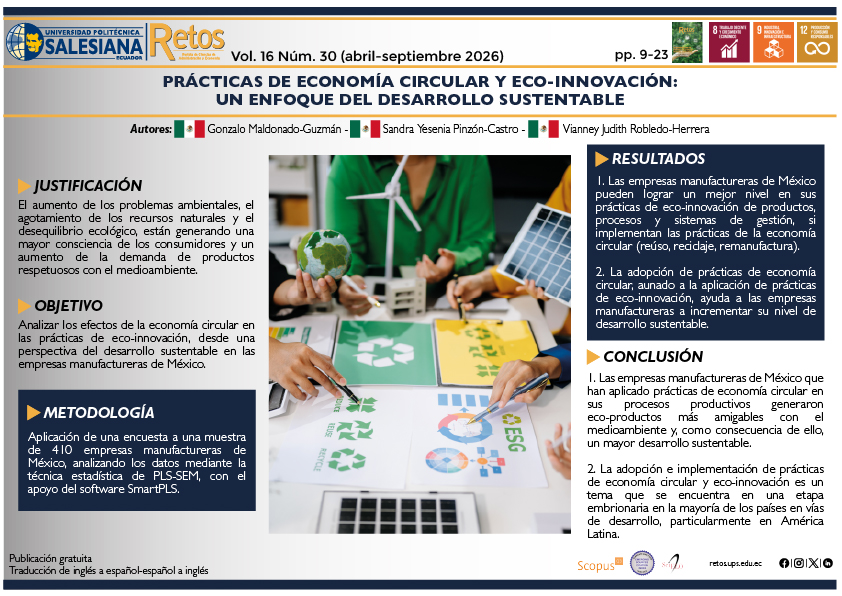
La literatura académica establece que la integración y aplicación de estrategias de economía circular incentiva a las empresas industriales a mejorar sus prácticas de eco-innovación y su desempeño sustentable, lo cual ayuda a impulsar la transición hacia un sistema económico más sustentable. Sin embargo, el conjunto de conocimientos y evidencia presentados en la literatura académica actual sobre los efectos de las prácticas de la economía circular en la eco-innovación y el desarrollo sustentable presenta evidencia y resultados fragmentados y, en algunos casos, contradictorios. Por ello, este estudio busca llenar este vacío y contribuir a abordar esta deficiencia mediante el análisis y la discusión de los efectos de las prácticas de la economía circular en la eco-innovación y el desarrollo sustentable de las empresas industriales. Para este fin, se distribuyó una encuesta en papel a una muestra de 410 empresas industriales en México, analizando los datos obtenidos a través de PLS-SEM. Los hallazgos derivados sugieren que las prácticas de la economía circular tienen una notable influencia beneficiosa tanto en las prácticas de eco-innovación como en las actividades del desarrollo sustentable, mientras que las prácticas de eco-innovación no ejercen una influencia positiva significativa en las actividades del desarrollo sustentable. En este contexto, los resultados llevaron a la inferencia final de que las empresas industriales mexicanas se encuentran en una etapa incipiente de transición de un modelo lineal tradicional a un modelo económico circular, que está mejorando las prácticas de eco-innovación y el desarrollo sustentable.
Detalles del artículo

Esta obra está bajo una licencia internacional Creative Commons Atribución-NoComercial-CompartirIgual 4.0.
Autoría: La lista de autores firmantes debe incluir únicamente a aquellas personas que hayan contribuido intelectualmente al desarrollo del trabajo. La colaboración en la recogida de datos no es, por sí misma, criterio suficiente de autoría. "Retos" declina toda responsabilidad por posibles conflictos derivados de la autoría de los trabajos que se publiquen.
Derechos de autor: La Universidad Politécnica Salesiana preserva los derechos de autor de los artículos publicados, y favorece y permite su reutilización bajo la licencia Creative Commons Attribution-NonCommercial-ShareAlike 3.0 Ecuador. Pueden ser copiados, utilizados, difundidos, transmitidos y expuestos públicamente, siempre y cuando: i) se cite la autoría y la fuente original de su publicación (revista, editorial y URL del trabajo); (Ii) no se utilicen con fines comerciales; Iii) se mencione la existencia y especificaciones de esta licencia.
Referencias
Ahmad, M., Ahmed, Z., Alvarado, R., Hussain, N. y Khan, A. S. (2024). Financial development, resource richness, eco-innovation, and sustainable development: Does geopolitical risk matter? Journal of Environmental Management, 351(2), 1-12. https://doi.org/10.1016/j.jenvman.2023.119824
Al Halbusi, H., Al-¬Sulaiti, K.I., lalwan, A. A. y Al-¬ Busaidi, A. S. (2025). AI capability and green innovation impact on sustainable performance: Moderating role of big data and knowledge management. Technological Forecasting and Social Change, 210(1), 1-12. https://doi.org/10.1016/J.TECHFORE.2024.123897
Bryman, A. (2016). Social research methods. 5th ed. Oxford University Press.
Chen, R., Ramzan, M., Hafeez, M. y Ullah, S. (2023). Green innovation-green growth nexus in BRICS: Does financial globalization matter? Journal of Innovation & Knowledge, 8(1), 1-12. https://doi.org/10.1016/J.JIK.2022.100286
Cheng, T. C. E., Kamble, S. S., Belhadi, Ndubisi, A. N. O., Lai, K. y Kharat, M. G. (2021). Linkages between big data analytics, circular economy, sustainable supply chain flexibility, and sustainable performance in manufacturing firms. International Journal of Production Research, 60(22), 6908-6922. https://doi.org/10.1080/00207543.2021.1906971
Cherrafi, A., Chiarini, A., Belhadi, A., El Baz, J. y Benabdellah, A. C. (2022). Digital technologies and circular economy practices: Vital enablers to support sustainable and resilient supply chain management in the post-COVID-19 era. The TQM Journal, 34(7), 179-202. https://doi.org/10.1108/TQM-12-2021-0374
Chien, F. S., Paramaiah Ch., Joseph, R., Chuong, P. H., Hien, P. T. T. y Ngo, Q. T. (2023). The impact of eco-innovation, trade openness, financial development, green energy and government governance on sustainable development in ASEAN countries. Renewable Energy, 211(7), 259-268. https://doi.org/10.1016/j.renene.2023.04.109
D’Amato, D., Droste, N., Winkler, K. J. y Toppinen, A. (2019). Thinking green, circular or bio? Eliciting research’s perspectives on a sustainable economy with Q method. Journal of Cleaner Production, 230(3), 460-476. https://doi.org/10.1016/j.jclepro.2019.05.099
De Angelis, R. y Ianulardo, G. (2024). Circular economy principles as a basis for sustainability management theory: A systems thinking and moral imagination approach. Business Strategy and the Environment, 33(8), 4861-4870. https://doi.org/10.1002/bse.3730
Dima, A. M., Maassen, M. A., Janoskova, K., Stamule, S. y Muresan, M. L. (2020). Models of dependencies in innovation in the European Union. Transformations in Business & Economics, 19(2B), 668-686.
Hair, J., Hult, T., Ringle, C., Sarstedt, M., Castillo, J., Cepeda, G. y Roldan, J. (2019). Manual de partial least squares PLS-SEM. OmniaScience. https://bit.ly/4rEKavy
Hair, J. F., Celsi, M., Money, A., Samouel, P. y Page, M. (2016). Essentials of business research methods. 3rd Ed. Routledge.
INEGI. (2020). La industria manufacturera en México. México: Instituto Nacional de Estadística y Geografía (INEGI). https://bit.ly/3OYbxSs
INEGI. (2023). National Statistical Directory of Economic Units. https://bit.ly/4s3my3f
Kemp, R. y Pearson, P. (2007). Final report mei project about measuring eco-innovation. Um-Merit, Maastricht. https://bit.ly/4rZeaBQ
Khan, I. y Kabir, Z. (2020). Waste-to-energy generation technologies and the developing economies: A multi-criteria analysis for sustainability assessment. Renewable Energy, 150(1), 320.333. https://doi.org/10.1016/j.renene.2019.12.132
Khan, S. A. R., Yu, Z., Sarwat, S., Godil, D. I., Amin, S. y Shujaat, S. (2021). The role of block chain technology in circular economy practices to improve organizational performance. International Journal of Logistics Research and Applications, 25(4-5), 605-622. https://doi.org/10.1080/1367556720211872512.
Kiefer, C. P., Del Río, P. y Carrillo-¬Hermosilla, J. (2021). On the contribution of eco-¬innovation features to a circular economy: A microlevel quantitative approach. Business Strategy and the Environment, 30(4), 1531-1547. https://doi.org/10.1002/BSE.2688.
Kirchherr, J., Piscicelli, L., Bour, R., Kostense-Smit, E., Muller, J., Huibrechtse-Truijens, A. y Hekkert, M. (2018). Barriers to the circular economy: evidence from the European Union. Ecological Economics, 150(1), 264-272. https://doi.org/10.1016/j.ecolecon.2018.04.028
Koseoglu, A., Yucel, A. G. y Ulucak, R. (2022). Green innovation and ecological footprint relationship for a sustainable development: Evidence from top 20 green innovator countries. Sustainable Development, 30(9), 976-988. https://doi.org/10.1002/sd.2294
Le, T. T., Ferraris, A. y Kumar, D. B. (2023). The contribution of circular economy practices on the resilience of production systems: Eco-innovation and cleaner production´s mediation role for sustainable development. Journal of Cleaner Production, 424(1), 1-13. https://doi.org/10.1016/j.jclepro.2023.138806
Mahmood, N., Zhao, Y., Lou, Q. y Geng, J. (2022). Role of environmental regulations and eco-innovation in energy structure transition for green growth: Evidence from OECD. Technological Forecasting and Social Change, 183(1), 1-12. https://doi.org/10.1016/j.techfore.2022.121890.
Mora-Contreras, R. y Carrillo-Hermosilla, J. (2025). Revelating the effects of circular economy, eco-innovation and Industry 4.0 on sustainable performance and competitive advantage in manufacturing companies. Sustainable Development, Early View. https://doi.org/10.1002/sd.70075
Mora-Contreras, R., Carrillo-¬Hermosilla, J., Hernández-¬ Salazar, G., Torres-¬Guevara, L. E., Mejia-¬Villa, A. y Ormazabal, M. (2025). Eco-innovation for circular economy and sustainability performance: Insights and evidence from manufacturing firms. Business Strategy and the Environment, 34(1), 1231-1256. https://doi.org/10.1002/BSE.4046.
Mora-Contreras, R., Torres-¬Guevara, L. E., Mejia-¬Villa, A., Ormazabal, M. y Prieto-¬Sandoval, V. (2023). Unraveling the effect of circular economy practices on companies' sustainability performance: Evidence from a literature review. Sustainable Production and Consumption, 35(1), 95-115. https://doi.org/10.1016/J.SPC.2022.10.022.
Ormazabal, M., Prieto-Sandoval, V., Puga-Leal, R. y Jaca, C. (2018). Circular economy in Spanish SMEs: Challenges and opportunities. Journal of Cleaner Production, 185, 157-167. https://doi.org/10.1016/j.jclepro.2018.03.031
Piyathanavong, V., Olapiriyakul, S., Garza-¬Reyes, J. A., Kumar, Huynh, V. V. N. y Karnjana, J. (2024). Implementing industry 4.0 and circular economy through the developmental culture perspective: Driving a competitive advantage in the manufacturing industry. Business Strategy and the Environment, 33(8), 9059-9074. https://doi.org/10.1002/BSE.3967.
Priyadarshini, P. y Abhilash, P. C. (2020). Circular economy practices within energy and waste management sectors of India: A meta-analysis. Bioresource Technology, 304(1), 1-14. https://doi.org/10.1016/j.biortech.2020.123018
Ramírez-¬Rodríguez, L. C., Ormazabal, M. y Jaca, C. (2024). Mapping sustainability assessment methods through the industrial symbiosis life cycle for a circular economy. Sustainable Production and Consumption, 50(1), 253-267. https://doi.org/10.1016/J.SPC.2024.08.005.
Ranta, V., Aarikka-Stenroos, L. y Mäkinen, S. J. (2018). Creating value in the circular economy: A structured multiple-case analysis of business models. Journal of Cleaner Production, 201(11), 988-1000. https://doi.org/10.1016/j.jclepro.2018.08.072
Ringle, C. M., Wende, S. y Becker, J. M. (2024). SmartPLS 4 (computer software). http://www.smartpls.com.
Rodríguez-Espíndola, O., Cuevas-Romo, A., Chowdhury, S., Díaz-Acevedo, N., Albores, P., Despoudi, S. y Dey, P. (2022). The role of circular economy principles and sustainable-oriented innovation to enhance social, economic and environment performance: Evidence from Mexican SMEs. International Journal of Production Economics, 248(6), 1-12. https://doi.org/10.1016/j.ijpe.2022.108495
Saha, K., Dey, P. K. y Papagiannaki, E. (2021). Implementing circular economy in the textile and clothing industry. Business Strategy and the Environment, 30(4), 1497-1530. https://doi.org/10.1002/BSE.2670.
Schaltegger, S., Loorbach, D. y Hörisch, J. (2023). Managing entrepreneurial and corporate contributions to sustainability transitions. Business Strategy and the Environment, 32(7), 891-902. https://doi.org/10.1002/bse.3080
Schultz, F. C. y Reinhardt, R. J. (2022). Facilitating systemic eco-innovation to pave the way for a circular economy: A qualitative-empirical study on barriers and drivers in the European polyurethane industry. Journal of Industrial Ecology, 26(5), 1646-1675. https://doi.org/10.1111/JIEC.13299 .
Scur, G., de Mello, A., Schreiner, L. y das Neves, F. (2019). Eco-design requirements in heavyweight vehicle development – A case study of the impact of the Euro 5 emissions standard on the Brazilian industry. Innovation & Management Review, 16(4), 404-442. https://doi.org/10.1108/INMR-08-2018-0063
Sebestová, J. y Sroka, W. (2020). Sustainable development goals and SMEs decisions: Czech Republic vs. Poland. Journal of Eastern European and Central Asian Research (JEECAR), 7(1), 39-50. https://doi.org/10.15549/jeecar.v7i1.418
Segarra-Oña, M., Peiró-Signes, A. y Payá-Martínez, A. (2014). Factors influencing automobile firm’s eco-innovation orientation. Engineering Management Journal, 26(1), 31-38. https://doi.org/10.1080/10429247.2014.11432002
Skalli, D., Charkaoui, A. Cherrafi, A., Garza-¬Reyes, J.A., Antony, J. y Shokri, A. (2024). Analyzing the integrated effect of circular economy, lean six sigma, and industry 4.0 on sustainable manufacturing performance from a practice-¬based view perspective. Business Strategy and the Environment, 33(2), 1208-1226. https://doi.org/10.1002/BSE.3546
Suki, N. M., Mohd Suki, N., Afshan, S., Sharif, A., Ariff Kasim, M. y Rosmaini Mohd Hanafi, S. (2022). How does green technology innovation affect green growth in ASEAN-6 countries? Evidence from advance panel estimations. Gondwana Research, 111(1), 165-173. https://doi.org/10.1016/j.gr.2022.06.019.
Sun, Y., Gao, P., Tian, W. y Guan, W. (2023). Green innovation for resource efficiency and sustainability: Empirical analysis and policy. Resource Policy, 81(1), 1-10. https://doi.org/10.1016/j.resourpol.2023.103369.
Susanty, A., Tjahjono, B. y Sulistyani, R. E. (2020). An investigation into circular economy practices in the traditional wooden furniture industry. Production Planning & Control, 31(16), 1336-1348. https://doi.org/10.1080/09537287.2019.1707322
Triguero, A., Cuerva, M. C. y Sáez-Martínez, F. J. (2022). Closing the loop through eco-innovation by European firms: Circular economy for sustainable development. Business Strategy and the Environment, 31(5), 2337-2350. https://doi.org/10.1002/bse.3024
Triguero, A., Moreno-¬Mondéjar, L. y Sáez-¬Martínez, F. J. (2023). Circular economy and firm performance: The influence of product life cycle analysis, upcycling, and redesign. Sustainable Development, 31(4), 2318-2331. https://doi.org/10.1002/SD.2509
Waddock, S. (2020). Achieving sustainability requires systemic business transformation. Global Sustainability, (e12), 1-16. https://doi.org/10.1017/sus.2020.9
Wuyts, W., Marin, J., Brusselaers, J. y Vrancken, K. (2020). Circular economy as a COVID-19 cure? Resource, Conservation and Recycling, 162(1), 1-12. https://doi.org/10.1016/j.resconrec.2020.105016