

Tecnologías emergentes para optimizar la sostenibilidad ambiental en la industria textil: una revisión sistemática
Barra lateral del artículo
Contenido principal del artículo
Resumen
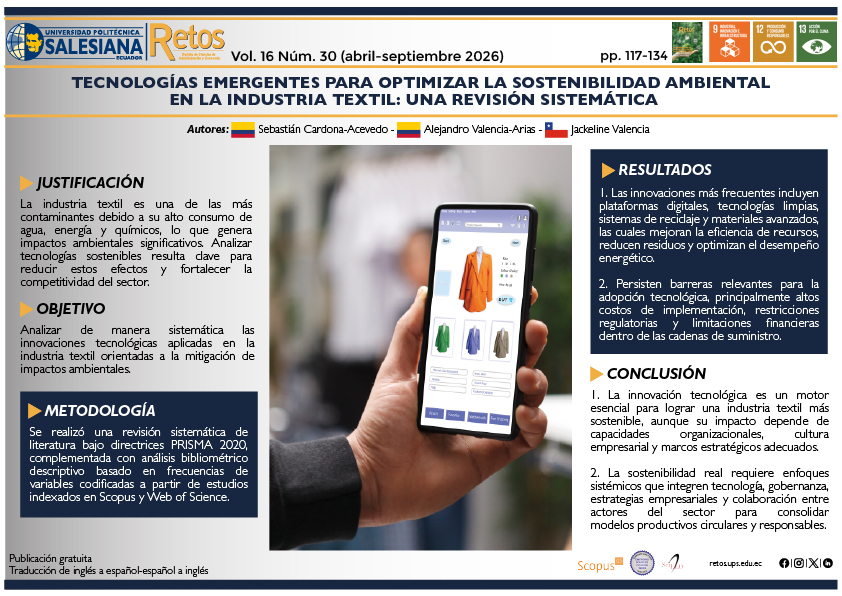
La industria textil se caracteriza por una elevada intensidad en el uso de recursos y un impacto ambiental significativo, asociado al alto consumo de agua y energía, la contaminación química y la generación de residuos. En este escenario, la innovación tecnológica ha adquirido un papel estratégico para disminuir la huella ambiental de los procesos productivos y, simultáneamente, fortalecer la competitividad organizacional. El objetivo de este estudio es analizar de manera sistemática las innovaciones tecnológicas aplicadas en la industria textil orientadas a la mitigación de impactos ambientales, con énfasis en los procesos productivos transformados, las métricas de desempeño ambiental, las barreras de adopción y las tendencias emergentes en sostenibilidad. La metodología se fundamenta en una revisión sistemática de la literatura desarrollada conforme a las directrices PRISMA 2020, complementada con una síntesis cuantitativa descriptiva de carácter bibliométrico basada en el análisis de frecuencias de variables codificadas. Los resultados evidencian que las plataformas digitales, las tecnologías limpias, los sistemas de reciclaje y los materiales avanzados constituyen las innovaciones más recurrentes, contribuyendo a una mayor eficiencia en el uso de recursos, la reducción de residuos y mejoras en el desempeño energético. Sin embargo, persisten barreras relevantes, como altos costos de implementación, restricciones regulatorias y limitaciones financieras en las cadenas de suministro.
Detalles del artículo

Esta obra está bajo una licencia internacional Creative Commons Atribución-NoComercial-CompartirIgual 4.0.
Autoría: La lista de autores firmantes debe incluir únicamente a aquellas personas que hayan contribuido intelectualmente al desarrollo del trabajo. La colaboración en la recogida de datos no es, por sí misma, criterio suficiente de autoría. "Retos" declina toda responsabilidad por posibles conflictos derivados de la autoría de los trabajos que se publiquen.
Derechos de autor: La Universidad Politécnica Salesiana preserva los derechos de autor de los artículos publicados, y favorece y permite su reutilización bajo la licencia Creative Commons Attribution-NonCommercial-ShareAlike 3.0 Ecuador. Pueden ser copiados, utilizados, difundidos, transmitidos y expuestos públicamente, siempre y cuando: i) se cite la autoría y la fuente original de su publicación (revista, editorial y URL del trabajo); (Ii) no se utilicen con fines comerciales; Iii) se mencione la existencia y especificaciones de esta licencia.
Referencias
Asubiaro, T., Onaolapo, S. y Mills, D. (2024). Regional disparities in Web of Science and Scopus Journal coverage. Scientometrics, 129(3), 1469-1491. https://doi.org/10.1007/s11192-024-04948-x
Awais-E-Yazdan, M., Iqbal, M. S., Mushtaq, M., Birau, R., Popescu, V. y Ninulescu, P. V. (2024). Green HRM practices in textile sector of Pakistan and its impact on green innovation and environmental sustainability. Industria Textila, 75(3), 275-282. https://doi.org/10.35530/IT.075.03.202383.2023.
Bibi, S., Khan, A., Fubing, X., Jianfeng, H. y Hussain, S. (2024). Integrating digitalization, environmental innovations, and green energy supply to ensure green production in China’s textile and fashion industry: environmental policy and laws optimization perspective. Environment, Development and Sustainability, 1-41. https://doi.org/10.1007/s10668-024-05417-4
Bibi, S., Khan, A., Fubing, X., Jianfeng, H., Hussain, S. y Khan, A. N. (2024). Impact of environmental policies, regulations, technologies, and renewable energy on environmental sustainability in China’s textile and fashion industry. Frontiers in Environmental Science, 12, 1496454. https://doi.org/10.3389/fenvs.2024.1496454
Brandão, S. C. G., Fontana, M. E., Silva, W. D. O. y da Silva, G. L. (2025). Drivers and barriers of sustainability-oriented innovations in Brazilian denim treatment facilities: an expert-driven decision support. Humanities and Social Sciences Communications, 12(1), 1-12. https://doi.org/10.1057/s41599-025-05006-4
Butturi, M. A., Neri, A., Mercalli, F. y Gamberini, R. (2025). Sustainability-oriented innovation in the textile manufacturing industry: Pre-consumer waste recovery and circular patterns. Environments, 12(3), 82. https://doi.org/10.3390/environments12030082
Ceicyte-Pranskune, J. (2025). Sustainability Values and Strategic Innovation in Sustainable Fashion MSMEs: the Dynamic Capabilities Perspective. Engineering Economics, 36(3), 317-333. https://doi.org/10.5755/j01.ee.36.3.34747
Chourasiya, R. y Pandey, S. (2024). Breathing new life: exploring the cutting edge of technology adoption in the textile industry. Research Journal of Textile and Apparel. https://doi.org/10.1108/RJTA-03-2024-0043
Cross, K., Mesjar, L., Steed, J. y Jiang, Y. (2025). Immersive innovations for the communication of heritage, handcraft and sustainability. International Journal of Fashion Design, Technology and Education, 18(1), 15-25. https://doi.org/10.1080/17543266.2023.2277264
Doliveira, S. L. D., Balbinot, Z., Silva, A. Q., Da Cunha, J. C. y Kuzma, E. L. (2018). The relationship between sustainability practices and innovation strategies: the effect of the clusterization inthe bop segment. Journal on Innovation and Sustainability RISUS, 9(3), 53-74. https://doi.org/10.24212/2179-3565.2018v9i3p53-74
Dominguez, M. F. O. y Bhatti, Y. A. (2022). From waste to luxury fashion at Elvis & Kresse: a business model for sustainable and social innovation in the circular economy. Sustainability, 14(19), 11805. https://doi.org/10.3390/su141911805
Dominidiato, M., Guercini, S., Milanesi, M. y Tunisini, A. (2024). Supplier-customer relationships for sustainability-led innovation in the textile industry. Journal of Business & Industrial Marketing, 39(13), 15-26. https://doi.org/10.1108/JBIM-01-2023-0060
Dutta, S. y Bansal, P. (2024). Evolution of sustainable wearables: Integrating cutting-edge techniques for future textile innovation. Research Journal of Textile and Apparel. https://doi.org/10.1108/RJTA-03-2024-0044
Faludi, J., Yiu, F. y Agogino, A. (2020). Where do professionals find sustainability and innovation value? Empirical tests of three sustainable design methods. Design Science, 6, e22 https://doi.org/10.1017/dsj.2020.17
Feng, T. (2023). Do intelligent manufacturing concerns promote corporate sustainability? Based on the perspective of green innovation. Sustainability, 15(14), 10958. https://doi.org/10.3390/su151410958
Flohr, T. T., Neiva, E. G. C., Dantas, M. P., Corrêa, R. C. G., Yamaguchi, N. U., Peralta, R. M., ... & de Oliveira, C. R. S. (2024). Characterization of Atlantic Forest Tucum (Bactris setosa Mart.) leaf fibers: aspects of innovation, waste valorization and sustainability. Plants, 13(20), 2916. https://doi.org/10.3390/plants13202916
Glogar, M., Petrak, S. y Mahnić Naglić, M. (2025). Digital technologies in the sustainable design and development of textiles and clothing—a literature review. Sustainability, 17(4), 1371. https://doi.org/10.3390/su17041371
Grigorescu, A. y Ion, A. E. (2022). Qualitative analysis of sustainability and innovation within the luxury business sector. Journal of the Knowledge Economy, 13(4), 3150-3171. https://doi.org/10.1007/s13132-021-00835-5
Harsanto, B., Primiana, I., Sarasi, V. y Satyakti, Y. (2023). Sustainability innovation in the textile industry: a systematic review. Sustainability, 15(2), 1549. https://doi.org/10.3390/su15021549
Hossain, M. T., Shahid, M. A., Limon, M. G. M., Hossain, I. y Mahmud, N. (2024). Techniques, applications, and challenges in textiles for a sustainable future. Journal of Open Innovation: Technology, Market, and Complexity, 10(1), 100230. https://doi.org/10.1016/j.joitmc.2024.100230
Jiju, P. S., Patel, A. K., Shruthy, N. S., Shalu, S., Dong, C. D. y Singhania, R. R. (2025). Sustainability through lignin valorization: recent innovations and applications driving industrial transformation. Bioresources and Bioprocessing, 12(1), 88. https://doi.org/10.1186/s40643-025-00929-x
Khan, A. Y., Akhtar, M. y Khan, A. Y. (2024). Digitalization for a sustainable performance: Dual-study analysis of digital leadership, circular economy, and technological innovation. Sustainability, 16(23), 10465. https://doi.org/10.3390/su162310465
Leal, W., Dinis, M. A. P., Liakh, O., Paço, A., Dennis, K., Shollo, F. y Sidsaph, H. (2024). Reducing the carbon footprint of the textile sector: an overview of impacts and solutions. Textile Research Journal, 94(15-16), 1798-1814. https://doi.org/10.1177/00405175241236971
Lu, X., Brennan, M. A. y Brennan, C. S. (2025). Harnessing the multifaceted potential of mushrooms: Sustainable development, health promotion, and industrial innovation. International Journal of Food Science and Technology, 60(2), vvaf159. https://doi.org/10.1093/ijfood/vvaf159
Mansi, G., Chavda, V., Ranga, S. y Raghav, S. (2025). green chemistry strategies for industrial product formulation. in towards green chemical processes: strategies and innovations (pp. 165-192). Springer Nature Switzerland. https://doi.org/10.1007/978-3-031-94090-3_8
Nayeemunnisa, A. y Padhy, P. C. (2025). The Role of Agile Practices and Green Innovation on Environmental Sustainability Through Waste Reduction in Indian Garment Manufacturing. International Journal of Environmental Sciences, 11(9s), 552-560. https://doi.org/10.64252/v84kp380
Nabi, M. N., Zhiqiang, L. y Akter, M. (2023). Transformational leadership and radical innovation for sustainability: mediating role of knowledge management capability and moderating role of competitive intensity. Innovation & Management Review, 20(3), 298-310. https://doi.org/10.1108/INMR-05-2021-0075
Nigatu, T., Degoma, A. y Tsegaye, A. (2024). Green practices and economic performance: Mediating role of green innovation in Ethiopian leather, textile, and garment industries—An integrated PLS-SEM analysis. Heliyon, 10(15). https://doi.org/10.1016/j.heliyon.2024.e35188
Nourin, S., Hakim, M. N., Choudhury, A., Alexander, R. y Lund-Thomsen, P. (2025). Climate change and slow fashion in Bangladesh. En Global value chains and climate change (pp. 199-213). Edward Elgar Publishing. https://doi.org/10.4337/9781035310968.00019
Ochigue, P. C. D., Aguilos, M. A., Lubguban, A. A. y Bacosa, H. P. (2025). Circular Economy Solutions: The Role of Thermoplastic Waste in Material Innovation. Sustainability, 17(2), 764. https://doi.org/10.3390/su17020764
Orisadare, E. A., Achukwu, O. E., Ogunyemi, A. A., Adedeji, D. O., Diyaolu, I. J., Ugwu, E. I., ... & Awoyelu, I. O. (2025). Digitalisation and green strategies: A systematic review of the textile, apparel and fashion industries. Circular Economy and Sustainability, 1-53. https://doi.org/10.1007/s43615-025-00555-x
Ostermann, C. M., Nascimento, L. D. S. y Zen, A. C. (2021). Business model innovation for circular economy in fashion industry: a startups' perspective. Frontiers in sustainability, 2, 766614. https://doi.org/10.3389/frsus.2021.766614
Page, M. J., McKenzie, J. E., Bossuyt, P. M., Boutron, I., Hoffmann, T. C., Mulrow, C. D., ... & Moher, D. (2021). The PRISMA 2020 statement: an updated guideline for reporting systematic reviews. BMJ, 372. https://doi.org/10.1136/bmj.n71
Sellappa, K. (2025). Sustainable transition to circular textile practices in Indian textile industries: a review. Clean Technologies and Environmental Policy, 1-21. https://doi.org/10.1007/s10098-025-03193-x
Sonar, H., Ghag, N. y Sharma, I. (2025). Reshaping industry 5.0: Unveiling supply chain resilience for a carbon-neutral future. Sustainable Futures, 9, 100513. https://doi.org/10.1016/j.sftr.2025.100513
Stelmaszczyk, M., Pierscieniak, A. y Abrudan, D. (2023). Managerial decisions and new product development in the circular economy model enterprise: absorptive capacity and a mediating role of strategic orientation. Decision, 50(1), 35-49. https://doi.org/10.1007/s40622-023-00336-1
Stenton, M., Houghton, J. A., Kapsali, V. y Blackburn, R. S. (2021). The potential for regenerated protein fibres within a circular economy: Lessons from the past can inform sustainable innovation in the textiles industry. Sustainability, 13(4), 2328. https://doi.org/10.3390/su13042328
Timbayo, O. O., Wijaya, D. I., Ikhsan, R. B. y Putri, S. A. (2025, April). Behavioural analysis of traditional clothing traders toward e-commerce adoption: a pathway to business sustainability. En IOP Conference Series: Earth and Environmental Science, 1488(1), 012030. IOP Publishing. https://doi.org/10.1088/1755-1315/1488/1/012030
Tolstykh, T., Shmeleva, N. y Gamidullaeva, L. (2020). Evaluation of circular and integration potentials of innovation ecosystems for industrial sustainability. Sustainability, 12(11), 4574. https://doi.org/10.3390/su12114574
Wood, J., Redfern, J. y Verran, J. (2023). Developing textile sustainability education in the curriculum: pedagogical approaches to material innovation in fashion. International Journal of Fashion Design, Technology and Education, 16(2), 141-151. https://doi.org/10.1080/17543266.2022.2131913
Xiaoyi, Z., Yang, H., Kumar, N., Bhutto, M. H., Kun, W. y Hu, T. (2023). Assessing Chinese textile and apparel industry business sustainability: the role of organization green culture, green dynamic capabilities, and green innovation in relation to environmental orientation and business sustainability. Sustainability, 15(11), 8588. https://doi.org/10.3390/su15118588
Yang, S. J. y Jang, S. (2020). How does corporate sustainability increase financial performance for small-and medium-sized fashion companies: Roles of organizational values and business model innovation. Sustainability, 12(24), 10322. https://doi.org/10.3390/su122410322
Yerushalmi, E. y Saha, K. (2025). How circular economy innovation can backfire on the environment: quantifying the rebound effect of the textiles and clothing sector. Business Strategy and the Environment. https://doi.org/10.1002/bse.70135