

Ontology and language: truth and meaning on the threshold of the two cultures
Article Sidebar
Main Article Content
Abstract
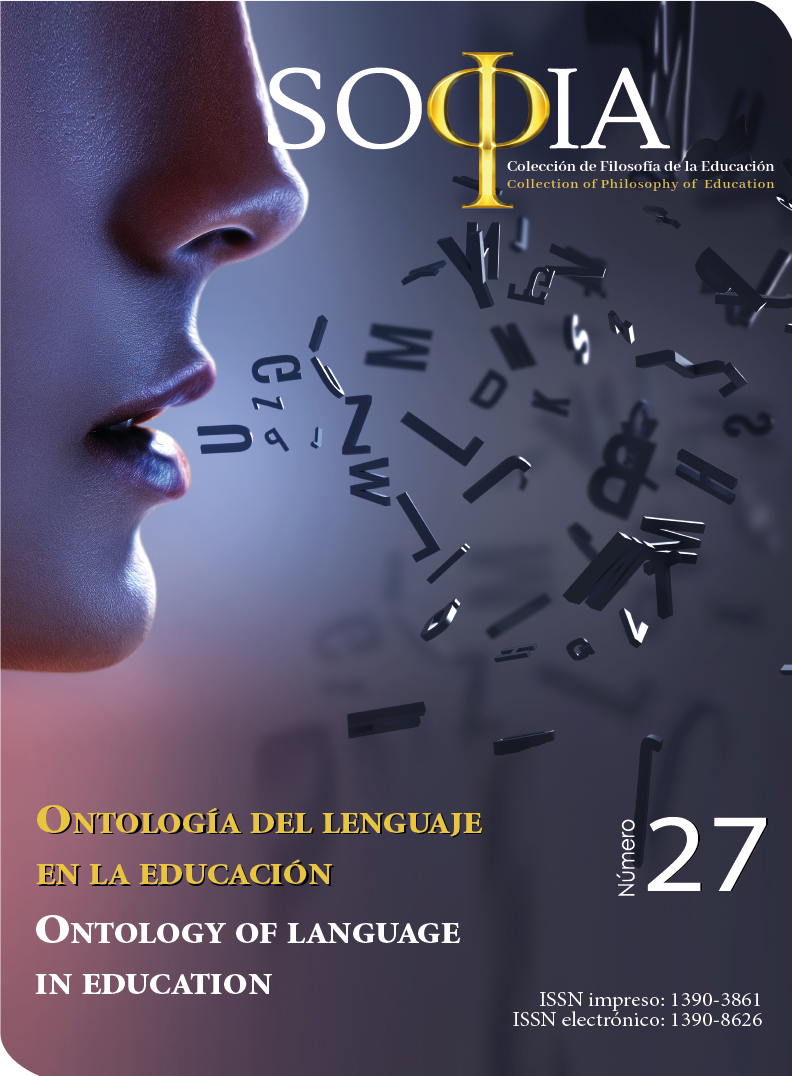
This article proposes an exploration of the implications between language and ontology in the light of two different traditions. On the one hand, the scope of the scientific statement and the relationships between meaning and truth: knowledge as the activity of describing a world that is made up of particular facts; on the other, the historical consideration whose objective is to understand a multiformed reality, where language does not only enunciate facts, but builds a meaning of the world in which human life finds the significant elements of its concrete reality. To put these two sites in perspective, it is assumed that in their development, philosophy and science were interconnected. However, as knowledge expanded, field differentiation became more and more necessary. But that strict parceling must be left behind; today a new critical reflection is required that goes beyond the dichotomy of Natural Sciences and Human or Spirit Sciences. At present, this schematism is the manifestation of an illusory understanding of nature as if it were an area of reality alien to man, and as if human beings were a ‘subject’ disconnected from the natural order. This classification evidences a rupture between nature and society, which obstructs the possibilities of an ontological gaze absent from prejudices. 21st century humanism must overcome such disjunction, as science is an essential activity for human beings to be present in multiple spheres of culture, from health services to food production, communications, recreation, politics, economics, education, etcetera. And, reciprocally, philosophical thought has provided a perspective of totality that allows to notice that the knowledge, in any of its branches, participates in the same objective, scope and value. Reflection on language can open up to understanding the differences and closeness of a shared reality.
Article Details
Authorship: The list of authors signing must include only those people who have contributed intellectually to the development of the work. Collaboration in the collection of data is not, by itself, a sufficient criterion of authorship. "Sophia" declines any responsibility for possible conflicts arising from the authorship of the works that are published.
Copyright: The Salesian Polytechnic University preserves the copyrights of the published articles, and favors and allows their reuse under the Creative Commons Attribution-NonCommercial-ShareAlike 3.0 Ecuador license. They may be copied, used, disseminated, transmitted and publicly displayed, provided that: i) the authorship and the original source of their publication (journal, editorial and work URL) are cited; (Ii) are not used for commercial purposes; Iii) mention the existence and specifications of this license.
References
ADORNO, Theodor & HORKHEIMER, Max 1998 Dialéctica de la Ilustración. Madrid: Trotta.
ARISTÓTELES 2000 Metafísica. Madrid: Gredos.
DILTHEY, Wilhelm 1949 Introducción a las ciencias del espíritu. México: Fondo de Cultura Económica.
FERRARIS, Maurizio 2003 La hermenéutica. México: Taurus.
FREGE, Gottlob 1972 Conceptografía y los fundamentos de la Aritmética. México: UNAM.
GADAMER, Hans Georg 1977 Verdad y método. Salamanca: Sígueme.
HUSSERL, Edmund 1984 Crisis de las ciencias europeas y la fenomenología trascendental. México: Folios.
KAFKA, Franz 2004 El castillo. Madrid: Valdemar.
KANT, Immanuel 2013 Crítica de la razón pura. Madrid: Taurus.
LOCKE, John 2002 Ensayo sobre el entendimiento humano. México: Fondo de Cultura Económica.
MAGEE, Bryan 1982 Los hombres detrás de las ideas. México: Fondo de Cultura Económica.
RUSSELL, Bertrand 1988 Introducción a la filosofía matemática. Barcelona: Paidós.
SCHLEIERMACHER, Friedrich Daniel Ernst 1991 Monólogos. Barcelona: Anthropos.
SCHRÖDINGER, Erwin 2009 Ciencia y Humanismo. Barcelona: Tusquets.
SNOW, Charles Percy 1959 The two cultures and the scientific revolution. New York: Cambridge University Press.
Wittgenstein, Ludwig 1963 Tractatus Logico-Philosophicus. London: Routledge & Kegan Paul.
Wittgenstein, Ludwig 1988 Investigaciones Filosóficas. México: UNAM, Crítica, Grijalbo.
Wittgenstein, Ludwig 1997 Tractatus Logico-Philosophicus. Madrid: Alianza.