

Objectivity and truth in Science of Education as a Design Science
Article Sidebar
Main Article Content
Abstract
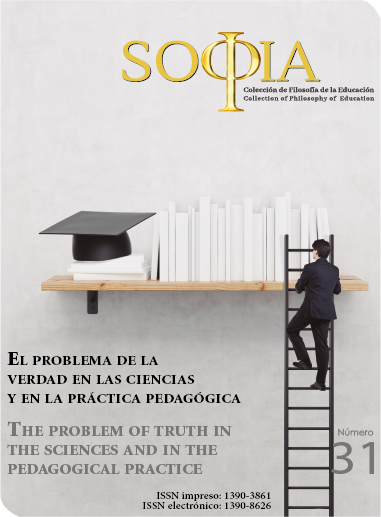
Objectivity and truth are key issues in Education which affect the reliability of knowledge and consequently, the recognition of its scientific character and the prestige of the teaching profession. This justifies the thematic debate to which philosophy of science contributes with its specific Methodology. Objectivity in Science is considered as a condition for reaching truth from the different levels that make it up: semantic, logical, epistemological, methodological, ontological, axiological and ethical. Science of Education comes from the “scientification” of practice, and it is revealed as an Applied Science of Design, that is Science of the Artificial. The perspective of Design Sciences is adopted, which: (i) seek to solve problems in a practical setting, (ii) use designs that pose objectives, processes and results; (iii) they are synthetic sciences that combine prediction with prescription; and (iv) they are then applied in specific contexts. This requires objectivity. Finally, the truth is addressed in its semantic, epistemological and ontological dimensions. It is examined how the progressive approach to the truth occurs in Applied Design Sciences and how it is possible in the Science of Education. It is concluded that the debate about the truth in Education cannot be carried out without considering the ends..
Article Details
Authorship: The list of authors signing must include only those people who have contributed intellectually to the development of the work. Collaboration in the collection of data is not, by itself, a sufficient criterion of authorship. "Sophia" declines any responsibility for possible conflicts arising from the authorship of the works that are published.
Copyright: The Salesian Polytechnic University preserves the copyrights of the published articles, and favors and allows their reuse under the Creative Commons Attribution-NonCommercial-ShareAlike 3.0 Ecuador license. They may be copied, used, disseminated, transmitted and publicly displayed, provided that: i) the authorship and the original source of their publication (journal, editorial and work URL) are cited; (Ii) are not used for commercial purposes; Iii) mention the existence and specifications of this license.
References
Alonso, A. M. (2020b): “La enseñanza en línea y la dimensión artificial de la Ciencia de la Educación: Análisis filosófico-metodológico como Ciencia de Diseño”. Scio: Revista de Filosofía, 19, pp. 229-259. DOI: 10.46583/scio_2020.19.687
Arrojo, M. J. (2020): “Objectivity and Truth in Sciences of Communication and the Case of the Internet”. In Gonzalez, W. J. (ed): New Approaches to Scientific Realism (pp. 415-435). Berlín/Boston: De Gruyter.
Diéguez, A. (1997): “Verdad y progreso científico”. En GONZALEZ, W. J. (ed.): Progreso científico e innovación tecnológica. Arbor, 157 (620), pp. 301-321.
Faerna, A. M. (1991): “Verdad y criterios: Sobre la justificación pragmática del conocimiento”. Anales del Seminario de Metafísica, 25, pp. 25-43
Gonzalez, W. J. (1990a): “La Ciencia y los problemas metodológicos”. En González, W. J. (ed.), Aspectos metodológicos de la investigación científica, 2ª ed. (pp. 16-21). Madrid- Murcia: Ediciones Universidad Autónoma de Madrid y Ediciones
Gonzalez, W. J. (1990b): “Progreso científico, Autonomía de la Ciencia y Realismo.” Arbor, 135(532), pp. 91-109.
Gonzalez, W. J. (1993): “El realismo y sus variedades: El debate actual sobre las bases filosóficas de la Ciencia”. En CARRERAS, A. (ed.) Conocimiento, Ciencia y Realidad (pp. 11, 58). Zaragoza: Mira Editores.
Gonzalez, W. J. (1996): “Caracterización del objeto de la Historia y bases de su configuración metodológica”. En Gonzalez, W. J. (ed.), Acción e Historia. El objeto de la Historia y la Teoría de la Acción (pp. 25-114). A Coruña: Publicaciones Universidad de A Coruña.
Gonzalez, W. J. (1997): “Progreso científico e innovación tecnológica: La ‘Tecnociencia’ y el problema de las relaciones entre Filosofía de la Ciencia y Filosofía de la Tecnología”, Arbor, 157(620), pp. 261-283
Gonzalez, W. J. (2005), “Karl Popper ante el problema de la verdad”. En Martínez Solano, J. F., El problema de la verdad en K. R. Popper: Reconstrucción histórico-sistemática (pp. 12-20). A Coruña: Netbiblo.
Gonzalez, W. J. (2007): “Análisis de las Ciencias de Diseño desde la racionalidad limitada, la predicción y la prescripción.” In: Gonzalez, W. J. (ed.): las Ciencias de Diseño: Racionalidad limitada, predicción y prescripción (pp. 3-38). A Coruña: Netbiblo.
Gonzalez, W. J. (2012): “La Economía en cuanto Ciencia: Enfoque desde la complejidad”, Revista Galega de Economía, 21(1), pp. 1-30
Gonzalez, W. J. (2013): “The Roles of Scientific Creativity and Technological Innovation in the Context of Complexity of Science.” In: Gonzalez, W. J. (ed.): Creativity, Innovation, and Complexity in Science (pp. 11-40). A Coruña: Netbiblo.
Gonzalez, W. J. (2015): Philosophico-Methodological Analysis of Prediction and its Role in Economics. Dordrecht: Springer.
Gonzalez, W. J. (2020): “Pragmatic Realism and Scientific Prediction: The Role of Complexity”. In Gonzalez, W. J. (ed.): New Approaches to Scientific Realism, pp. 251-287. Berlín/Boston: De Gruyter.
Gonzalez, W. J. (2021): “Semantics of Science and Theory of Reference: An Analysis of the Role of Language in Basic Science and Applied Science”. In Gonzalez, W. J. (ed), Language and Scientific Research (pp. 41-92). Cham: Palgrave Macmillan. https://doi.org/10.1007/978-3-030-60537-7_2.
Macintyre, A. (2007). After Virtue, (1ª ed., 1981). Londres: Bristol Classical Press.
Niiniluoto, I. (1980): “Scientific Progress.” Synthese, 45, pp. 427-464.
Niiniluoto, l. (1984): Is Science Progressive? Dordrecht: Reidel.
Niiniluoto, I (1987a): Trutlikenness. Dordrecht: Reidel.
Niiniluoto, I. (1987b): “Progress, Realism, and Verosimilitude.” In: Weingartner, P. and Schurz, G. (eds.): Logic, Philosophy of Sciences and Epistemology (pp. 151-161). Vienna: Holder-Pichler·Tempsky.
Niiniluoto, I. (1993): “The Aim and Structure of Applied Research.” Erkenntnis, 38, pp. 1-21.
Popper, K. R. (1979): Objective Knowledge. An Evolutionary Approach (1ª ed., 1972). Oxford: Clarendon Press.
Popper. K. R. (1983): Realism and the Aim of Science. London: W. W. Bartley 111, Hutchinson.
Rescher, N. (1978): Scientific Progress: Oxford: B. Blackwell.
Rescher, N. (1997): Objectivity: The Obligations of Impersonal Reason: N. Dame, IN: Notre Dame University Press.
Rescher, N. (1999): Razón y valores en la Era científico-tecnológica. Barcelona: Paidós.
Simon, H. A. (1996): The Sciences of the Artificial, 3rd ed. Cambridge, MA: The MIT Press.
Tardif, M. (2004). Los saberes del docente y su desarrollo profesional. Madrid: Narcea Ediciones.
Touriñán, J. M. y Rodríguez, A. (1993): “La significación del conocimiento en educación”. Revista de educación, 302, pp. 165-192.