

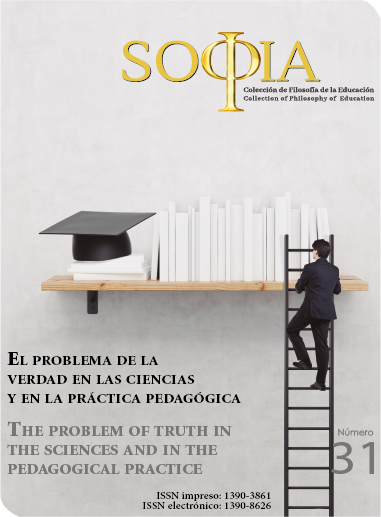
Reflections about problem of truth, science and technology and its implications in the educational field
Article Sidebar
Main Article Content
Abstract
First, this research will be done a cartography about main streams of philosophy to understand
present discussion about truth, knowledge and science considering a world marked by technology
and the corresponding implications in education. In this sense, using the genealogical method
I analyze the emergence of the technology concept to identify both the historical and conceptual
conditions of possibility. This allows us to appreciate how the application and consolidation of
modern science caused a break in the conception of technique to move to technology. In this way,
the relationship between technology and the human being is analyzed under the confrontation of
two opposite perspective, on the one hand, the reflections made by Martin Heidegger and on the
other hand, the approaches made by Ortega y Gasset to make visible the dispute of the vision of
technology. The results of this debate will allow us to appreciate the implications of the technological
revolution in different fields of education, considering its limits and possibilities. Among the main
findings is that modern science direct influences on the consolidation of technology as opposed to
the traditional technique under positivist criteria that have monopolized the concept and knowledge
about truth, set aside other spheres such as art, politics, or love. This has led to a growth of relativistic
cultural positions. In addition, these aspects have marked the contemporary world, also affecting the
educational field.
Article Details
Authorship: The list of authors signing must include only those people who have contributed intellectually to the development of the work. Collaboration in the collection of data is not, by itself, a sufficient criterion of authorship. "Sophia" declines any responsibility for possible conflicts arising from the authorship of the works that are published.
Copyright: The Salesian Polytechnic University preserves the copyrights of the published articles, and favors and allows their reuse under the Creative Commons Attribution-NonCommercial-ShareAlike 3.0 Ecuador license. They may be copied, used, disseminated, transmitted and publicly displayed, provided that: i) the authorship and the original source of their publication (journal, editorial and work URL) are cited; (Ii) are not used for commercial purposes; Iii) mention the existence and specifications of this license.
References
Artigas, M. (1999). Filosofía de la ciencia . Navarra: Eunsa.
Badiou, A. (1999). El ser y el acontecimeinto . Buenos Aires : Manantial.
Badiou, A. (2010). La filosofía, otra vez. España: Errata naturae.
Chalmers, A. (1990). ¿Qué es esa cosa llamada ciencia? Madrid : Siglo XXI .
Díaz, T. (2011). La función de las TIC en la transformación de la sociedad y de la educación. En R. Carneiro, J. Toscano , & T. Díaz, Los desafíos de las TIC para el cambio educativo (págs. 155-165). Madrid: Santillana.
Diéguez, A. (2014). La acción tecnológica desde la perspectiva orteguiana: el caso del transhumanismo. Estudios Orteguianos, 131-152.
Feenberg, A. (2000). La tecnología y el fin de la Historia. Oxford University Press.
Feenberg, A. (2005). Teoría crítica de la tecnología. Revista CTS, 109-123.
Ferrater, J. (2009). Diccionario de Filosofía. Barcelona: Ariel .
Gabriel, M. (2016). Por qué no existe el mundo . México : Oceano .
Gabriel, M. (2019). El sentido del pensamiento. Barcelona : Pasado Presente.
Gadamer, H.-G. (1977). Verdad y método . España: Sigueme.
Gimeno, J. (2012). Tecnología y educación ¿Qué hay de nuevo? En G. Hoyos, Filosofía de la educación (págs. 126-156). Madrid: Trotta .
Gómez, R. (2014). La dimensión valorativa de las ciencias . Buenos Aires : Universidad Nacional de Quilmes.
Heidegger, M. (1994). La pregunta por la técnica. En M. Heidegger, Conferencias y artículos (págs. 9-37). Barcelona: Serbal.
Heidegger, M. (2012). Ser y tiempo . Madrid : Trotta.
Kranzberg, M. (1986). Technology and History: "Kranzberg's Laws". Technology and Culture , 544-560.
Linares, J. (2003). La concepción heideggeriana de la técnica: destino y peligro para el ser del hombre. Signos filosóficos , 15-44.
Lozano, R. (2011). De las TIC a las TAC: tecnologías del aprendizaje y del conocimiento. Anuario ThinkEPI, 45-47.
Lyotard, J.-F. (1987). La condición postmoderna . Argentina: Catedra .
Martín, O. (2011). Educar en comunidad: promesas y realidades. En R. Carneiro , J. Toscano, & T. Díaz, Los desafíos de las TIC para el cambio educativo (págs. 79-94). Madrid: Santillana.
Medina, M. (1989). Prólogo. En C. Mitcham, ¿Qué es la filosofía de la tecnología? (págs. 9-11). País Vasco: Anthropos.
Meirieu, P. (2013). Recuperar la pedagogía. De lugares comunes a conceptos claves . Buenos Aires : Paidós .
Mejía, M. R. (2020). Educación, escuela y pedagogía en la cuarta revolución industrial desde nuestra América . Colombia: Desde abajo.
Ortega y Gasset, J. (1982). Meditación de la técnica y otros ensayos sobre ciencia y filosofía. Madrid : Alianza editorial .
Patricia , A. (2010). Heidegger y la pregunta por la técnica. Madrid : Edita.
Quintanilla, M. (2017). Tecnología: un enfoque filosófico y otros ensayos de filosofía de la tecnología. México: Fondo de Cultura Económica.
Sarsanedas, A. (2015). La filosofía de la tecnología. Barcelona: UOC.
Varela, J., & Alvarez , F. (1991). La arqueología de la escuela. Madrid: La Piqueta .
Wittgenstein, L. (2016). Tractatus lógico-philosophicus. España: Tecnos.
Zizek, S. (2006). Visión de paralaje. Buenos Aires: Fondo de Cultura Económica .