

The use of lenguage, beyond the rules
Article Sidebar
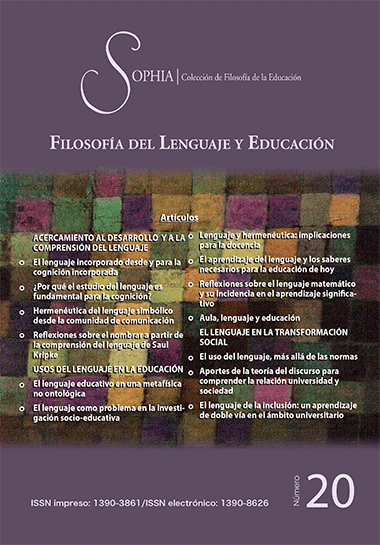
Main Article Content
Abstract
This paper aims to understand through a literature review descriptive standard language as opposed to institutional or prescriptive standard, in order to perform an analysis of the current communication, the uses of language and forms of expression, in relation to the standards imposed
institutionally, through a review of the different proposals on standards and their development, from social norms to the perverse rule, in addition with the explanation of language, uses and functions.
In the first part of the paper, its presented a description of the theories about standards from social norms to the perverse rule, and this proposal from the Social Psychology of the Psychology of Language will be linked by reviewing the descriptive rules and prescriptive about the use of the proposals by the Royal Academy of Language.
The second part of the paper presents a language analysis, functions as a prerequisite in the communication process, emphasizing especially syntactic and pragmatic levels that allow subsequent expression of language.
Finally the relationship between them is discussed, to understand the language as a process and product of the person.
Article Details
Authorship: The list of authors signing must include only those people who have contributed intellectually to the development of the work. Collaboration in the collection of data is not, by itself, a sufficient criterion of authorship. "Sophia" declines any responsibility for possible conflicts arising from the authorship of the works that are published.
Copyright: The Salesian Polytechnic University preserves the copyrights of the published articles, and favors and allows their reuse under the Creative Commons Attribution-NonCommercial-ShareAlike 3.0 Ecuador license. They may be copied, used, disseminated, transmitted and publicly displayed, provided that: i) the authorship and the original source of their publication (journal, editorial and work URL) are cited; (Ii) are not used for commercial purposes; Iii) mention the existence and specifications of this license.
References
Beramendi, M. & Zubieta, E. . (2013). Norma perversa: transgresión como modelo de legitimidad. Univ. Psychol, vol 12, no.2, 591 - 600.
Beramendi, M. & Zubieta, E. (2014). Construcción y Validación de la escala de percepción del sisteman normativo. Revista Mexicana de Psicolog{ia. Vol 31, no. 2, 124 - 137.
Beramendi, M. (2013). Percepción el sistema normativo, transgresión y sus correlatos psicosociales en Argentina. Buenos Aires: Tesis Doctoral Universidad de Buenos Aires, Facultad de Psicología.
Bicchieri, C. (2006). The grammar of Society. The nature of dynamics of social norms. Cambridge: Cambridge University Press.
Bosque, I. & Demonte, V. (1999). Gramática Descriptiva de la Lengua Española. Madrid: Espasa Calpe.
Bühler, K. (1950). Teoría del Lenguaje. Madrid: Biblioteca Conocimiento del hombre.
Chomsky, N. (1999). Estructuras Sintácticas. Buenos Aires: Siglo XXI.
Cialdini, R. & Goldstein, N. (2004). Social Influencie: Compliance and conformity. Annu. Rev. Pshycchology, 591 - 621.
Cialdini, R. & Kallgren, C. (1990). A focus theory of normative conduct: reclycing the concept of norms to reduce littering in public places. Journal of personality and social psychology Vol. 58, N|. 6, 1015 - 1026.
Cialdini, R. (2007). Descrptive Social norms as underappreciated sources of social control. Pshychometrica, vol 72, no. 2, 263 - 268.
Demonte, V. (2003). La esquiva norma del español, sus funsiones y relaciones con la variación del estándar. Simposio Variación y Descripción.
Elkartea, G. (2010). La Estandarización de la Lengua, la recuperación del euskara II. 11.
Elosúa, M. R. (2006). Procesos Psicológicos Básicos. Madrid: Mac Graw Hill.
Elster, J. (1997). El cemento de la Sociedad: la sparadojas del orden social. Barcelona: Gedisa.
Española, R. A. (2010). Manual Nueva Gramática de la Lengua Española. Madrid: Espasa.
Eysenck. (2010). Psicología Cognitiva.
Fernández Dols, J. (1992). Procesos escabrosos en Psicología Social: El concepto de norma perversa. Aprendizaje Revista de Psicología Social, 7, 243 - 255.
Fernández Dols, J. (1993). Norma Perversa: hipótesis teóricas. Psicothema, Vol 5, suplemento, 91 - 101.
Fernández Dols, J. (1993). Norma Perversa: Hipótesis Teóricas. Psicothema, 91 - 101.
Güell, A. & Tena, J. (2010). Hacia un concepto de norma social integrable en modelos de simulación social multi-agente. Seminario de Psicología Social y Analítica.
Hernández, F. (2006). Metodología de la Investigación Científica. México: Mac Graw Hill.
Jakobson, R. (1986). Ensayos de Lingüística General. Buenos Aires: Planeta-Di Agostini.
Martínez De Sousa, J. (2003). La contravención de la norma en el lenguaje.
Micolich, G. (2006). El uso social del lenguaje: Saussure y Wittgenstein. Encuentros y Divergencias. 1 - 10.
Montes, J. (1983). Habla, lengua e idioma. Centro Virtual Cervantes, TH. XXXVIII, 325 - 330.
Oceja, L., Adarves, I., Fernández, J. (027). Norma Perverrsa en Estudios de Ingeniería. Tarbiya Revista de investigación e Innovación Educativa, 27.
Ocejas, L., Adarves, I. & Fernández Dols, J. (2077). Norms perversas en los estudios de Ingeniería. Tarbiya Revista de Investigación e Innovación Educativa, 27, 5 - 26.
Romano, V. (2008). La intoxicación lingüística. El uso perverso de la lenguja.
Shults, W., Nolan, J., Cialdini, R., Goldstein, N. & Griskevicius, V. (2007). The Constructive, Destructive and Reconstructive Power of Social Norms. Association for Psychological Science. vol. 18, number 5, 429 - 434.
Van Dijk, A. (1980). Texto y Contexto: sem{antica y pragmática del Discurso. Madrid: Ediciones Cátedra S. A.