

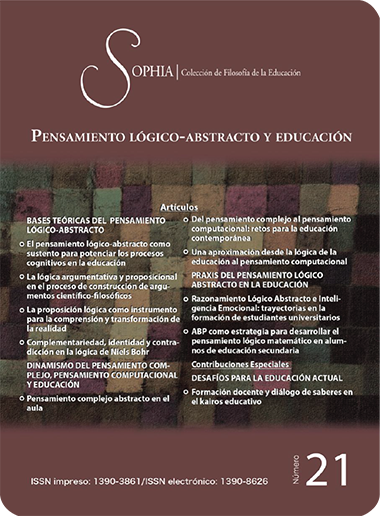
Complex thinking to computational thinking: contemporary challenges in education
Article Sidebar
Main Article Content
Abstract
One of the problems of education today is that it continues to favoring the teaching of contents instead applying skills and cognitive abilities that allow a development of the thought of the students. Besides a traditional education, it is considered that a reflection of the complex thought can contribute to a better understanding of a contemporary reality. Education today has as a challenge the explanation and understanding, from a hermeneutic perspective, of the new complexities of reality to the occurrence and the everyday use of the internet, ICTS web 2.0 and
social networks. For this reason, the proposal of this article is that there is a relationship between complex thinking and computational thinking that affects an improvement of the quality of education. This research focuses on a reflection on education from the conception of uncertainty and complexity. It refer to the relationship between a complex thought and a computational thinking from connectivism and the challenges of a society 3.0 in which ICT is incorporated into the daily life of human beings. In the other hand, a definition of computational thinking will put us on this new way of thinking from real problems through a new computational logic to achieve solutions. The computational thinking challenges the contemporary education to incorporate this new approach to the solution of problems, building systems and prospective understanding of the
relationship between science, technology and society 3.0.
Article Details
Authorship: The list of authors signing must include only those people who have contributed intellectually to the development of the work. Collaboration in the collection of data is not, by itself, a sufficient criterion of authorship. "Sophia" declines any responsibility for possible conflicts arising from the authorship of the works that are published.
Copyright: The Salesian Polytechnic University preserves the copyrights of the published articles, and favors and allows their reuse under the Creative Commons Attribution-NonCommercial-ShareAlike 3.0 Ecuador license. They may be copied, used, disseminated, transmitted and publicly displayed, provided that: i) the authorship and the original source of their publication (journal, editorial and work URL) are cited; (Ii) are not used for commercial purposes; Iii) mention the existence and specifications of this license.
References
2015 Recuperado el 22 de agosto de 2016, de https://code.org/
Code Club
2016 Recuperado el 22 de agosto de 2016, de https://www.codeclubworld.org/
Coderise
2016 Recuperado el 22 de agosto de 2016, de http://coderise.org
Eduteka
2016 Recuperado el 22 de agosto de 2016, de http://eduteka.icesi.edu.co/
AVILÉS, Mauro
2013 Hermenéutica analógica y educación superior. Revista Sophia: Colección en Filosofía de la Educación, 15, 149-163.
BRENAN, Karen, & RESNICK, Mitchel
2012 Nuevas propuestas para evaluar el desarrollo dell pensamiento computacional. Obtenido de Eduteka: http://eduteka.icesi.edu.co/articulos/EvaluarPensamientoComputacional
CHUN, Benjamin, & PIOTROWSKI, Tim
2012 Pensamiento computacional ilustrado. Obtenido de Eduteka: http://www.calameo. com/read/0001706218d162b5b27f9
COBO, Cristóbal, & MORAVEC, John
2011 Aprendizaje invisible. Hacia una nueva ecología de la educación. Barcelona: Publicacions i Edicions de la Universitat de Barcelona.
GREENFIELD, Adam
2006 Everyware. The dawning age of ubiquitous computing. Obtenido de http:// www.pdf-archive.com/2014/07/26/everyware/everyware.pdf
HAN, Byung-Chul
2012 La sociedad del cansancio. Barcelona: Herdes.
HOUTART, Francois
2006 La Ética de la incertidumbre en las ciencias sociales. La Habana: Casa Editorial Ruth.
MORAVEC, John
2013 Knowmad society. Minneapolis: Education Futures.
MORIN, Edgar
2007 Introducción al pensamiento complejo. Barcelona: Gedisa.
MOYA, Mónica
2013 De las TICs a las TACs: la importancia de crear contenidos educativos. Revista DIM (27).
PÉREZ-GÓMEZ, Ángel
2010 Aprender a educar. Nuevos desafíos para la formación de docentes. Revista Interuniversitaria de Formación del Profesorado, 68 (24,2), 37-60.
PÉREZ, Hamilton, & ROIG-VILA, Rosabel
2015 Entornos de programación no mediados simbólicamente para el desarrollo del pensamiento computacional. Una experiencia en la formación de profesores de Informática de la Universidad Central del Ecuador. RED. Revista de Educación a Distancia, 46(9), 22. 15 de septiembre.
SIEMENS, George
2014 Conectivismo: una teoría de aprendizaje para la era digital. Obtenido de http://www.diegoleal.org/docs/2007/Siemens(2004)-Conectivismo.doc
VALVERDE, Jesús, FERNÁNDEZ, Rosa, & GARRIDO, María del Carmen
2015 El pensamiento computacional y las nuevas ecologías del aprendizaje. RED. Revista de Educación a Distancia, 46(9). 15 de septiembre
WING, Jeannette
2006 Computational Thinking. Obtenido de CACM viewpoint: https://www.
cs.cmu.edu/~15110-s13/Wing06-ct.pdf
2009 Obtenido de Computational Thinking and Thinking About Computing:
https://competencias3m.files.wordpress.com/2011/08/traduccion-jeannet
te-m-wing-computational-thinking-and-thinking-about-computing.pdf, 10 de octubre