

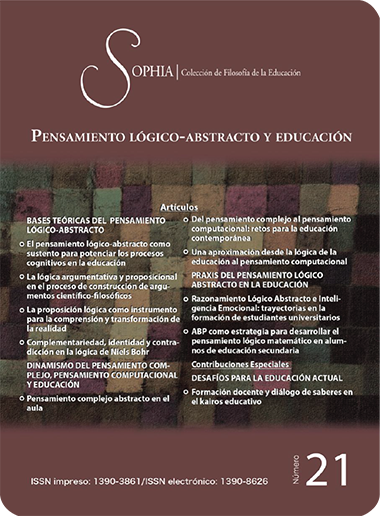
ABP as a strategy to develop mathematical logical thinking in high school students
Article Sidebar
Main Article Content
Abstract
In the latest PISA assessment conducted in Mexico (2015 ) , the third graders of high school, on average, were located on level two “ students can interpret and recognize situations in context that require only direct inferences “ by what the research project proposes to implement strategies to achieve the level IV on mathematics skills specified by PISA. This level considers “ students are able to work effectively with explicit models for complex concrete situations” favoring the mathematical logical thinking of students.
The research was conducted with 60 subjects from 14 to 15 years attending the Technical Secondary School No. 78 “ Dr. Guillermo Massieu Helguera”, in the Municipality of Chimalhuacán in the State of Mexico. The sample is not random without randomization with an intact group with pretest and posttest. It is an exploratory quantitative research scope. The purpose is to make a first approximation to obtain data to meet and propose inputs and strategies that support the development of mathematical and logical skills of abstract thinking.
Implementation of an instrumental design considering the strategy of problem-based learning, which can generate significant new knowledge was resulted that the strategy implemented 92.4 % of students used the knowledge gained to select viable alternative solutions to problems, 73.3 % established relationships between variables of a problem using mathematical language and 66% through language could pose a problem for algebraic solution. The results are considered relevant but are not representative.
Article Details
Authorship: The list of authors signing must include only those people who have contributed intellectually to the development of the work. Collaboration in the collection of data is not, by itself, a sufficient criterion of authorship. "Sophia" declines any responsibility for possible conflicts arising from the authorship of the works that are published.
Copyright: The Salesian Polytechnic University preserves the copyrights of the published articles, and favors and allows their reuse under the Creative Commons Attribution-NonCommercial-ShareAlike 3.0 Ecuador license. They may be copied, used, disseminated, transmitted and publicly displayed, provided that: i) the authorship and the original source of their publication (journal, editorial and work URL) are cited; (Ii) are not used for commercial purposes; Iii) mention the existence and specifications of this license.
References
1999 El aprendizaje basado en problemas-un enfoque investigativo. Buenos Aires: Manantial SRL.
BIGGS, John
1988 Approaches to learning and to assay writing. Learning strategies and learning styles. New York: R. Sarachek.
CORD
2003 Enseñanza contextual de las matemáticas, piedra angular del cambio de paradigmas. Estados Unidos de América: CORD Comunications.
GUEVARA, Gabriela
2010 Aprendizaje basado en problemas como técnica didáctica para la enseñanza del tema de la recursividad. Revista Intercedes, XI(XX). Revista electrónica de las sedes regionales de la Universidad de Costa Rica.
2011 Vicerrectoría Académica, Dirección de Investigación y Desarrollo Educativo. El Aprendizaje Basado en Problemas como técnica didáctica. http://www.sistema.itesm.mx/va/dide/inf-doc/estrategias/, 31 de mayo de 2016.
LEYVA B., Yolanda
2010 Evaluación del aprendizaje: una guía práctica para profesores. www.ses.unam.mx/curso2012/pdf/Guía_evaluación_aprendizajes2010.pdf.porYELBarajas-2010, 9 de mayo de 2016.
MILLA, Milagros
2012 Pensamiento crítico en estudiantes de 5° de secundaria de los colegios de Carmen de la Legua Callao (Tesis de maestría). Lima: Universidad San Ignacio de Loyola. www.academia.edu./.../2012_Milla_Pensamiento-crítico-en-estu
diantesde quinto-de-secundaria. 3 de junio de 2016.
MORALES, Patricia & LANDA, Virginia
2004 Aprendizaje basado en problemas. Lima: PUCP Departamento de Ciencias,sección química.
OCDE
2002 Aptitudes para lectura, matemáticas y ciencias. París: OCDE. México: Aula XXI. Santillana.
2006 El programa de PISA de la OCDE, qué es y para qué sirve. Paris: OCDE. México: Grupo Santillana
2012 Assessing Scientific, Reading and Mathematical Literacy. A Framework for PISA 2012. OECD Publishing.
RODRÍGUEZ, Fernando
2015 Reprueba la educación en México. http://expansión.mx/.../2015/06/.../ocdereprueba-
la-educación-en-méxico-graficas-de-la-semana. 5 de junio de
2016.
SECRETARÍA DE EDUCACIÓN PÚBLICA
2012 Educación por Niveles. México: SEP.
VIZCARRO, Carmen
2010 La metodología del aprendizaje basado en problemas. ¿Qué es y cómo funciona el aprendizaje basado en problemas? Madrid: Universidad Autónoma de Madrid. http://ub.edu/dikasteia/LIBRO_MURCIA.pdf, 6 de junio de 2016.