

Educación emprendedora y bienestar en los emprendimientos nacientes universitarios
Barra lateral del artículo
Contenido principal del artículo
Resumen
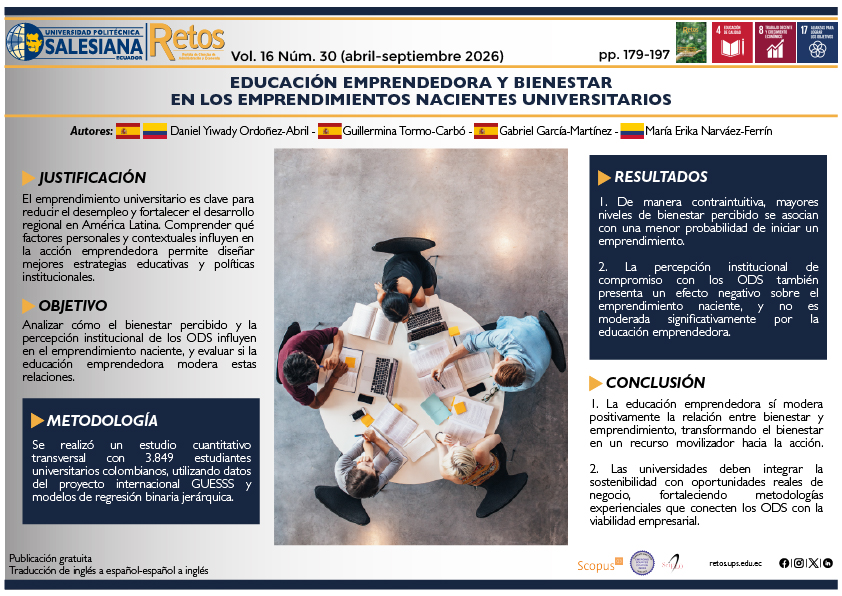
El desarrollo de la actividad emprendedora entre estudiantes es clave para reducir las tasas de desempleo y configurar el desarrollo regional. Este estudio explora el impacto del bienestar percibido por los estudiantes; el grado en que perciben que la universidad está orientada a la consecución de los Objetivos de Desarrollo Sostenible (ODS); y la educación como moderadora del emprendimiento naciente. Se adoptó un enfoque cuantitativo transversal, realizando un análisis de regresión binaria en una muestra de 3849 estudiantes universitarios, utilizando un cuestionario estructurado basado en el proyecto internacional GUESSS, adaptado para Latinoamérica. La variable dependiente fue emprendimiento incipiente (NES), medida como variable dicotómica. Las variables independientes correspondieron a percepciones de: (1) bienestar estudiantil (PWb) e (2) institucional de los ODS, mientras que (3) la educación emprendedora (EDU) se incorporó como moderadora. Los resultados muestran predominancia de mujeres (56.1 %), padres trabajadores independientes (52.4 %) y actividades de formación emprendedora del 22.8 %. Asimismo, se evidencia de manera contraintuitiva, que el bienestar percibido y la percepción institucional de los ODS tienen un efecto negativo y significativo sobre el emprendimiento naciente. Sin embargo, la educación emprendedora modera positivamente la relación entre bienestar y emprendimiento, atenuando dicho efecto e incrementando la probabilidad de acción emprendedora. Concluyéndose que la educación en emprendimiento naciente mejora la relación entre factores personales y contextuales, aumentando la probabilidad de los estudiantes en ser emprendedores emergentes.
Detalles del artículo

Esta obra está bajo una licencia internacional Creative Commons Atribución-NoComercial-CompartirIgual 4.0.
Autoría: La lista de autores firmantes debe incluir únicamente a aquellas personas que hayan contribuido intelectualmente al desarrollo del trabajo. La colaboración en la recogida de datos no es, por sí misma, criterio suficiente de autoría. "Retos" declina toda responsabilidad por posibles conflictos derivados de la autoría de los trabajos que se publiquen.
Derechos de autor: La Universidad Politécnica Salesiana preserva los derechos de autor de los artículos publicados, y favorece y permite su reutilización bajo la licencia Creative Commons Attribution-NonCommercial-ShareAlike 3.0 Ecuador. Pueden ser copiados, utilizados, difundidos, transmitidos y expuestos públicamente, siempre y cuando: i) se cite la autoría y la fuente original de su publicación (revista, editorial y URL del trabajo); (Ii) no se utilicen con fines comerciales; Iii) se mencione la existencia y especificaciones de esta licencia.
Referencias
Alakaleek, W., Harb, Y. y Harb, A.A. (2023). The impact of entrepreneurship education: A study of entrepreneurial outcomes. The International Journal of Management Education, 21(2), 100800. https://doi.org/10.1016/j.ijme.2023.100800
Amorós J.E, Bonomo, O.A, & Sosa, J.C. (2024), Guest editorial: Sustainable entrepreneurship: a new approach in Latin America and the Caribbean. Management Research: Journal of the Iberoamerican Academy of Management, 22(3), 213-229. https://doi.org/10.1108/MRJIAM-08-2024-977
Amorós, J. E., Bosma, N. y Levie, J. (2016). Ten years of global entrepreneurship monitor: Accomplishments and prospects. International Journal of Entrepreneurial Venturing. 5(2),1-9. http://dx.doi.org/10.1504/IJEV.2013.053591
Amorós, J. E., Cristi, O. y Naudé, W. (2021) Entrepreneurship and subjective well-being: Does the motivation to start-up a firm matter? J. Bus. Res. 127, 389-398. https://doi-org.bibliotecavirtual.unad.edu.co/10.1016/j.jbusres.2020.11.044
Aragón, C., Cabrera, M. y Iturrioz, C. (2024). Leadership succession and transgenerational entrepreneurship in family firms: an evolutionary perspective of familiness. European Journal of Family Business, 14(1), 54-71. https://doi.org/10.24310/ejfb.14.1.2024.18799
Arce, D. y Gordillo, E. (2023). Abordaje socioeducativo para promover el emprendimiento con jóvenes en vulnerabilidad: Caso Fundación Salesiana PACES. Revista San Gregorio, 1(55), 237-253. https://doi.org/10.36097/rsan.v1i55.2103
Baldacchino, L. y Sassetti, S. (2025). The Effects of Coping Strategies on Entrepreneurs' Psychological Well‐Being Under Uncertainty. Strategic Change, 34(2), 253-265. https://doi.org/10.1002/jsc.2613
Borsi, B. y Dőry, T. (2020). Perception of multilevel factors for entrepreneurial innovation success: A survey of university students. Acta Oeconomica, 70(4), 615-632. https://doi.org/10.1556/032.2020.00039
Contreras, N., Acuña, E., Oyanedel, J. C., Salazar, G., Vega, A. y Ariza, A. (2022). Well-being and entrepreneurship intention: an empirical study of new perspectives. Sustainability, 14(7), 3935. https://doi.org/10.3390/su14073935
Di Paola, N., Meglio, O. y Vona, R. (2023). Entrepreneurship education in entrepreneurship laboratories. International Journal of Management Education, 21(2), 100793. https://doi.org/10.1016/j.ijme.2023.100793
Diener, E., Suh, E. M., Lucas, R. E. y Smith, H. L. (1999). Subjective well-being: Three decades of progress. Psychological Bulletin, 125(2), 276-302.https://doi.org/10.1037/0033-2909.125.2.276
Edelman, L. F., Manolova, T. S., Shirokova, G. y Tsukanova, T. (2016). The impact of family support on young entrepreneurs' start-up activities. Journal of Business Venturing, 31(4), 428-448. https://doi.org/10.1016/j.jbusvent.2016.04.003
Espinoza, R. F. R., Huertas, K. S., Obando, E. C. y Cordova, F. (2023). Corporate social responsibility in Latin-American corporations: Role and importance. Problems & Perspectives in Management, 21(2), 642-652. http://dx.doi.org/10.21511/ppm.21(2).2023.58
Fayolle, A. (2013). Personal views on the future of entrepreneurship education. Entrepreneurship & Regional Development, 25(7-8), 692-701. https://doi.org/10.1080/08985626.2013.821318
Galindo, M, Méndez, M. y Castaño, M. (2020). The role of innovation and institutions in entrepreneurship and economic growth in two groups of countries. International Journal of Entrepreneurial Behavior & Research, 26(3), 485-502. https://doi.org/10.1108/IJEBR-06-2019-0336
Guerrero, M. y Lira, M. (2023). Entrepreneurial university ecosystem’s engagement with SDGs: looking into a Latin-American University. Community Development, 54(3), 337-352. https://doi.org/10.1080/15575330.2022.2163411
Hassan, A., Anwar, I., Saleem, I., Islam, K. y Hussain, S. (2021). Individual entrepreneurial orientation, entrepreneurship education and entrepreneurial intention: The mediating role of entrepreneurial motivations. Industry and Higher Education, 35(4), 403-418.https://doi.org/10.1177/09504222211007051
Holienka, M., Pilkova, A. y Jancovicova, Z. (2017). Youth entrepreneurship in Visegrad countries. Entrepreneurship and Sustainability Issues, 4(4), 577-591.http://dx.doi.org/10.15678/EBER.2016.040407
Jin, X. y Ye, Y. (2022). Impact of fine arts education on psychological wellbeing of higher education students through moderating role of creativity and self-efficacy. Front. Psychol. 13, 1-10. https://bit.ly/4r51DMe
Laspita, S., Breugst, N., Heblich, S. y Patzelt, H. (2012). Intergenerational transmission of entrepreneurial intentions. Journal of Business Venturing, 27(4), 414-435. https://doi.org/10.1016/j.jbusvent.2011.11.006
Laspita, S., Sitaridis, I. y Sarri, K. (2024). The Effect of Sustainable Development Goals and Subjecting Well-Being on Art Nascent Entrepreneurship: The Moderating Role of Entrepreneurship Education. Education Sciences, 14(5), 491. https://doi.org/10.3390/educsci14050491
Lechuga, M. y Rincón, I.B. (2024). Emprendimiento rural femenino, una forma de vida en las comunidades rurales de la sierra en el estado de Durango, México. Aposta. Revista de Ciencias Sociales, 101, 97-110, https://bit.ly/4rN8cVd
Leiva, J. C., Mora, R., Krauss, C., Bonomo, A. y Solís, M. (2021), Entrepreneurial intention among Latin-American university students. Academia Revista Latinoamericana de Administracion, 34(3), 399-418. https://doi.org/10.1108/ARLA-05-2020-0106
Lent, R. W., Brown, S. D. y Hackett, G. (2000). Contextual supports and barriers to career choice: A social cognitive analysis. Journal of Counseling Psychology, 47(1), 36-49. https://doi.org/10.1177/1069072707305769
Lyu, J., Shepherd, D. y Lee, K. (2023). From intentional to nascent student entrepreneurs: The moderating role of university entrepreneurial offerings. Journal of Innovation & Knowledge, 8(1),100305. https://doi.org/10.1016/j.jik.2023.100305
Mahfud, T., Abdul, G. y Nur, K. (2025) How to boost entrepreneurial intentions among students? A systematic literature review. Pertanika Journal of Social Sciences & Humanities. 33(4), 1545-1568. https://doi.org/10.47836/pjssh.33.4.07
Montes, J., Ávila, L., Hernández, D., Apodaca, L., Zamora, S. y Cordova, F. (2023). Impact of entrepreneurship education on the entrepreneurial intention of university students in Latin America. Cogent Business & Management, 10(3), 2282793. https://doi.org/10.1080/23311975.2023.2282793
Nabi, G., Liñán, F., Fayolle, A., Krueger, N. y Walmsley, A. (2017). The impact of entrepreneurship education in higher education: A systematic review and research agenda. Academy of management learning & education, 16(2), 277-299. https://doi.org/10.5465/amle.2015.0026
Núñez, J. M., Puccia, A. y González, M. (2024). Empowering tomorrow's entrepreneurs: unraveling the connections between SDG knowledge, attitudes towards sustainability and sustainable entrepreneurship on sustainable behaviors. Discov Sustain., 5, 406. https://doi.org/10.1007/s43621-024-00652-1
Ryff, C.D. (1989). Happiness is everything, or is it? Explorations on the meaning of psychological well-being. Journal of Personality and Social Psychology, 57(6), 1069-1081. https://bit.ly/40AxSZ0
Shir, N., Nikolaev, B. N. y Wincent, J. (2019). Entrepreneurship and well-being: The role of psychological autonomy, competence, and relatedness. J. Bus. Ventur., 34, 105875. https://doi.org/10.1016/j.jbusvent.2018.05.002
Shirokova, G., Osiyevskyy, O. y Bogatyreva, K. (2017). Exploring the intention-behavior link in student entrepreneurship. International Small Business Journal, 34(1), 60-82. https://doi.org/10.1016/j.emj.2015.12.007
Shirokova, G., Osiyevskyy, O., Bogatyreva, K., Edelman, L. y Manolova, T. (2021). Moving from intentions to actions in youth entrepreneurship: An institutional perspective. Entrepreneurship Research Journal, 12(1), 25-69. https://doi.org/10.1515/erj-2019-0201
Steira I. M, Wigger K. y Rasmussen E (2024). Variety of entrepreneurial skills measured in the entrepreneurship education literature. Education+Training, 66(7), 755-776. https://doi.org/10.1108/ET-09-2023-0374
Taneja, M., Kiran, R. y Bose, S.C. (2023). Assessing entrepreneurial intentions through experiential learning, entrepreneurial self-efficacy, and entrepreneurial attitude. Studies in Higher Education, 49(1), 98-118. https://doi.org/10.1080/03075079.2023.2223219
Tsaknis, P. A., Sahinidis, A. G., Kavoura, A. y Kiriakidis, S. (2025). The differential effects of personality traits and risk aversion on entrepreneurial intention following an entrepreneurship course. Administrative Sciences, 15(2), 53-68. https://doi.org/10.3390/admsci15020053
Valencia, A., Londoño, W. y Moya, L.P. (2025). Sustainable entrepreneurial intention in undergraduates: the influence of entrepreneurship education. Discov Sustain., 6, 588. https://doi.org/10.1007/s43621-025-01379-3
Vallejo, I. R. y Robalino, A. (2025). The role of Latin-American universities in entrepreneurial ecosystems: a multi-level study of academic entrepreneurship in Ecuador. Administrative Sciences, 15(3),108-134. https://doi.org/10.3390/admsci15030108
Zancanaro, M., Mathias, T. y Hahn, I. S. (2024). O papel das instituições de ensino superior na promoção da inovação e empreendedorismo para o desenvolvimento regional. Revista on Line De Política E Gestão Educacional, 28(00), e023027. https://doi.org/10.22633/rpge.v28i00.19742