

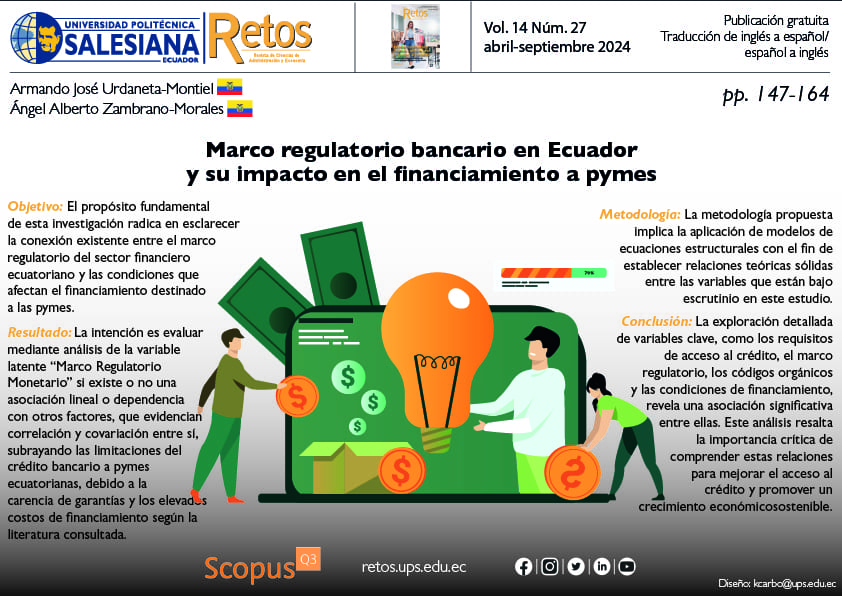
Banking regulatory framework in Ecuador and its impact on SME financing
Article Sidebar
Main Article Content
Abstract
The investigation, contextualized within the quantitative epistemological approach and the positivist paradigm, allowed determining the relationship between the regulatory framework of the financial sector in Ecuador and the financing conditions for SMEs. This was of a descriptive-correlational type, allowing a descriptive and factorial analysis of variables related to the knowledge and application of laws and regulatory codes by 54 credit officers in the banking sector of El Oro, Ecuador. Two dimensions were identified: one related to the monetary regulatory framework and another to organic codes. Surveys indicate that the most applied laws are the General Law of Institutions of the Financial Sector and the Company Law. The first regulates the creation, operation, and closure of private financial institutions in Ecuador to protect the population and ensure financial stability. The Banking Superintendence supervises and controls their regulatory and operational compliance. The second simplifies and expedites the process of establishing companies, allowing various types of companies and flexibility in their structure. The Ecuadorian banking regulatory framework has undergone reforms to strengthen the solidity and transparency of the system, such as the Securities Market Law and the Law of Institutions of the Private Insurance System, which have contributed to stability, regulation, consumer financial protection, and promotion of competition, generating more favorable financing conditions, including trust, competitive interest rates, and a wide range of financial options.Principio del formulario
Article Details

This work is licensed under a Creative Commons Attribution-NonCommercial-ShareAlike 4.0 International License.
Authorship: The list of authors signing must include only those people who have contributed intellectually to the development of the work. Collaboration in the collection of data is not, by itself, a sufficient criterion of authorship. "Retos" declines any responsibility for possible conflicts arising from the authorship of the works that are published.
Copyright: The Salesian Polytechnic University preserves the copyrights of the published articles, and favors and allows their reuse under the Creative Commons Attribution-NonCommercial-ShareAlike 3.0 Ecuador license. They may be copied, used, disseminated, transmitted and publicly displayed, provided that: i) the authorship and the original source of their publication (journal, editorial and work URL) are cited; (Ii) are not used for commercial purposes; Iii) mention the existence and specifications of this license.
References
Acosta, G. R. (2019). Responsabilidad social empresarial: Inclusión financiera en el sistema bancario privado ecuatoriano. Visión de Futuro, 23(1), 1-11. https://bit.ly/3UUH20S
Ahmed, S., Ejaz Majeed, M., Thalassinos, E. y Thalassinos, Y. (2021). The impact of bank specific and macro-economic factors on non-performing loans in the banking sector: Evidence from an emerging economy. Journal of Risk and Financial Management, 14(217). 1-14. https://doi.org/10.3390/jrfm14050217
Álvarez, J., Cabrera, P. y Jácome, H. (2023). Territorial inequalities in financial inclusion: A comparative study between private banks and credit unions. Socio-Economic Planning Sciences, 87(Part A). https://doi.org/10.1016/j.seps.2023.101561
Amadasun, D. y Mutezo, A. (2022). Infuence of access to fnance on the competitive growth of SMEs in Lesotho. Journal of Innovation and Entrepreneurship, 11(1), 1-20. doi:https://doi.org/10.1186/s13731-022-00244-1
Anzules, W. y Novillo, S. (2023). Innovation capacity, entrepreneurial orientation, and flexibility: an analysis from industrial SMEs in Ecuador. Sustainability, 15(13), 1-24. https://doi.org/10.3390/su151310321
Asamblea Nacional del Ecuador. (2018). Código Orgánico Monetario y Financiero. Quito, Ecuador.
Asamblea Nacional del Ecuador. (2021). Ley Orgánica de Emprendimiento e Innovación. Suplemento del Registro Oficial No. 151 , 28 de Febrero 2020.
Bacuilima, E., Morocho, J., Aguirre, J., Coronel, K. y Mora, P. (2023). Financing Ecuadorian social enterprises: what is the role of impact investment? Sustainability, 15(14), 1-19. https://doi.org/10.3390/su151411210
Bakhtiari, S., Breunig, R., Magnani, L. y Zhang, J. (2020). Financial constraints and small and medium enterprises: a review. Economic Recor, 96. 1-8. https://doi.org/10.1111/1475-4932.12560
Beck, T., Demirguc-Kunt, A. y Maksimovic, V. (2008). Financing patterns around the world: Are small firms different? Journal of Financial Economics, 89(3), 467-487. https://doi.org/10.1016/j.jfineco.2007.10.005
Briozzo, A. y Albanese, D. (2020). Voluntary audit, investment, and financing decisions in Latin American small and medium enterprises. Journal of International Accounting, Auditing and Taxation, 38,1-11. https://doi.org/10.1016/j.intaccaudtax.2020.100302
Bruner, J. S. (2018). Desarrollo cognitivo y educación. Ediciones Morata.
Byrne, B. M. (2021). Structural equation modeling with AMOS: basic concepts, applications, and programming. (4th ed.). Routledge. https://doi.org/10.4324/9781315757421
Cheong, C., Huui, M. y Arul, M. (2020). Credit access, tax structure and the performance of Malaysian manufacturing SMEs. International Journal of Managerial, 16(4), 433-454. https://doi.org/10.1108/IJMF-08-2019-0308
Contractor, F. J., Nuruzzaman, N., Dangol, R. y Raghunath, S. (2021). How FDI inflows to emerging markets are influenced by country regulatory factors: an exploratory study. Journal of International Management, 27(1). https://doi.org/10.1016/j.intman.2021.100834
Corredera, F., Di Pietro, F. y Trujillo, A. (2021). Post COVID 19 SME fnancing constraints and the credit guarantee scheme solution in Spain. Journal of Banking Regulation, (22), 250-260. https://doi.org/10.1057/s41261-021-00143-7
Demirguc, A., Martinez, M. y Tressel, T. (2019). The global financial crisis and the capital structure of firms: Was the impact more severe among SMEs and non-listed firms? Journal of Corporate Finance, 60. 1-66. https://doi.org/10.1016/j.jcorpfin.2019.101514
Espinoza, G. (2020). El Crédito Bancario y las Pymes en Ecuador. YACHANA, 9(2), 77-90. https://doi.org/10.62325/10.62325/yachana.v9.n2.2020.649
Feijó, N., Ceular, N. y Navajas, V. (2023). Behavioral patterns that influence the financing choice models of small enterprises in Ecuador through latent class analysis. Sustainability, 15(8), 1-17. https://doi.org/10.3390/su15086790
Gana, K. y Broc, G. (2021). Structural equation modeling: an introduction using R and R-Studio. Routledge.
Hair, J., Hult, T., Ringle, C., Sarstedt, M., Danks, N. y Ray, S. (2021). Partial Least Squares Structural Equation Modeling (PLS-SEM) Using R. Springer.
Henseler, J., Hubona, G. y Ray, P. A. (2021). Using PLS Path modeling in new technology research: updated guidelines. Industrial Management & Data Systems, 121(1), 2-20. https://doi.org/10.1108/IMDS-09-2015-0382
Hurtado, J. (2012). Metodología de la investigacion. Guía para la comprension holística de la ciencia. Quirón ediciones.
Johnson, R. A. y Wichern, D. W. (2022). Applied Multivariate Statistical Analysis. Pearson.
Karakaya-Ozyer, K. y Aksu-Dunya, B. (2018). A review of structural equation modeling applications in Turkish educational science literature. International Journal of Research in Education and Science, 4(1), 279-291. https://doi.org/10.21890/ijres.383177
Kumar, K. (2022). Research Methodology in Social Science. K.K. Publications.
Lam, T., Nhien, D., Anh, T., Xuan, T., Thuy, T. y Uyen, T. (2022). The impact of supply chain financing on SMEs performance in Global supply chain. Uncertain Supply Chain Management, 10, 255-270. https://doi.org/10.5267/j.uscm.2021.9.003
Lasak, P. (2022). The role of financial technology and entrepreneurial finance practices in funding small and medium-sized. Journal of Entrepreneurship, Management and Innovation, 18(1), 7-34. https://doi.org/10.7341/20221811
Liu, Y., Dilanchiev, A., Xu, K. y Merdan, A. (2022). Financing SMEs and business development as new post Covid-19 economic recovery determinants. Economic Analysis and Policy, 76, 554-567. https://doi.org/10.1016/j.eap.2022.09.006
Manaces, G., Rivera, G., Zambrano, M. y Triviño, K. (2023). Constitution of popular and solidary economic organizations in post-pandemic for the Ecuadorian economic reactivation. Baltic Journal of Law & Politics, 16(3), 1-10. https://doi.org/10.2478/bjlp-2023-00000111
Mejía-Escobar, J., González-Ruiz, J. y Duque-Grisales, E. (2020). Sustainable financial products in the Latin America banking industry: Current status and insights. Sustainability, 12(5648),1-25. https://doi.org/10.3390/SU12145648
Motta, V. y Sharma, A. (2019). Lending technologies and access to finance for SMEs in the hospitality industry. International Journal of Hospitality Management, 86, 1-9. https://doi.org/10.1016/j.ijhm.2019.102371
Mpofu, O. y Bongani, A. (2022). Informal finance: a boon or bane for African SMEs? Journal of Risk and Financial Management, (15), 1-15. https://doi.org/10.3390/jrfm15060270
Páez Pérez, P., Jaramillo Vasconez, O. y Ramírez González, R. (mayo de 2021). Concentración y tasas de interés en el sistema financiero ecuatoriano. Economía, 73(1), 93-104. htps://doi.org/10.29166/economia.v73i117.2629
Proaño, B. y Feria, J. (2022). Are Ecuadorian banks enough technically efficient for growth? A clinical study. WILEY, 1-19. https://doi.org/10.1002/ijfe.2775
Pu, G., Qamruzzaman, M., Muneeb, A. N. y Karim, S. (2021). Innovative finance, technological adaptation and SMEs Sustainability: the mediating role of government support during COVID-19 Pandemic. Sustainability, (13), 1-27. https://doi.org/10.3390/su13169218
Sellbom, M. y Tellegen, A. (2019). Factor analysis in psychological assessment research: Common pitfalls and recommendations. Psychological Assessment, 21(12), 1428-1441. https://doi.org/10.1037/pas0000623
Van, N., Thi, T., Duc, T., Dinh, V., Thi, N., Van, D., Mingh, N., Van, T., Dang, N. y Ba, T. (2021). SME fnancing role in developing business environment and economic growth: empirical evidences from technical SMEs in Vietnam. Environmental Science and Pollution Research, 29. https://doi.org/10.1007/s11356-022-19528-w
Vogt, W. (2015). Structural Equation. Dictionary of Statistics & Methodology.
Zhavoronok, A., Shchur, R., Zhezherun, Y., Sadchykova, I., Viadrova, N. y Tychkovska, L. (2022). The role of the credit services market in ensuring stability of the banking system. International Journal of Safety and Security Engineering, 12(6), 667-679. https://doi.org/1org/10.18280/ijsse.120602