

Prediction of online purchase behavior: an application of the S-O-R Model
Article Sidebar
Main Article Content
Abstract
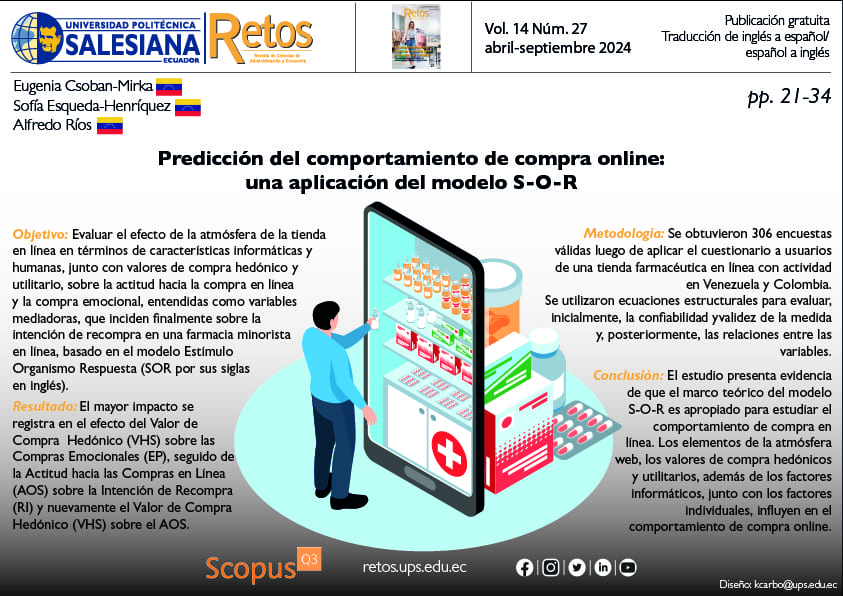
The objective of this study was to evaluate the effect of the online store atmosphere, shopping values, attitude toward online shopping and emotions on the repurchase intention in an online store, based on the Stimulus-Organism-Response model (S-O-R). Although these elements
have been studied in the context of brick-and-mortar stores, recent articles that analyze the influence of these elements in the online environment
demonstrate the relevance of this study in current marketing research. The results of an online survey conducted with 306 users of an online
pharmaceutical store, which included residents of Venezuela and of other Latin American countries, were analyzed using structural equations, evaluating both the measurement model and the relationship model. The findings allow us to conclude that the use of the S-O-R model is appropriate
in predicting online purchase behavior, having achieved an adequate fit, and confirm that the hedonic purchase value has a significant direct
impact on both the attitude toward online shopping and the emotional purchase. On the other hand, the utilitarian purchase value negatively
affects the emotional purchase and the computer factor favors the attitude toward online purchase. Finally, the attitude toward online shopping
and the emotional purchase predicts the repurchase intention. Implications for marketers are discussed.
Article Details

This work is licensed under a Creative Commons Attribution-NonCommercial-ShareAlike 4.0 International License.
Authorship: The list of authors signing must include only those people who have contributed intellectually to the development of the work. Collaboration in the collection of data is not, by itself, a sufficient criterion of authorship. "Retos" declines any responsibility for possible conflicts arising from the authorship of the works that are published.
Copyright: The Salesian Polytechnic University preserves the copyrights of the published articles, and favors and allows their reuse under the Creative Commons Attribution-NonCommercial-ShareAlike 3.0 Ecuador license. They may be copied, used, disseminated, transmitted and publicly displayed, provided that: i) the authorship and the original source of their publication (journal, editorial and work URL) are cited; (Ii) are not used for commercial purposes; Iii) mention the existence and specifications of this license.
References
Anaya-Sánchez, R., Castro-Bonaño, J. M. y González-Badía, E. (2020). Millennial consumer preferences in social commerce web design. Revista Brasileira de Gestao de Negócios, 22, 123-139. https://doi.org/10.7819/rbgn.v22i1.4038
Ajzen, I. (2008). Consumer Attitudes and Behavior. En C. P. Haugtvedt, P. M. Herr y F. R. Kardes (eds.), Handbook of Consumer Psychology (pp. 525-548). Lawrence Erlbaum Associates.
Anwar, A., Waqas, A., Zain, H. M. y Kee, D. M. H. (2020). Impact of music and colour on customers emotional states: An experimental study of online store. Asian Journal of Business Research, 10(1), 104-125. https://doi.org/10.14707/ajbr.200077
Babin, B. J., Darden, W. R. y Griffin, M. (1994). Work and/or fun: measuring hedonic and utilitarian shopping value. Journal of consumer research, 20(4), 644-656. https://doi.org/10.1086/209376
Baker, J., Grewal, D. y Parasuraman, A. (1994). The Influence of Store Environment on Quality Inferences and Store Image. Journal of the Academy of Marketing Science, 22(4), 328-339. https://doi.org/10.1177/0092070394224002
Bui, M. y Kemp, E. (2013). E-tail emotion regulation: examining online hedonic product purchases. International Journal of Retail & Distribution Management, 41(2), 155-170. https://doi.org/10.1108/09590551311304338
Calkins, S. D. y Hill, A., (2007). The emergence of emotion regulation: Biological and behavioral transactions in early development. En J. Gross, ed. Handbook of Emotion Regulation (pp. 229-248). Guilford Press.
Castillo, E. (2021). Environment, hedonic and utilitarian purchase value in the intention to repurchase in online stores: an approach from the S-O-R model. (Bachelor's degree). Andrés Bello Catholic University. Universidad Católica Andrés Bello.
Dailey, L. (2004). Navigational web atmospherics: Explaining the influence of restrictive navigation cues. Journal of Business Research, 57(7), 795-803. https://doi.org/10.1016/S0148-2963(02)00364-8
De Aguiar, S., Jucá de Queiroz, M., Bernardes de Queiroz, R. S. y Ascencao Guedes, L. F. (2019). The importance of the atmosphere of the environment in Brazilian physical retail in 2030. Brazilian Journal of Management, 12, 1278-1292. https://doi.org/10.5902/19834659 41854
Donovan, R. J., Rossiter, J. R., Marcoolyn, G. y Nesdale, A. (1994). Store atmosphere and purchasing behavior. Journal of retailing, 70(3), 283-294. https://doi.org/10.1016/0022-4359(94)90037-X
Donovan, R. J. y Rossiter, J.R. (1982). Store atmosphere: an environmental psychology approach. Journal of retailing, 58(1), 34-57.
Eroglu, S. A., Machleit, K. A. y Davis, L. M. (2001). Atmospheric qualities of online retailing: A conceptual model and implications. Journal of Business research, 54(2), 177-184. https://doi.org/10.1016/S0148-2963(99)00087-9
Forero-Bautista, A. y Ortegón-Cortázar, L. (2023). Por qué visitar lifestyle centers? Variables alternativas de atracción a través de un modelo de ecuaciones estructurales. RETOS. Revista de Ciencias de la Administración y Economía, 13(25), 87-103. https://doi.org/10.17163/ret.n25.2023.06
Fornell, C. y D. Larcker. (1981). Evaluating structural equation models with unobservable and measurement error. Journal of Marketing Research, 18(1), 39-50. https://doi.org/10.2307/3151312
Gatautis, R. y Vaiciukynaite, E. (2013). Website atmosphere: towards revisited taxonomy of website elements. Economics & Management, 18(3), 537-544. http://dx.doi.org/10.5755/j01.em.18.3.5285
Hair, J. F., Black, W. C., Babin, B. J., Anderson, R. E. y Tatham, R. L. (2006). Multivariate data analysis. Prentice Hall.
Hausman, A. V. y Siekpe, J. S. (2009). The effect of web interface features on consumer online purchase intentions. Journal of Business research, 62(1), 5-13. https://doi.org/10.1016/j.jbusres.2008.01.018
Hebbar, S., Kamath, G. B., Mathew, A. O. y Kamath, V. (2020). Attitude towards online shopping and its influence on purchase intentions: an urban Indian perspective. International Journal of Business Innovation and Research, 22(3), 326-341.https://doi.org/10.1504/IJBIR.2020.107961
Kim, Y. K. Park, S. H (2005). A consumer shopping channel extension model: attitude shift toward the online store. Journal of Fashion Marketing and Management, 9(1), 106-121. http://dx.doi.org/10.1108/13612020510586433
Kim, Y. K., Lee, M. Y. y Park, S. H. (2014). Shopping value orientation: Conceptualization and measurement. Journal of Business Research, 67(1), 2884-2890. https://doi.org/10.1016/j.jbusres.2012.06.006
Koo, D. M. y Ju, S. H. (2010). The interactional effects of atmospherics and perceptual curiosity on emotions and online shopping intention. Computers in Human Behavior, 26(3), 377-388. https://doi.org/10.1016/j.chb.2009.11.009
Kotler, P. (1973). Atmospherics as a marketing tool. Journal of retailing, 49(4), 48-64.
Lee, B. C. Y. (2007). Consumer attitude toward virtual stores and its correlates. Journal of Retailing and Consumer services, 14(3), 182-191. https://doi.org/10.1016/j.jretconser.2006.07.001
Manganari, E. E., Siomkos, G. J. y Vrechopoulos, A. P. (2009). Store atmosphere in web retailing. European Journal of Marketing, 43(9-10), 1140-1153. https://doi.org/10.1108/03090560910976401
Mehrabian, A. y Russel, J. (1974). An approach to Environmental Psychology. MIT Press.
Moon, M. A., Khalid, M. J., Awan, H. M., Attiq, S., Rasool, H. y Kiran, M. (2017). Consumers perceptions of website's utilitarian and hedonic attributes and online purchase intentions: A cognitive-affective attitude approach. Spanish Journal of Marketing-ESIC, 21(2), 73-88. https://doi.org/10.1016/j.sjme.2017.07.001
Nunnally, J. C. (1978). Psychometric theory. McGraw-Hill.
Peng, C. y Kim, Y. G. (2014). Application of the stimuli-organism-response (SOR) framework to online shopping behavior. Journal of Internet Commerce, 13(3-4), 159-176. https://doi.org/10.1080/15332861.2014.944437
Picot-Coupey, K., Krey, N., Huré, E. y Ackermann, C. L. (2021). Still work and/or fun? Corroboration of the hedonic and utilitarian shopping value scale. Journal of Business Research, 126, 578-590. https://doi.org/10.1016/j.jbusres.2019.12.018
Prashar, S., Sai Vijay, T. y Parsad, C. (2017). Effects of online shopping values and website cues on purchase behaviour: A study using S-O-R framework. Vikalpa, 42(1), 1-18. https://doi.org/10.1177%2F0256090916686681
Richard, M. O. (2005). Modeling the impact of internet atmospherics on surfer behavior. Journal of Business research, 58(12), 1632-1642. https://doi.org/10.1016/j.jbusres.2004.07.009
Sheeran, P. (2002). Intention behavior relations: a conceptual and empirical review. European review of social psychology, 12(1), 1-36. https://doi.org/10.1080/14792772143000003
Saricam, C. (2023). Analyzing the influence of store atmospherics on younger generation in apparel retail market with an extended SOR model. Journal of Global Fashion Marketing, 14(2), 143-156. https://doi.org/10.1080/20932685.2022.2032794
Spence, C. (2022). Experimental atmospherics: a multi-sensory perspective. Qualitative Market Research: An International Journal, 25(5), 662-673. https://doi.org/10.1108/QMR-04-2022-0070
Shukla, S. (2019). Neuromarketing: a change in marketing tools and techniques. International Journal of Business Forecasting and Marketing Intelligence, 5(3), 267-284. https://doi.org/10.1504/IJBFMI.2019.104044
Sututemiz, N. y Saygili, M. (2020). The effects of hedonic and utilitarian shopping motivations on online purchasing intentions: a Turkish case study. The retail and marketing review, 16(1), 61-83. https://hdl.handle.net/10520/EJC-1ea7711ded
Xiao, L., Guo, F., Yu, F. y Liu, S. (2019). The effects of online shopping context cues on consumers purchase intention for cross-border E-Commerce sustainability. Sustainability, 11(10), 2777. https://doi.org/10.3390/su11102777
Zhang, P. y Von Dran, G. M. (2000). Satisfiers and dissatisfiers: A two-factor model for website design and evaluation. Journal of the American society for information science, 51(14), 1253-1268.
https://doi.org/10.1002/1097-4571(2000)9999:9999%3C::AID-ASI1039%3E3.0.CO;2-O
Zhu, B., Kowatthanakul, S. y Satanasavapak, P. (2020), Generation Y consumer online repurchase intention in Bangkok: Based on Stimulus Organism-Response (SOR) model. International Journal of Retail & Distribution Management, 48(1), 53-69. https://doi.org/10.1108/IJRDM-04-2018-0071