

Strategic Drivers of Green Employment in Firms:Environmental Awareness, Resilience, and Technology
Article Sidebar
Main Article Content
Abstract
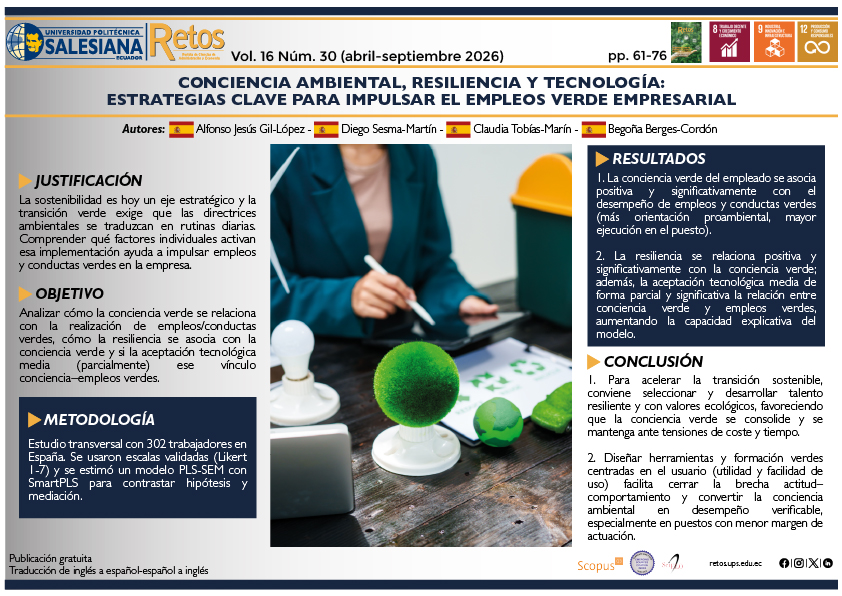
This study investigates the associations between individual factors and organizational outcomes related to sustainability, with a focus on the implementation of green jobs and green behaviors. Specifically, the analysis examines (a) the relationship between green awareness and green jobs, (b) the association between resilience and green awareness, and (c) the mediating role of technology acceptance in the relationship between green awareness and green jobs. A sample of 302 workers in Spain was analyzed using a PLS-SEM model (SmartPLS) with validated scales for technology acceptance, green awareness, green jobs/skills, and resilience (Likert 1–7). The results indicate that green awareness is positively associated with green job and behavior performance, resilience is positively related to green awareness, and technology acceptance partially mediates the effect of green awareness on green jobs. Among the control variables, education level does not show a significant effect, while job category is negatively associated with green jobs, possibly due to limited opportunities for action at lower hierarchical levels. Due to the cross-sectional design, these findings should be interpreted as associative rather than causal. Overall, the results highlight that integrating pro-environmental behavior and technology adoption provides insight into the attitude–behavior gap in the green transition and underscores the importance of selecting and developing resilient employees with ecological values, as well as designing user-centered green tools, training, and working conditions that support the translation of attitudes into environmental performance.
Article Details

This work is licensed under a Creative Commons Attribution-NonCommercial-ShareAlike 4.0 International License.
Authorship: The list of authors signing must include only those people who have contributed intellectually to the development of the work. Collaboration in the collection of data is not, by itself, a sufficient criterion of authorship. "Retos" declines any responsibility for possible conflicts arising from the authorship of the works that are published.
Copyright: The Salesian Polytechnic University preserves the copyrights of the published articles, and favors and allows their reuse under the Creative Commons Attribution-NonCommercial-ShareAlike 3.0 Ecuador license. They may be copied, used, disseminated, transmitted and publicly displayed, provided that: i) the authorship and the original source of their publication (journal, editorial and work URL) are cited; (Ii) are not used for commercial purposes; Iii) mention the existence and specifications of this license.
References
Aguinis, H. y Glavas, A. (2012). What we know and don’t know about corporate social responsibility: A review and research agenda. Journal of Management, 38(4), 932-968. https://doi.org/10.1177/0149206311436079
Ajzen, I. (1991). The theory of planned behavior. Organizational Behavior and Human Decision Processes, 50(2), 179-211. https://doi.org/10.1016/0749-5978(91)90020-T
Alherimi, N., Marva, Z., Hamarsheh, K. y Alzaatreh, A. (2024). Employees’ pro-environmental behavior in an organization: a case study in the UAE. Scientific Reports, 14, 15371. https://doi.org/10.1038/s41598-024-66047-4
Alt, E., Spitzeck, H. y Heidenreich, S. (2016). Improving environmental performance through unit-level organizational citizenship behaviors for the environment. Journal of Environmental Management, 182, 48-58. https://doi.org/10.1016/j.jenvman.2016.07.034
An, J., Di, H., Yao, M. y Jin, S. (2022). The role of payment technology innovation in environmental sustainability: Mediation effect from consumers’ awareness to practice. Frontiers in Environmental Science, 10, 881293. https://doi.org/10.3389/fenvs.2022.881293
Antonakis, J., Bendahan, S., Jacquart, P. y Lalive, R. (2010). On making causal claims: A review and recommendations. The Leadership Quarterly, 21(6), 1086-1120. https://doi.org/10.1016/j.leaqua.2010.10.010
Avey, J. B., Reichard, R. J., Luthans, F. y Mhatre, K. H. (2011). Meta-analysis of the impact of positive psychological capital on employee attitudes, behaviors, and performance. Human Resource Development Quarterly, 22(2), 127-152. https://doi.org/10.1002/hrdq.20070
Avey, J. B., Wernsing, T. S. y Luthans, F. (2008). Can positive employees help positive organizational change? Impact of psychological capital and emotions on relevant attitudes and behaviors. The Journal of Applied Behavioral Science, 44(1), 48-70. https://doi.org/10.1177/0021886307311470
Bakker, A. B. y Demerouti, E. (2007). The Job Demands–Resources model: State of the art. Journal of Managerial Psychology, 22(3), 309-328. https://doi.org/10.1108/02683940710733115
Bamberg, S. y Möser, G. (2007). Twenty years after Hines, Hungerford, and Tomera: A new meta-analysis of psycho-social determinants of pro-environmental behaviour. Journal of Environmental Psychology, 27(1), 14-25. https://doi.org/10.1016/j.jenvp.2006.12.002
Blake, J. (1999). Overcoming the 'value-action gap' in environmental policy: Tensions between national policy and local experience. Local Environment, 4(3), 257-278. https://doi.org/10.1080/13549839908725599
Bohnenberger, K. (2022). Is it a green or brown job? A Taxonomy of Sustainable Employment. Ecological Economics, 200, 107469. https://doi.org/10.1016/j.ecolecon.2022.107469
Boiral, O. (2009). Greening the corporation through organizational citizenship behaviors. Journal of Business Ethics, 87(2), 221-236. https://doi.org/10.1007/s10551-008-9881-2
Chen, M. F. y Tung, P. J. (2014). Developing an extended theory of planned behavior model to predict consumers’ intention to visit green hotels. International Journal of Hospitality Management, 36, 221-230. https://doi.org/10.1016/j.ijhm.2013.09.006
Connor, K. M. y Davidson, J. R. T. (2003). Development of a new resilience scale: The Connor‐Davidson Resilience Scale (CD-RISC). Depression and Anxiety, 18(2), 76-82. https://doi.org/10.1002/da.10113
Daddi, T., Testa, F., Frey, M. y Iraldo, F. (2016). Exploring the link between institutional pressures and environmental management systems effectiveness: An empirical study. Journal of Environmental Management, 183(Pt 3), 647-656. https://doi.org/10.1016/j.jenvman.2016.09.025
Davis, F. D. (1989). Perceived usefulness, perceived ease of use, and user acceptance of information technology. MIS Quarterly, 13(3), 319-340. https://doi.org/10.2307/249008
Deci, E. L. y Ryan, R. M. (2000). The “What” and “Why” of Goal Pursuits: Human Needs and the Self-Determination of Behavior. Psychological Inquiry, 11(4), 227-268. https://doi.org/10.1207/S15327965PLI1104_01
Dietz, T., Stern, P. C. y Guagnano, G. A. (1998). Social structural and social psychological bases of environmental concern. Environment and Behavior, 30(4), 450-471. https://doi.org/10.1177/001391659803000402
Dumont, J., Shen, J. y Deng, X. (2017). Effects of green HRM practices on employee workplace green behavior: The role of psychological green climate and employee green values. Human Resource Management, 56(4), 613-627. https://doi.org/10.1002/hrm.21792
Fornell, C. y Larcker, D. F. (1981). Evaluating structural equation models with unobservable variables and measurement error. Journal of Marketing Research, 18(1), 39-50. https://doi.org/10.2307/3151312
Franzen, A. y Meyer, R. (2010). Environmental attitudes in cross-national perspective: A multilevel analysis of the ISSP 1993 and 2000. European Sociological Review, 26(2), 219-234. DOI: https://doi.org/10.1093/esr/jcp018
Fredrickson, B. L. (2001). The role of positive emotions in positive psychology: The broaden-and-build theory of positive emotions. American Psychologist, 56(3), 218-226. https://doi.org/10.1037/0003-066x.56.3.218
García-Salirrosas, E. E. (2023). Impacto del clima organizacional proambiental en el compromiso y comportamiento sostenible de los trabajadores en Perú. RETOS. Revista de Ciencias de la Administración y Economía, 13(26), 205-222. https://doi.org/10.17163/ret.n26.2023.02
Gifford, R. (2011). The dragons of inaction: Psychological barriers that limit climate change mitigation and adaptation. American Psychologist, 66(4), 290-302. https://doi.org/10.1037/a0023566
Gifford, R. y Nilsson, A. (2014). Personal and social factors that influence pro‐environmental concern and behavior: A review. International Journal of Psychology, 49(3), 141-157. https://doi.org/10.1002/ijop.12034
Hair, J. F., Hult, G. T. M., Ringle, C. M. y Sarstedt, M. (2014). A primer on partial least squares structural equation modeling (PLS-SEM). SAGE.
Hair, J. F., Ringle, C. M. y Sarstedt, M. (2011). PLS-SEM: Indeed a silver bullet. Journal of Marketing Theory and Practice, 19(2), 139-151. https://doi.org/10.2753/MTP1069-6679190202
Hart, S. L. (1995). A natural-resource-based view of the firm. Academy of Management Review, 20(4), 986-1014. https://doi.org/10.2307/258963
Henseler, J., Ringle, C. M. y Sarstedt, M. (2015). A new criterion for assessing discriminant validity in variance-based structural equation modeling. Journal of the Academy of Marketing Science, 43(1), 115-135. https://doi.org/10.1007/s11747-014-0403-8
Hermundsdottir, F. y Aspelund, A. (2022). Competitive sustainable manufacturing—Sustainability strategies, environmental and social innovations, and their effects on firm performance. Journal of Cleaner Production, 370, 133474. https://doi.org/10.1016/j.jclepro.2022.133474
Hobfoll, S. E. (1989). Conservation of resources: A new attempt at conceptualizing stress. American Psychologist, 44(3), 513-524. https://doi.org/10.1037/0003-066x.44.3.513
Katz, I. M., Rauvola, R. S., Rudolph, C. W. y Zacher, H. (2022). Employee green behavior: A meta-analysis. Corporate Social Responsibility and Environmental Management, 29(5), 1146–1157. DOI: https://doi.org/10.1002/csr.2260
Kim, N. y Lee, K. (2023). Environmental consciousness, purchase intention, and actual purchase behavior of eco-friendly products: the moderating impact of situational context. International Journal of Environmental Research and Public Health, 20(7), 5312. https://doi.org/10.3390/ijerph20075312
Kollmuss, A. y Agyeman, J. (2002). Mind the Gap: Why do people act environmentally and what are the barriers to pro-environmental behavior? Environmental Education Research, 8(3), 239-260. https://doi.org/10.1080/13504620220145401
Leesakul, N., Oostveen, A.-M., Eimontaite, I., Wilson, M. L. y Hyde, R. (2022). Workplace 4.0: Exploring the implications of technology adoption in digital manufacturing on a sustainable workforce. Sustainability, 14(6), 3311. https://doi.org/10.3390/su14063311
Luthans, F., Youssef, C. M. y Avolio, B. J. (2006). Psychological capital: Developing the human competitive edge. Oxford University Press. https://doi.org/10.1093/acprof:oso/9780195187526.001.0001
Martínez-Fernández, C., Hinojosa, C. y Miranda, G. (2010). Greening jobs and skills: Labour market implications of addressing climate change (OECD Local Economic and Employment Development (LEED) Papers, No. 2010/02). OECD Publishing. https://dx.doi.org/10.1787/5kmbjgl8sd0r-en
Norton, T. A., Parker, S. L., Zacher, H. y Ashkanasy, N. M. (2015). Employee green behavior: A theoretical framework, multilevel review, and future research agenda. Organization & Environment, 28(1), 103-125. https://doi.org/10.1177/1086026615575773
Paillé, P. y Boiral, O. (2013). Pro-environmental behavior at work: Construct validity and determinants. Journal of Environmental Psychology, 36, 118-128. https://doi.org/10.1016/j.jenvp.2013.07.014
Paillé, P., Chen, Y., Boiral, O. y Jin, J. (2014). The impact of human resource management on environmental performance: An employee-level study. Journal of Business Ethics, 121(3), 451-466. https://doi.org/10.1007/s10551-013-1732-0
Podsakoff, P. M., MacKenzie, S. B., Lee, J.-Y. y Podsakoff, N. P. (2003). Common method biases in behavioral research: A critical review of the literature and recommended remedies. Journal of Applied Psychology, 88(5), 879-903. https://doi.org/10.1037/0021-9010.88.5.879
Renfors, S. M. (2024). Supporting green transition in the Finnish tourism sector by identifying green skills. European Journal of Tourism Research, 36, 3612. https://doi.org/10.54055/ejtr.v36i.3223
Venkatesh, V., Morris, M. G., Davis, G. B. y Davis, F. D. (2003). User acceptance of information technology: Toward a unified view. MIS Quarterly, 27(3), 425-478. https://doi.org/10.2307/30036540
Weiss, A., Huber, A., Minichberger, J. y Ikeda, M. (2016). First application of robot teaching in an existing Industry 4.0 environment: Does it really work? Societies, 6(3), 20. https://doi.org/10.3390/soc6030020