

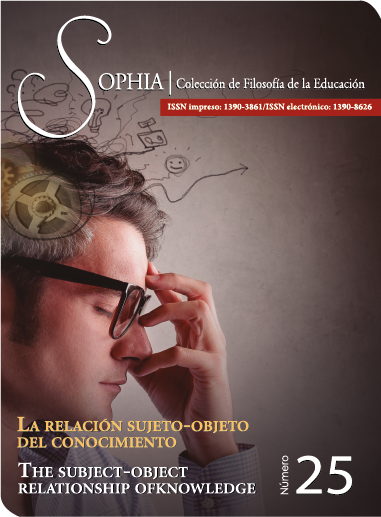
The redefinition of the cognitive subject: the act of intellection as knowledge
Article Sidebar
Main Article Content
Abstract
This work analyzes the intentionality of human beings as cognoscente subjects, a preponderant factor to reaffirm their way of being and the knowledge of the environment in which they stablish relationships. Afterwards, there is a twist as there is the intention of reaffirming this nature, which in some cases results in something alien, that is to say, human beings are at a crossroads where they leave their modal character aside and can end up becoming an object in the midst of objects, losing all capacity for intellection and, therefore, falling into pointlessness. The methodology is framed in an analytical-reflective and historical-critical process, in contrast to practical questioning; the educational process as one of the factors where people fulfill themselves, from stances taken by some authors who have made significant contributions among which are: Lonergan, Husserl, Scheler, Locke (classical thinkers), and taking into account documents and articles that complement their contributions, as well as the connotations of different thoughts, where some analogies are made regarding the proposed topic. Finally, the conclusions have to do with the first approach: human beings cannot dispense with their immanent nature of reaching the knowledge of the objects, which are alien to their way of existing and which can be comprehended by the human intellect.
Article Details
Authorship: The list of authors signing must include only those people who have contributed intellectually to the development of the work. Collaboration in the collection of data is not, by itself, a sufficient criterion of authorship. "Sophia" declines any responsibility for possible conflicts arising from the authorship of the works that are published.
Copyright: The Salesian Polytechnic University preserves the copyrights of the published articles, and favors and allows their reuse under the Creative Commons Attribution-NonCommercial-ShareAlike 3.0 Ecuador license. They may be copied, used, disseminated, transmitted and publicly displayed, provided that: i) the authorship and the original source of their publication (journal, editorial and work URL) are cited; (Ii) are not used for commercial purposes; Iii) mention the existence and specifications of this license.
References
AQUINO, Santo Tomás. 1943. Suma Teológica (Vol. segunda edición popular para la colección austral). Buenos Aires - Argentina: Editora Espasa - Calpe, S. A.
BOLIO, Antonio Paoli. 2012. Husserl y la fenomenología trascendental: Perspectivas del sujeto en las ciencias del siglo XX. Reencuentro, 22, 20-29.
BRICEÑO, Jesús, & SÁEZ RIVAS, Yasmelis. 2012. Interrelación sujeto-objeto y la complejidad del acto de investigar. EDUCERE La Revista Venezolana de Educación, 155-162.
CÁRDENAS MARÍN, William. 2016. La proposición lógica como instrumento para la comprensión y transformación de la realidad. SOPHIA Colección de Filosofía de la Educación 21(2), 83-99.
DE ZUBURÍA, Miguel. 2009. ABC de Pedagogía Conceptual 4. Cómo funcionan la mente humana. Más allá de la Psicología Cognitiva. Bogotá: Fundación Internacional de Pedagogía Conceptual Alberto Merani.
ENCISO, Oswaldo. 2004. Aprendiz y maestro con programación neurolinguistica . Colombia : Ayala Ávila y Cía.
GUYTON, Arthur. 2001. Tratado de fisiología médica. México: Interamericana Editores S.A.
HESSEN, Johannes. 2013. Teoría del conocimiento. Instituto Latinoamericano de Ciencia y Artes (ILCA), 13.
HUSSERL, Edmund. 1988. Las conferencias de Paris. México: UNAM.
LLINÁS, Rodolfo. 2003. El cerebro y el mito del yo. El papel de las neuronas en el pensamiento y el comportamiento humanos. Bogotá: Norma.
LOCKE, John. 2002. Compendio del ensayo sobre el entendimiento humano. Madrid: Alianza Editorial S.A.
LONERGAN, Bernard. 1999. INSIGHT Estudio sobre la comprensión humana. Salamanca-México: Ediciones Sígueme.
MARTÍ, José. 1975. Obras completas. La Habana: Editorial Ciencias Sociales.
MORENO CEDEÑO, María. 2014. La construcción del ser en educación: una mirada desde el constructivismo. SOPHIA: Colección de Filosofía de la Educación 17(2), 193-209.
MOUNIER, Emmanuel. 1976. Manifiesto al servicio del personalismo. España: Taurus.
SAN MARTÍN GARCÍA, Rómulo. 2017. Inconsistencia de la dimensión analítica empírica desde la formación cerebral cognitiva. Sophia, Colección de Filosofía de la Educación, 22(1), 55-81.
SARRAMONA, Jaime. 2000. Teoría de la educación, reflexión y normativa pedagógica. España: Editorial Ariel S.A.
SARTRE, Jean Paul. 1966. El ser y la nada. Buenos Aires: Losada.
SCHELER, Max. 1962. La esencia de la filosofía y la condición moral del conocer filosófico (Segunda edición ed.). Buenos Aires: Nova.
SKINNER, Burrhus. 1972. Más allá de la libertad y la dignidad. Barcelona: Fontanella.
VÁSQUEZ RODRÍGUEZ, Fernando. 2004. La cultura como texto lectura semiótica y educación. Bogotá: Javegraf.